Kate, Edmund, and the Admiral

November 17, 2015

The Almirante Saboia was back in port the weekend before last. I did not see here enter port, but I suspected something was going on. I saw a few groups of young men wandering around Old San Juan. Their heads snapped around every time a nice looking woman walked by. Since this behavior is typical of sailors who’ve been at sea for too long, I figured some kind of ship was making a port call. I walked down to the port and found her docked at Pier 1.

You recall I wrote a little about this ship last year. See my post Two Warships in Port to refresh your memory. She is a landing ship, built to support amphibious operations. She was originally built for the Royal Navy, and saw duty in the Falklands.

I wonder what the purpose of a port call is. It is probably in some part ceremonial, with official welcomes and greetings. There are probably meetings with US Coast Guard and Navy officials, going over protocols of various sorts. I suspect the sailors look forward to a bit of shore leave.

Of course, the port call may have been unplanned. Tropical Storm Kate was brewing in the Atlantic, near the Bahamas, and perhaps the Almirante Saboia came into port to avoid the storm. Kate formed on Monday, November 9, near Cat Island in the Bahamas. That Kate formed so late in the season is unusual in an El Nino year. She is the eleventh named storm of the year, just below the average of twelve, but high for an El Nino year.

By the way, the Great Lakes steamer Edmund Fitzgerald sank forty years ago, on November 10, 1975, with all 29 of her crew. She sank during a strong mid-latitude storm that passed over Lake Superior near the Fitzgerald, subjecting her to winds of more than 50 knots. Pressure at the center of the storm was as low as 975 mbs. See the figure below, and recall that Hurricane Patricia’s central pressure was 879 mbs, indicating again just how powerful that storm was (see my post Joaquin, Patricia and Chapala – Oh My!).

751110_12utc_surface_map

Surface weather map valid for 6 am CDT  Monday, November 10, 1975. Note the very strong low pressure over the western Great Lakes. This is the storm that generated ‘the gales of November’ that caused the sinking of the Edmund Fitzgerald. The storm’s central pressure soon fell to 975 millibars. Image credit: CIMSS Weather Blog from the University of Wisconsin – Madison.

The Canadian songwriter Gordon Lightfoot was motivated to write his song The Wreck of the Edmund Fitzgerald because he thought the event was underreported. He was, in particular, disturbed by contemporary newspaper accounts that gave her name as the Edmond Fitzgerald. Lightfoot’s song was released in 1976 and reached number 2 in the US; the number one spot was defended by Rod Stewart’s Tonight’s the Night. The event even made it into a Seinfeld episode – I’ll leave it to the TV buffs to figure out which one.

The Great Lake iron ore carrier Edmund Fitzgerald.

The Great Lake iron ore carrier Edmund Fitzgerald. Image from adhemar-marine.blogspot.com.


The Jones Act – Background

            November 14, 2015

Republican presidential candidate Ben Carson was here in Puerto Rico this past weekend. He actually made sense when asked about statehood. He pointed out that the last two states to enter the union – Alaska and Hawaii, back in the mid-50s – had financial difficulties then, and have since prospered. He thought the same thing could happen here. The debt problems here, he said, are the result of unfair treatment of Puerto Rico as a territory. Puerto Rico is currently trying to manage $72 billion dollars in public debt and the issue, as you can imagine, is contentious.

The current fiscal difficulties here in Puerto Rico have many people talking about the Jones Act and its effects on the economy. The problem is that there are really two Jones Acts, both passed about the same time. They both, in their way, relate to the current economic conditions.

The Jones-Shafroth Act, signed into law by President Woodrow Wilson in 1917, was written to establish a system of government on the island, and to clarify the citizenship status of Puerto Ricans. Section 3 of the law also stipulated that Puerto Rican municipal bonds would be triple tax exempt – no federal, state, or local taxes – no matter where the bondholder lived.

The Spanish American War of 1898 occurred as Puerto Ricans were seeking greater autonomy from Spain, at a time when the Spanish government was itself in turmoil. Luis Munoz Rivera, born in Barranquitas in 1859, was a leader of the autonomy movement. He was born to Luis Munoz Barrios and Monserrate Rivera Vazquez and, by Spanish custom, took both his parents’ names. Barranquitas, then a small rural town, offered few educational opportunities. Luis was home-schooled at first, then finished the town school, first in his class, at age 10. He showed great interest in Cervantes, especially Don Quixote. By age 14, unable to continue his education in either Cuba or Spain, he was helping with legal documents for his family’s business, and also writing poetry.

In 1883, presumably against his father’s wishes, Munoz Rivera joined the Liberal Party, which, in 1887, at a meeting in Coamo, splintered into a new party, the Autonomists. In this, he became associated with Román Baldorioty de Castro, José Celso Barbosa and José de Diego. The Autonomists pursued a separate government for Puerto Rico, while keeping some relationship with Spain.

Their influence grew rapidly, and the Conservative Party responded by closing newspapers. Governor Palacio, an appointee of the Spanish monarchy, soon caused the arrest of more than 100 liberals. In spite of a travel ban, the liberal politician Juan Arrillaga Roque travelled to Madrid and made the situation known. King Alfonso XII responded by replacing Palacio with Juan Contreras Martinez, and political tensions eased somewhat.

Luis Munoz, in 1893, travelled to Spain to learn of its political system. While there, he met Praxedes Mateo Sagasta, president of the Spanish Fusion Party, and realized he was the Autonomists best ally within the Byzantine Spanish political system. Upon his return, he found the Autonomist Party in disarray, with Barbosa and his followers (the Barboistas) rejecting any ties with Sagasta, thinking he was a Royalist.

Munoz Rivera and his followers (the Munocistas) drafted the Plan de Ponce and, after much debate, agreed to send four members, including Munoz Rivera, to Spain. Sagasta proposed that, should he become Premier, he would grant a Chapter of Autonomy giving Puerto Rico the same degree of sovereignty as any other Spanish province. Sagasta became Prime Minister after the assassination of Antonio Canovas del Castillo and granted, in December 1897, the promised autonomous government.

Munoz Rivera’s accomplishment was short-lived. An on-going revolt in Cuba had garnered American interest, in large part because of the lurid yellow journalism of William Randolph Hearst’s newspaper empire. On February 16, 1898, the battleship USS Maine (Remember the Maine!) exploded and sank in Havana Harbor. This became the pretext for the Spanish-American War of 1898. Military operations in Puerto Rico began with a US Navy bombardment of San Juan on May 12, 1898, and a land invasion, in Guanica, with 3,300 American troops, beginning on July 25. The military campaign ended with the signing of the Treaty of Paris on August 13, at which time Cuba and Puerto Rico came under US military government.

I believe this building was a hospital during the US Navy bombardment of San Juan, in 1898. It is said that a shell landed in the hospital but did not explode, thus allowing an orderly evacuation.

I believe this building was a hospital during the US Navy bombardment of San Juan, in 1898. It is said that a shell landed in the hospital but did not explode, thus allowing an orderly evacuation.

The arrival of the Americans led to another split among the Barboistas, who generally welcomed the Americans, and the Munocistas, who feared becoming an American possession. Munoz Rivera retired to his family home in Barranquitas and published a poem, Sísifo, which related Puerto Rico’s politics to the eternal struggles of Sisyphus.

Munoz Rivera was persuaded to return to San Juan, but the discussions between the Americans, the Barboistas, and the Munocistas became bitter. In 1900, the Barboistas formed the pro-statehood Republican Party of Puerto Rico. Munoz Rivera wrote scathing denunciations of the pro-statehood movement in his newspaper El Diario, which led to rumors of assassination attempts, actual exchanges of gunfire, and, in 1901, attacks on the newspaper’s offices.

Munoz Rivera moved his family to New York City where he continued his criticism of the US position on Puerto Rico via his bilingual newspaper Puerto Rico Herald. He travelled back and forth and, with the help of Rosendo Matienzo Cintron, Antonio R. Barcelo, and Jose de Diego, founded the Union of Puerto Rico party, which won the election in 1904. Munoz Rivera was elected to the House of Delegates.

In 1910, he ran for and was elected as Resident Commissioner to the US House of Representatives. He befriended influential Congressmen, including Henry L. Stimpson and future Supreme Court justice Felix Frankfurter. In 1915, he proposed equal rights for Puerto Rico, without statehood, with greater autonomy in Puerto Rican affairs. This evolved into the Jones-Shafroth Act, signed by President Woodrow Wilson on March 2, 1917.

Munoz Rivera was not alive to see the signing. He died on November 16, 1916, from complications of a gall-bladder infection.

The complicated relationship between the US and Puerto Rico thus had its roots in a revolt against Spanish rule in Cuba, a sunk battleship, yellow journalism, an American naval bombardment followed by invasion, and the efforts of impassioned Puerto Rican statesmen.

Puerto Ricans honor the statesmen of the Autonomists in various ways. The park across the street from our building is Parc Luis Munoz Rivera, and Avenida Luis Munoz Rivera is a major highway in the Hato Rey section of San Juan. The expressway to the airport is the Baldorioty de Castro; there are Avenida Barosas in San Juan, Catano, and other cities and towns. Avenida de Diego goes south through Condado to Santurce.

I’ll have more to say about the Jones-Shafroth Act in an upcoming post. Stay tuned.

Notes: First image is statue of Luis Munoz Rivera in the park that bears his name.

See the Wikipedia entries for Luis Munoz Rivera, the Jones-Shafroth Act, and the Puerto Rican campaign of the Spanish American War for more information.

Joaquin, Patricia and Chapala – Oh My!

Tropical storms – cyclones, hurricanes, typhoons – are elaborate mechanisms by which heat energy is transferred from the tropics to the northern latitudes. Puerto Rico is under threat from hurricanes each season. In fact, the word hurricane is derived from ‘huracan’, a Taino and Carib (West Indies natives) storm god. The Spanish modified the word to hurricane, and it is now used to describe Atlantic and Eastern Pacific storms that meet hurricane criteria.

Historically, Puerto Rico has suffered damage from hurricanes, notably Betsy in 1956 and Hugo, in 1989. Betsy destroyed 15,000 homes in Puerto Rico and caused 16 deaths. Both Betsy and Hugo started as tropical waves off the African Coast. Puerto Rico has been spared in recent years, although it has had several close calls, in particular Gonzalo in 2014.

The 2015 tropical storm season will probably be considered relatively quiet as no major storms struck the US mainland. Tropical waves and depressions formed but strong winds aloft created shearing forces which prevented storm formation. These shearing winds are a feature of El Nino events, and explain in part why hurricane activity diminishes during El Ninos, a condition we’re in right now. The winds counteract the effects of warmer than usual surface waters which act to promote storm formation by providing energy to the developing storm. By the way, the information I present here has been distilled from the excellent blog entries of Dr. Jeff Masters, of the Weather Undergound, at www.wunderground.com. Refer to his entries for detailed and lucid explanations of these complex events.

Map showing surface temperature excursions during September, 2015. Note especially the warm temperatures (indicated by shades of red) in the Atlantic off Florida, the Pacific off Mexico, and the Arabian Sea.

Map showing surface temperature excursions during September, 2015. Note especially the warm temperatures (indicated by shades of red) in the Atlantic off Florida, the Pacific off Mexico, and the Arabian Sea.

To think the 2015 hurricane season was uneventful represents a mainland-centric and thus skewed version of this season’s meteorology. There were in fact several remarkable weather events this season. Hurricane Fred struck the Cape Verde islands, close to the coast of Africa, at the end of August. The last time that occurred was in 1892. The islands (now more properly known as the Republic of Cabo Verde) are desert like, with average annual rainfall of about 10 inches. Fred delivered about that much rain in a day, thus causing extensive flooding.

The shearing winds died down in late September and Tropical Storm Joaquin grew explosively into a Category 3 hurricane. From the very beginning, Joaquin was unusual. Eighty-five per cent of strong Atlantic hurricanes originate with low pressure waves off of Africa – Joaquin did not. Joaquin apparently started as a wave off the South Carolina coast that established a warm-core tropical cyclone northeast of the Leeward Islands. This area is normally too far north and therefore too cold to produce strong tropical cyclones. This year, the warmer than normal surface water temperatures (see the temperature figure, above) allowed for storm development.

And it is not just surface water temperatures that are important. The cyclonic winds churn the waters and cause surface waters to sink, and deeper waters (perhaps to 50 meters in depth) to come to the surface. Since these deeper waters are now as warm as the surface, a brewing storm gains energy, allowing it to intensify.

Hurricane Joaquin, October 2, as photographed from the International Space Station. The lights at the top of the image are Miami and Miami Beach.

Hurricane Joaquin, October 2, as photographed from the International Space Station. The lights at the top of the image are Miami and Miami Beach.

Joaquin intensified rapidly, going from a Category 1 storm (85 mph sustained winds) to a Category 3 (115 mph) in only six hours. The day before (Tuesday, September 29), the top winds were only 70 mph. Joaquin thus became the second major hurricane of the season (Danny was the first), unusual for a strong El Nino year. By October 3, Joaquin had grown into a Category 5 storm, also unusual in an El Nino year.

The rapid intensification led to a tragedy related to Puerto Rico. The container ship El Faro left Jacksonville early in the morning of September 30, on her way to San Juan. At that time, Joaquin was a tropical storm, with top winds of 70 mph, expected to grow in to a minimal Category 1 storm centered in the Bahamas. El Faro’s course would take it with 200 miles of Joaquin, with expected winds of 35 mph and 10 feet seas. Joaquin intensified rapidly and the El Faro, for some reason without power, found herself, in the morning of October 1, right in the northwest eyewall. The El Faro sank with all hands (28 Americans and 5 Poles); the Coast Guard yesterday (October 30) located her hull and hopes to retrieve her data recorder soon.

Joaquin contributed to, but did not cause, exceptionally heavy rainfalls- 20 inches or more in a 2 to 3 day period – and consequent severe flooding in South Carolina. These rains actually resulted from a Nor’easter fed by copious amount of moisture from the warm off shore waters.

On Tuesday, October 20, Tropical Depression 20-E formed in the Pacific, 445 miles east-southeast of Acapulco, Mexico, under conditions of light wind shear, warm waters (86 F) and a moist atmosphere. While poorly organized at first, TD-20-E was in ideal circumstances for rapid intensification. This in fact happened. TD-20-E morphed into Hurricane Patricia and became the fastest intensifying Western Hemisphere hurricane ever observed. Her central pressure was 980 mb (mb -millibar – a unit of atmospheric pressure. Typical atmosphere pressure is about 1,000 mb) at 5 am Thursday, October 22, and 880 mb 24 hours later – an astonishing drop of 100 mb in one day. Her winds intensified by 100 mph in 24 hours, from tropical storm to a Category 5 hurricane. By the next day, Patricia’s pressure was measured at 879 mb, with sustained winds of 200 mph, maintained for twelve hours. This was the lowest pressure ever observed in an Eastern Pacific hurricane, and also the highest reliably measured wind speeds for a tropical cyclone anywhere on earth.

MODIS satellite image of Hurricane Patricia, October 22. Patricia was a Category 4 storm at that time.

MODIS satellite image of Hurricane Patricia, October 22. Patricia was a Category 4 storm at that time.

Fortunately, Patricia struck the Mexican Pacific coast in a rugged, relatively unpopulated area and dissipated its energy in the mountains of Central Mexico. As a tropical depression, she carried moisture into Texas and added to an already wet month. In fact, the Dallas – Fort Worth area recorded one of the wettest Octobers on record, with over 20 inches of rain. Remnants of Patricia were sufficiently strong so as to generate strong wind warnings and heavy rains in Upstate New York, and cause wind-related delays at Newark and other east coast airports as late as October 27 and 28.

As I write this (November 1), another very rare event is occurring – a Category 4 tropical storm in the Arabian Sea, heading for the Yemen coast. Tropical Cyclone Chapala, the second strongest storm on record for the Arabian Sea, is a rare event because the Arabian Sea is small, with a short tropical storm season, May – early June, and then late October through November, on either end of the Southwest Monsoon. Furthermore, typically high wind shears and dry air from the Middle East deserts hinder storm formation. Tropical Cyclone Chapala will be only the third cyclone to hit Yemen since the 1960s.Coastal Yemen typically gets about two inches of rain per year. Even the mountains there get only about 10 inches per year. Chapala will likely deliver several years’ worth of rain in a short time. Destructive flooding is a distinct possibility. If landfall is near the mouth of the Gulf of Aden, as expected, maritime commerce (400 ships per day pass through the Gulf of Aden) will be affected.

Tropical Cyclone Chapala nearing Yemen, October 31, 2015.

Tropical Cyclone Chapala nearing Yemen, October 31, 2015.

Quiet year in the Atlantic? I don’t think so. Consider:
• Hurricane Fred striking the Cape Verde islands.
• Two strong hurricanes in the Atlantic (Danny and Joaquin), rare for an El Nino year.
• The strange genesis of Hurricane Joaquin, near the Leeward Islands, and its rapid intensification to a Category 5 storm, again rare for an El Nino year.
• The huge rainfall event in South Carolina, and
• The exceptional rainfall totals in Texas, both in May and again in October.

Add to that the rapid intensification of and amazingly powerful Hurricane Patricia and the most unusual Tropical Cyclone Chapala. And did I mention the unusually large number of hurricanes near Hawaii this year? Or the very active Pacific typhoon season? The record heat in South Africa? The drought-induced wildfires in Indonesia, and the US west?

Last February, during a cold spell in Washington, James Imhofe, Republican from Oklahoma, tossed a snowball onto the floor of the US Senate and offered it as part of his case for why global warming is a hoax. Imhofe is the author of the book The Greatest Hoax: How the Global Warming Conspiracy Threatens Your Future.

I would have to believe, if Senator Imhofe were to read this blog entry, even he would be impressed. Probably not. I suspect Senator Imhofe suffers from epistemic closure: one who lives in a bubble into which inconvenient facts can’t penetrate.

I think it was Mark Twain who wrote “Reader, suppose you were an idiot. And suppose you were a member of Congress. But I repeat myself.”


Notes: As noted in the text, most of the information here has been taken from Dr. Jeff Master’s blog entries on www.wunderground.com.

The three storms in the top image are three named storms in the Pacific -Kilo, Ignacio and Jimena, in August 2015. Three named storms at one time is unusual.

April, 1797 – The Siege of San Juan

March 31, 2015 

It is April, 1797. The British are at the gates of San Juan. They are led by General Ralph Abercromby (sometimes spelled Abercrombie), the hero of the invasion of Trinidad. Things look bleak for the defenders. It will take a miracle to repel the invaders.

Spain had until recently been an ally of the British, but was defeated by the French in War of the Pyrenees, in 1795. The Peace of Basel, which ended that war, led, in 1796, to an alliance between France and Spain, and thus a state of war with England. France, after the French revolution of 1792, had been fighting the so-called French Revolutionary Wars, which pitted the French and allies against the European monarchies. The wars took on a global character as the wars continued. As had often been the case, the Antilles, Leeward and Windward Islands became pawns in the broader European struggles.

Arercromby was the military commander of the British forces in the West Indies. He had begun his military career in 1756, as an officer with the Third Dragoon Guards, serving in Europe during the Seven Years War. While there, he was able to study the tactics of Frederick the Great, studies which served him well in his career. By 1781, he had become colonel of the King’s Irish Infantry. Dissatisfied with his government’s treatment of the American colonists, he retired, at half pay, and became a Member of Parliament, representing his district of Clackmannanshire.

Abercromby was recalled to active duty when France declared war on England, in 1793. He served in the Netherlands, commanding a brigade under the Duke of York. He was wounded at Nijmegen and, after medical treatment, was appointed, in 1795, the commander of British forces in the West Indies. He began his Caribbean escapades by, in 1796, invading Grenada. This action was to put down a revolt by slaves and former French colonists, led by Julien Fedon, against British rule, which had been restored from the French under terms of the Treaty of Versailles, in 1783.

After a brief excursion to the Dutch settlements of Demerara and Essequibo in South America, the British West Indies forces turned their attention to Trinidad. Rear Admiral Henry Harvey was in command of a fleet of four sail of the line, several frigates and sloops, and transports carrying the invasion troops, commanded by Abercromby.

Trinidad had been a Spanish colony since the third voyage of Christopher Columbus, in 1498. The population was largely French, from Martinique. For whatever reason, Trinidad lagged behind other islands in adopting the plantation system, especially as compared to nearby Tobago and the larger Jamaica. It was, in 1797, defended by a naval force about the same size as the British invaders, with troops in fortified positions around the island. In particular, the Spanish naval forces included four ships of the line and one frigate: San Vincente (84 guns), Gallardo (74 guns), Arrogante (74 guns), San Damaso (74 guns), and Santa Cecilia (36 guns), under the command of Rear-Admiral Don Sebastian Ruiz de Apodaca.

Now, anybody with any military knowledge at all will agree that landing troops on a hostile shore is one of the most difficult tasks a military force can undertake. One need only recall the World War Two landings at Salerno, Omaha Beach, Tarawa and Iwo Jima to be reminded of that. It should also be noted that the Spanish were proficient at amphibious warfare, both on offense and defense. In fact, Spain, under Philip II, was the first European power to establish specialized troops trained in landing operations, complete with barges to land horse drawn artillery, and special row boats equipped with small cannon. The Spanish used their Royal Marines in the 1560s to recover Malta from the Ottoman Turks and, in 1583, in the Azores against an Anglo-French-Portuguese garrison.

The Spanish were no slouches on defense, either. In 1741, a smaller Spanish garrison repulsed a British invasion force of 24,000 men, 2,000 guns, and 186 ships, at Cartagena de Indias, in present day Colombia.

Rear Admiral Harvey and General Abercromby thus had every right to expect a robust Spanish defense of Trinidad. Harvey maneuvered his fleet to block the Spanish ships, and Abercromby’s forces scouted for potential landing sites. They were both surprised to see the Spanish ships begin to burn. The Spanish torched them, and in addition withdrew their forces from the fortified Caspar Grande battery. The next day, the 14th Regiment of Foot occupied the island, without opposition, and on February 20, 1797, Governor Don Jose Maria Chacon surrendered the island to Abercromby without any effort at defense.

The British thus gained a new Crown Colony, with Spanish laws and a French speaking population. Of course, the Spanish might have known what they were doing. Trinidad never fully embraced the plantation n system, and grew slowly compared to other British possessions, in part because of a chronic labor shortage. At the time of abolition in the British colonies, in 1834, Trinidad had, according to her census, about 17,500 slaves, while Jamaica, twice the size of Trinidad, counted 370,000 slaves.

In any case, Harvey and Abercromby turned their attentions to Puerto Rico. The Puerto Ricans observed the British invaders off the northern coast on the morning of April 17, 1797. The Puerto Rican Governor, Brigadier General Ramón de Castro, called his military leaders together and they enacted their defensive plan, placing troop contingents at several points along the shore. The defenders were Puerto Rican militia, with no main force Spanish troops available. The British forces, which included German mercenaries, did manage to land, but the navy could not force their way into the harbor against the guns of Castillo San Felipe el Morro. The Spanish destroyed the San Antonio Bridge connecting Miramar to San Juan, on Friday April 21, and the British began their siege from the land. On April 24, Sergeant Francisco Diaz led a party of 70 men to attack a British battery. They forced 300 British soldiers to retreat and captured fourteen prisoners before they were forced back by a British counter attack.

Fighting, including artillery duels and infantry skirmishes, continued for the next several days and conditions within the walls of San Juan were getting desperate. Juan Bautista de Zengotita y Bengoa, the Bishop of San Juan, ordered Rogativa (prayer processions) to be conducted around the island asking for God’s help in defeating the British. On the night of April 30, the Bishop, and the women and children remaining in San Juan, conducted a Rogativa which, with torches and accompanied by church bells, wound its way through the streets of San Juan. According to long standing legend, Abercromby, watching from a ship off shore, thought the procession represented reinforcements from the interior of the island to San Juan. In any case, the British re-embarked their troops, set sail, and disappeared over the horizon. One of the largest invasions of Spanish territory in the New World was thus defeated by the Puerto Rican militia and, legend has it, the effects of a prayer procession.

What would the British do with a military leader who managed to conquer an undefended island and then leave his siege of San Juan at the sight of a prayer procession? Promote him, of course! Abercromby was promoted to Lieutenant General and appointed Commander in Chief of the forces in Ireland, and then Scotland. He travelled with the Duke of York to try to regain Egypt from France, and was wounded during the Battle of Alexandria, on March 21, 1801. He died seven days later.

I wonder if Gilbert and Sullivan had Abercromby in mind when they wrote of a Major General in their opera buffa, The Pirates of Penzance, in 1879.

I am the very model of a modern Major-General,
I’ve information vegetable, animal, and mineral,
I know the kings of England, and I quote the fights historical
From Marathon to Waterloo, in order categorical;
I’m very well acquainted, too, with matters mathematical,
I understand equations, both the simple and quadratical
About binomial theorem I’m teeming with a lot o’ news;
With many cheerful facts about the square of the hypotenuse.

In 1971, the New Zealand artist Lindsay Dean completed four bronze statues commemorating the prayer procession. They are located just inside the walls of Old San Juan, near the San Juan gate, in an area now known as the Plazuela de la Rogativa. It is said the artist buried toys under the statues in honor of his child, who died at an early age.

Siege_Blog_1

Siege_Blog_3

Siege_Blog_6

Apparently, in late April, San Juan stages a recreation of the siege, with participants in period uniforms. I’ve not seen that, as we head back up north before then.

The images in this post are all mine, doctored to varying degrees with Adobe Photoshop®.

Emancipation

March 22, 2015

Today is Emancipation Day, a Puerto Rican holiday. It celebrates the day, in 1873, when slaves were freed on the island.

Emancipation came relatively late to the Spanish Antilles. The Abolition Law ended slavery in the British West Indies in 1834, with a six year transition period. In the French Antilles, slavery ended on April 27, 1848, with a national proclamation from Paris. In the US, of course, President Lincoln issued the Emancipation Proclamation as a presidential proclamation and executive order, on January 1, 1863, during the height of the Civil War. The reasons for the Spanish tardiness had to do with the strength of the English Abolitionists, the popularity of a liberal movement in France, a defeat of the Spanish Army in the Dominican Republic, in 1860, and revolutions in Cuba and Puerto Rico in the 1860s. Oh, and sugar cane.

Sugar was first extracted from sugar cane in New Guinea, about 8,000 BC, and the technology flowered in India, particularly during the Gupta dynasty, about 350 AD. The Persians brought the idea of sugar (the word is derived from the Arabic, sukkar) to the Middle East, and it was introduced (as was coffee) to Europe during the period of Arab expansion. In response to growing demand, the Portuguese started sugar cane plantations in Madeira and the Algarve; the Spanish in Andalusia.

Sugar cane plantations are labor intensive in both growing and harvesting. The cane is bulky and difficult to transport, meaning that sugar extraction was most economically done on or near the plantation. The conversion of cane to sugar began with crushing operations to extract the cane juice, and then several boiling operations to produce the crystallized sugar. Sugar cane plantations required a cheap source of labor, and African slaves were introduced to the Portuguese and Spanish plantations as early as the 1440s. The African slave trade began, and was largely driven by, the labor needs of sugar cane plantation owners.

Christopher Columbus brought sugar cane with him on his second voyage to the New World, to Hispaniola, in 1493. About the same time, the Portuguese introduced the cane plant to Brazil. There was thus an early understanding the Caribbean and South American climates were well-suited for sugar cane production, given the plant’s requirement for relatively high temperatures and copious amounts of water. This also set the stage for trade in African slaves to the Americas and the Caribbean.

The early sugar industry in the New World was dominated by the British, French and Portuguese, with the Dutch and Danish colonies playing minor roles, as the Spanish were more interested in exploiting the mineral resources of Mexico and, especially, Peru. The British plantation owners, in Barbados and then Jamaica, developed essentially sugar cane monocultures, and had to import food, draft animals and an increasing number of African slaves to maintain production. The French followed suit, and soon their colony of Saint-Domingue (now Haiti) became a large sugar exporter. The French efforts were helped by trade laws more rational than the British sugar laws, especially in taxation polices, and that the French allowed the export of the semi-refined sucre blanc rather than the cheaper but less desirable muscovado form of semi-refined sugar.

The Caribbean sugar economies were fuelled by increases in demand for sugar throughout Europe, but especially in England. Consumption tripled between 1700 and 1740. Sugar became the most valuable commodity in Caribbean and European trade. While the British and French colonies were profiting from the sugar trade, the islands of the Spanish Antilles lagged behind. In fact, in the 1700s, Puerto Rico was essentially an impoverished island, with military and government officials but little or no agricultural exports.

The English Abolitionists gained strength in Parliament, and against the strong objections of the plantation owners, passed, in 1833, the Abolition Law, which declared slavery illegal in British colonies, starting on August 1, 1834. This meant, by one census, 664,970 slaves were freed and converted to an apprenticeship arrangement, to last no more than six years. This arrangement proved difficult to manage, and the Abolition Law was amended and freed all slaves in the British West Indies, as of August 1, 1838. The French followed suit with their abolition proclamation of April 27, 1848.

The British and French plantation owners experienced labor shortages, and began to import contracted laborers, from Sierra Leone, Ireland, England, Germany, the US, Canada, and Portugal, especially Madeira. Plantation owners in Trinidad imported 2,500 laborers from China as well, but the labor shortages persisted and sugar production decreased in the British and French colonies.

Puerto Rico and especially Cuba expanded existing and began new sugar cane plantations to meet the unmet demand. By 1860, Cuba had become the largest sugar exporter, producing 541,695 tons for export. Puerto Rico was second, producing in that year more than 50,000 tons, while Jamaica exported 26,040 tons, a significant drop from earlier levels.

But plantation owners in the Spanish Antilles had their own sets of troubles. The British had forced Spain to sign treaties to stop the trade in African slaves, and the Royal Navy searched vessels entering Cuban and Puerto Rican waters. The Puerto Ricans managed for a while by bringing in slaves from the French colonies, while Cuba began importing Chinese laborers. Plantation owners on both islands still attempted to smuggle African slaves but that source diminished over time.

In Spain, a liberal government had taken power in the 1850s and worked slowly to address the issues of the Reformistas. The Cortes (Spanish parliament) in 1865 formed the Comite de Informacion de Ultramar (Foreign Affairs Committee) to study the labor and other problems in the Antilles and make recommendations to the Spanish government. The Comite was composed of 20 representatives, 16 from Cuba and four from Puerto Rico, each selected by a special election held in March 1866.

The Comite finished their work in 1867, but by that time the conservatives were back in power and the Comite’s recommendations were ignored. Indeed, the Spanish levied burdensome new taxes on plantation owners.

Meanwhile, Spain had fought an unsuccessful action to regain the Dominican Republic, and revolutionaries on both Puerto Rico and Cuba, upset by the Comites lack of success, took note of Spain’s presumed weakness. A Cuban revolt began in 1867, in Bayamo, in eastern Cuba. In August of 1868, more than 600 armed revolutionaries captured the town officials and Spanish merchants in Lares, and proclaimed the birth of the Republic of Puerto Rico. The Spanish mobilized quickly and crushed the revolt, at the cost of 551 lives. The Cuban insurrection was more successful, in part because of the support of the Cuban Junta, based in the US, that provided them arms and funds.

Spain, not wanting to lose more income from her colonies, mobilized to maintain control of Cuba, a move made more palatable by rumors that the US, under President U S Grant, in response to domestic pressures from abolitionists and hawkish newspapers, was preparing to annex Cuba. The Spanish foreign minister, Segismundo Moret, proposed abolition as one means of retaining control over the Antilles.

In any event, slavery was crumbling in Puerto Rico, as owners realized that salaried workers were cheaper than slaves.  The number of slaves fell from 41,000 in 1869, to 31,041 in December 1872. The Cortes finally passed the Law for the Abolition of Slavery in Puerto Rico which, when it took effect on March 22, 1873, freed the last of the 29,335 slaves on the island.

Cuba, in the midst of what became known as the First Ten Years War of Independence, greeted the news with widespread protests, as Cuban sugar production was increasing even during the war. Cuban slaves and Chinese laborers were finally freed in February, 1878, as part of the Zanjon Pact, after the Spanish army defeated the revolutionaries.

So, the next time you put sugar in your morning coffee, think about  sugar cane plantations and the peoples that system displaced around the world. And be thankful that most of the world’s sugar now comes from sugar beets.


References: For more information, see the Wikipedia entries for sugar and history of sugar.

See also From Columbus to Castro – The History of the Caribbean by Eric Williams, Random House NY, 1970.

I found History of the Caribbean, by Frank Moya Pons, Markus Weiner, Princeton, NJ, 2007, to be informative and in all ways a pleasure to read.

Our friend Vionette told me of several public works of art celebrating emancipation, I’ll find them and add images to the post.
Ironman

March 19, 2015

San Juan hosted a professional ironman competition last Sunday. It was actually a half ironman – 1.2 mile swim, 56 mile bike ride, 13 or so mile run. It began with the swim in Laguna Condado, with transitions to bike and then run in Stadium Sixto Escobar. These are all close to my apartment so I spent the morning watching and taking pictures.

The swim began with groups entering the water at five minute intervals. The elite, professional athletes started first, at 6:50 am. I’m not sure of the criteria used to place competitors in subsequent starts, or waves as they are called. In any case, when I got there, most of the 1500 or so athletes had at least started their swim, and the professionals had completed theirs.

The swimmers were close to the end of the first leg when they came under Puentes Dos Hermanos.

The swimmers were close to the end of the first leg when they came under Puentes Dos Hermanos.

It was a beautiful morning for a swim.

It was a beautiful morning for a swim.

 A ramp had been placed in the lagoon, near the Caribe Hilton. The swimmers were helped up the ramp to begin their short run to the transition zone.

Volunteers in bright orange t-shirts helped the swimmers up the ramp.

Volunteers in bright orange t-shirts helped the swimmers up the ramp.

The athletes next ran about a quarter of a mile, often in bare feet, to start the bike event. Note that they are wearing some kind of ankle bracelet. I suspect this is an electronic tag of some sort to help with timing the different legs of the event.

Athletes are running to start their bike event.

Athletes are running to start their bike event.

The athletes ran into the arena, usually used for soccer or track and field events, to get their bikes. It was closed to the public so I went to the exit. They had to reach a line outside the stadium before they could mount their bikes and start their ride. The route took them to Dorado and back, and traffic was controlled the whole way to allow them an unhindered ride.

The bikers rode out of the Park on Calle San Agustin on their way to Dorado and back.

The bikers rode out of the Park on Calle San Agustin on their way to Dorado and back.

At the completion of the bike ride, the athletes dismounted before a specified line, and ran with their bikes into the stadium. They then put on their running shoes and began the run, essentially three laps to Old San Juan and back.

End_Bike

The end of the bike ride.


These are the elite competitors, and they look comfortable starting the run.

These are the elite competitors, and they look comfortable starting the run.

The runners made three trips to and from Old San Juan, so there were runners going and coming along Avenida Munoz Rivera.

Runners coming from and going to Old San Juan.

Runners going to and coming from Old San Juan.

The runners, after their third lap, entered a chute to the finish line. Here are some of the elite athletes finishing the event.

Runners nearing the finish line.

Runners nearing the finish line.

The winner, Igor somebody (I have to check) from Brazil finished the event in under four hours.

I have to wonder about the event’s name, though. I mean, it is here in San Juan. The Spanish word for iron is some form of ferro, from the Latin ferium. How about translating Ironman to Spanish, at least for this event? I propose FerroHombre. If you want something a little more genteel, how about FerroCaballero?  That even has a bit of poetry to it, don’t you think? I can see the t-shirts now.

If you want me to follow up on this, send a check for $10,000 or whatever you can afford, and I’ll get right on it.


.


Record Day

February 28, 2015

 Wednesday February 25 was a record setting day in Old San Juan. Six large cruise ships were in port, and they brought 18,000 passengers to town. This is the most for any one day since records like this have been kept, at least according to El Dia, a Spanish language newspaper I try to read every morning. Four of the ships came in  early – between 6 and 7:30 am; the last two came in about 1 pm.

I was in Old San Juan in the morning and it was, as you can imagine, crowded. What do 18,000 visitors do? Well, they certainly visited the stores catering to tourists, and bought t-shirts. And they used the trolleys to get around the city and visit the two forts. And, if they were in Plaza d’Armes, they had the chance to learn the salsa.

Salsa party in Plaza d’Armes, February 25, 2015.

An agency promoting tourism in Puerto Rico had hired a salsa band, and an enthusiastic young woman was counting the rhythm and teaching the steps. In a short while, several people were in the Plaza, dancing the salsa, with varying degrees of proficiency.

They were joined by young people on stilts and in various costumes.

Salsa on stilts? Why not? These two made it look easy.

 Now, for me the idea of learning how to do the salsa is daunting enough. I suspect I would have injured myself severely had I attempted to learn while on stilts. But these two were having fun, and in an infectious way. Even I began to feel the rhythm.

I’m not sure what some of the other costumes were all about. Take, for instance, the distinguished gentleman’s head. Is this an important figure in Puerto Rican history? Perhaps it is meant to be Luis Munoz Rivera, a statesman who negotiated a degree of autonomy for Puerto Rico during the last few decades of Spanish rule. Or maybe he is a Baccardi, of the rum family. Or the owner of a coffee plantation. Whoever he is, he can do the salsa.

He can do the salsa, whoever he is.

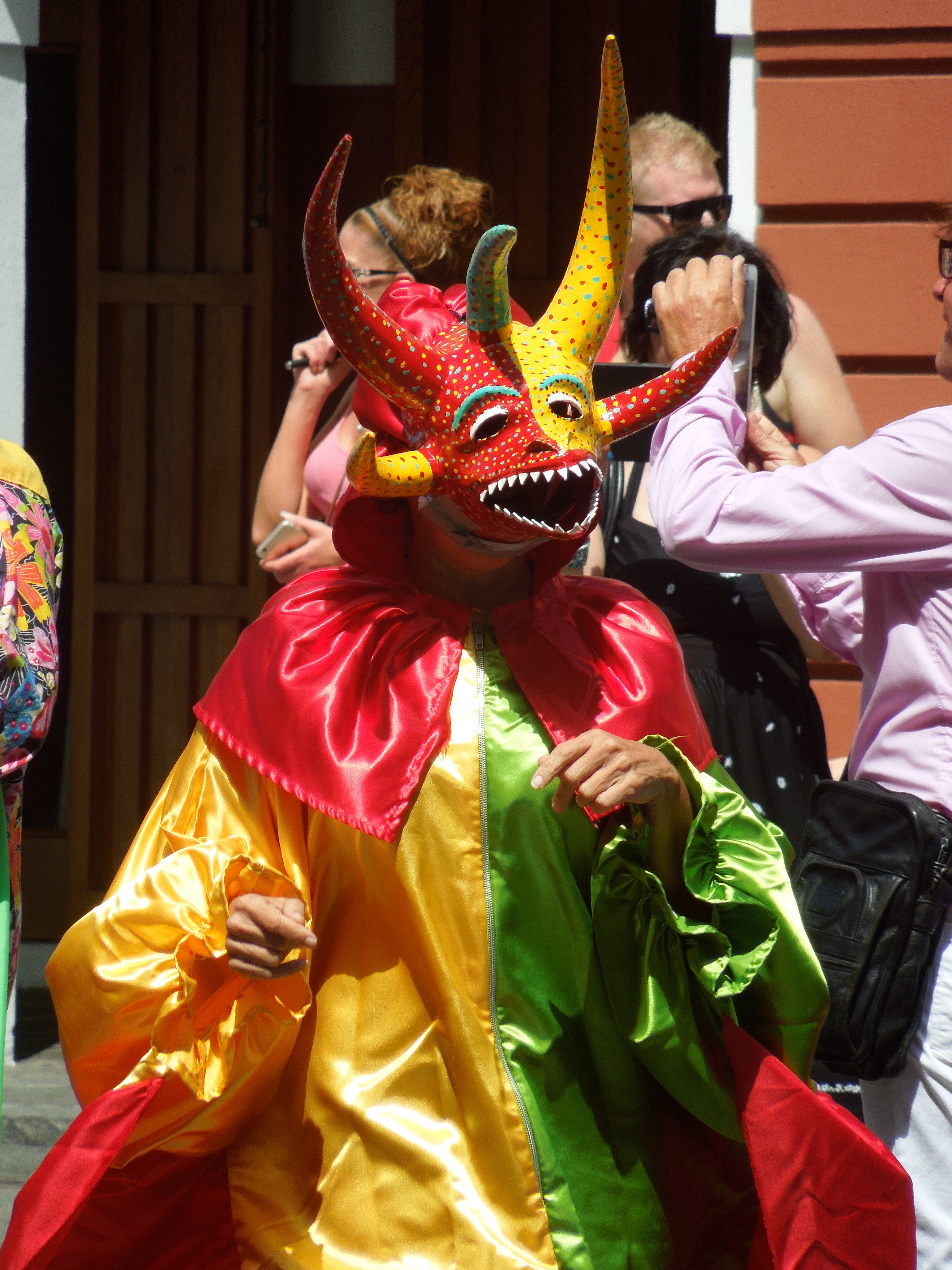
 Finally, there were one or two dancers in brightly colored robes, wearing colorful effigies on their heads. I believe these are masks are called vejigante, and are a common feature of carnival parades in Ponce and Patillas and other towns along the Caribbean coast.

DSCN1529

So, how do you deal with 18.000 tourists in one day? Teach them to salsa. It seemed to work on February 25.


Street Art II

March 7, 2015

We walked to the Plaza del Mercado in Santurce the other day, from Condado. We walked under the highway bridge carrying the highway Expreso Roman Baldorioty de Castro. That highway carries traffic to and from Old San Juan, in an east-west direction.

It is often the case that bridge walls serve as canvases for the local artists. The image below demonstrates the size of some of these works.

Art on bridge wall in Santurce, March 2015.

Art on bridge wall in Santurce, March 2015.

I like the running motif with the gaily colored shoes. I’m not sure what the head to the right is all about – is he an artist, looking for a space to show his talent?

I was particularly taken by a series of more or less black and white images to the right (downhill) from the purported artist. Our friend Thomas had seen a documentary about the artist, and said he was the same person who had created the iguanoid creature I wrote about in an earlier post (see Street Art I). Unfortunately, Thomas did not remember his/her name. Perhaps some reader can provide me that information.

In any case, here are four images of his (her?) work.

Plaza_Bridge_1a

Plaza_Bridge_2

Plaza_Bridge_3

Plaza_Bridge_4

I cleaned up the images in Adobe Photoshop® by fiddling with the contrast, and removing what I took to be streaks caused by running paint. See for example the streak on the left leg on the last image – it extended a bit further down. In fact, here is the unretouched version for comparison.

DSCN1555

What do you think?

By the way, the smiling shark is from a wall panel on Calle Canal as we walked up towards the Plaza del Mercado. I wonder if Shark Number 9 was the inspiration for Left Shark, of Super Bowl fame.

A Left Port, and Came Right Back

February 24, 2015

A left port yesterday morning. I saw her on the high seas from a fifteenth floor apartment in a building in Condado. We have had a series of high surf warnings, and so it is possible the ocean was a bit rough yesterday. If so, it did not seem to affect A – she moved through the water very smoothly, from what I could observe. She arrived in late December, and had been tied up at Pier 16 ever since, with little or no activity around her. I once noticed three or four crew members mopping the deck, and another time there was some kind of lift allowing the crew to work on a window from the dock.

A at seas, February 23, 2015.

A at sea, February 23, 2015.

I’m not sure where A was going. She was headed east, towards the US Virgin Islands, and the nearer Puerto Rican islands of Culebra and Vieques. Of course, she may have been heading to Casablanca, or Gibraltar. She did look spectacular in the morning sun.

DSCN1510

A came back into port in the late afternoon – it was just a day trip. I watched her come into the harbor and then down the channel in back of our building. She, as before, did a 180 degree turn and backed down to Pier 16. Here are some images of A coming down the channel.

A-1

 A-2A-3Mr. Andrey Milinchenko, if you are reading this post, I must tell you how very disappointed I am in you. OK, so three months may have been too much to ask to use A – even though it has been sitting at the dock doing nothing. But a day trip – now that would have been nice. Some caviar and ice cold Stoli – think about it the next time you take her for a little spin.

For more information see my earlier post A Came into Port.

Santa Came to Town Today

December 20, 2014

Santa Claus came to Parc Luis Munoz Rivera last Saturday. He arrived, not in a sleigh with reindeers, but rather atop an off-road vehicle. His vehicle was escorted by about fifty other jeeps, land rovers, and the like, most of which were equipped with sirens. As Santa approached, the sirens sounded like emergency vehicles responding to a ten alarm fire. I did not anticipate any of this and thus failed to get a picture of Santa sitting in his beach chair on top of a Land Rover.

Santa Claus in Parc Luis Munoz Rivera, December 2014. He is in front of the vehicle he rode in on.

Santa Claus in Parc Luis Munoz Rivera, December 2014. He is in front of the vehicle he rode in on.

Here are images of some of his escort vehicles.

Santa_1

Again, there were about fifty off-road vehicles, most of which had emergency sounding sirens at full volume.

I noticed, later in the afternoon, heavy traffic heading into Old San Juan, so much so that the buses were gummed up by being caught in the traffic. It was a beautiful night (what a surprise!) and so I decided to investigate.

Another beautiful late afternoon in Old San Juan.

Another beautiful late afternoon in Old San Juan.

I waited for a bus which, when it came, was standing room. We get caught in traffic before the bus terminal and so the driver let everyone off just below the Capitol. It was an easy walk to the waterfront in the new park, to the east of the piers in Old San Juan.

There were thousands of people there, and it was impossible to get close to the water’s edge. This was the night of the San Juan Yacht Club’s annual Christmas parade. About 100 yachts, all equipped with Christmas lights, lighted figures, and sound systems playing Christmas music, paraded down the channel from the marina, and then returned passing close the edge of the waterfront park. An announcer from the club described and named each boat as it passed a reviewing stand. While I could not understand a lot of what was said, I did hear him describe one yacht as having a theme of a Jurassic Park Christmas. I had to hold my camera over my head to try to get an image or two. This did not work very well, as the images below prove.

Two very poor images of the San Juan Yacht Club’s annual Christmas parade.

Two very poor images of the San Juan Yacht Club’s annual Christmas parade.

I was so disappointed with these poor results that I spent the rest of the night at the Douglas Pub. At least I got invited to their Christmas party.

The next night, Sunday, I walked across the bridge into Condado. I did not have my camera with me, which was a shame since there was a parade of decorated bicycles through the heart of that part of San Juan. Most of the bikes, mountain bikes and BMX types mostly, had Christmas lights strung along the frame. Some even had, I’m not sure how, lights intertwined within the spokes of the wheels. A few of the bikes were equipped with boom boxes playing Christmas music. The San Juan police motorcycle escort added to the ambience with their blue flashing lights.

There are Christmas lights and decorations all over San Juan. Last night, in Plaza d’Armes, the Marshalls store had dancers as their window display. I wonder what it is like to dance in a Christmas present costume. I bet it is hot. Here are some images from around the city.

Santa-3

Santa-4

Santa-5

Finally, Feliz Navidad and Happy Holidays to all who read this missive.