Wall art (street art, street murals, whatever) is temporary. The art fades, becomes defaced, gets painted over. I notice a one-time favorite gone. Sometimes I go through my library of images to remember them. Here are a few. You’ve probably seen some before. But they still intrigue me.
Calle Canale
Calle Canale connects Condado to Santurce. It goes underneath the highway separating the two neighborhoods and passes near the Placita de Mercado. Someone, some group, recently painted the bridge abutment.
New wall art on bridge abutment on Calle Canale, near the Placita de Marcado.
Apparently ADMCRU identifies the work of a group of street artists. Click here for other examples of their work. I have to admit I don’t particularly like it. And I miss what was painted over. Here are some recent images of the artwork underneath the new paint.
Some of the artwork painted over by the ADMCRU 2020 work. Clearly, these works had seen better days and had been defaced.
I had long been intrigued by these works and had spent some time editing them. Here are three examples of my edits.
Compare my edited versions to what was on the wall just before it was painted over.
Copyright?
Someone commented on one of my earlier blogs on street art and wondered if I had obtained permission from the artists. He/she wondered if some of the works were protected by copyright. (I inadvertently deleted that comment before I could reply.)
I did some internet research. Here is what I think I learned. I am free to take pictures of wall art – they are public things in public places. I may or may not choose to identify the artist. In many cases, the artist is unidentified, as in the works above. If the artists name is on the mural, I try not to delete it.
I am free to edit my images any way I wish. Once I capture the image, it is mine and I can do with it what I want. I can share my work informally with my friends, and via, for example, this blog.
What I cannot do is use any of the my edits for profit. I can’t sell postcards based on the images without attempting to contact the artist and obtaining his/her permission and, perhaps, contractual arrangement. Which is too bad because I think some of my wall art edits would make attractive post/notecards.
I wonder what happens to a copyright if a work is painted over, as happened here. The original work no longer exists. My images are a record of what was and no longer what is. Does a copyright still pertain? Anyone care to share your thoughts with me?
Other Examples
Here is a comparison of what is now and once was on a wall on a side street near the Placita de Mercado.
Wall as it is today.Wall as it once was on a side street in Santurce. I always liked this – it is rare to see wall art with so much red.
You’ve seen this one before. The Woman with Green Face adorned a wall in the Sagrado Corazon neighborhood. She’s long since painted over.
The Woman with Green Face has been painted over.
Here is another mural that has long intrigued me, again in the Sagrado Corazon neighborhood.
This mural covers a three story building near the urban train station in Sagrado Corazon. I suspect I brightened the colors a bit as compared to the original image.Current status of mural shown above, as seen from the Sagrado Corazon urban train station. It has faded and been defaced.
Defacement
Here is another example of defacement.
A happy old gentleman near the Placita de Mercado in Santurce.Current status of this example of wall art.
I’m not sure how to translate the words on this mural. The best I can do is “Jose Luis Feliciano Pillo the bird the incest . .” And of course loco means crazy. If you can, feel free to send me a better translation.
New?
I noticed this mural the other day, on a side street off of Calle Cerra. I haven’t done any editing yet but I’m cdertainly intrigued.
Wall art on a side street off of Calle Cerra, in Santurce.
The 1492 mural interests me. I’ll have to see what do with it once I start my edits. For example, would it be effective in black and white?
The San Juan Star, the English language newspaper here, devotes two issues in late December to a recap of significant news events. I’ll use that as a starting point for my description of events as I experienced them. I’ll liven the post with images. They won’t necessarily relate to the topic but they’ll add some color.
January 2020
On January 3, the World Health Organization reported an outbreak of pneumonia caused by a new type of corona virus. The first cases were reported in Wuhan, China.
A magnitude 5.9 earthquake struck the south western part of the island on Jaunary 6, Three Kings Day. A swarm of earthquakes had begun in that region on December 28, often with four or five small tremors each day.
A 6.4 magnitude earthquake occured in the early morning hours of January 7, again just off the south western coast. We felt the tremors here in San juan, about 70 miles away, and felt several aftershocks during that day. The earthqauke was strong enough to cause generating stations along the south coast to stop. Power went off across the whole island as crews reviewed damage. Fortunately, the power outage here lasted only six or so hours.
Puerto Rico is in a seismically complex zone and earthquakes are a constant risk. I wrote about that in an earlier post. Refresh your memory here.
On January 17, citizens were working to distribute supplies to people affected by the earthquakes. Officials found a warehouse in the La Guancha section of Ponce filled with supplies (cots, bottled water, disposable diapers, gas stoves, FEMA blue tarps, etc.) dating from October 2017 and that should have been distributed after Hurricane Maria. An activist posted a video on social media; thousands flocked to the site demanding that the supplies be distributed.
Street art in Condado, since painted over. This has nothing to do with the warehouse found filled with post-Maria relief supplies that had never been distributed. I’ve lalways been impressed by the work of this unknown artist.
That same day, Governor Wanda Vasquez Garced fired Carlos Acevedo, then Director of the Emergency Management and Disaster Bureau. At the time, the Governor stated she did not know of the warehouse. A subsequent investigation revealed she had signed an “Joint Operational Catastrophic Incident Plan” that noted the warehouse and its cached supplies.
The 50th San Sebastian festival went on as planned during the third weekend of January. It was muted compared to previous years; some argued it should have been cancelled in support of earthquake victims and recovery efforts. Click here for an earlier post on SanSe2020.
On Jaunary 27, the Puerto Rico Health Secretary, Rafael Rodriguez Marcado, said he thought covid would not arrive on the island since there were no direct flights from China to Puerto Rico. He was more worried about the illegal aliens arriving from China as potential virus carriers. He did not give numbers for how many individuals that might entail.
February
San Juan hosted the Caribbean Series (Serie del Carribe) at the Hiram Bitthorn Stadium in Hato Rey. Five countries besides San Juan sent teams. Click here for an earlier post.
Action at the Serie del Caribbe, Ferbrary 2020. I went to five of the games.
On February 24, Neulisa Alexa Luciano Ruiz, a homeless, Black, trans woman was murdered in Toa Baja, in the eastern part of the San Juan metro complex. Someone had called the police and reported, falsely, that Ruiz had used the women’s bathroom in a local McDonalds. The Puerto Rican LGBTQIAP+ community held a vigil at the Unversity of Puerto Rico to pay respect and raise awareness. The theme was that trans lives matter and deserve better.
There has not yet been an arrest in the case.
March
On March 1, Health Chief Rodriguez Marcado said that the coronavirus could arrive in Puerto Rico after all. He noted the first case in the Dominican Republic, brought by an Italian woman there on holiday.
On March 8, the Puerto Rican Health Department noted its first suspicious case – a 68 year old Italian woman who had flown from Italy to Miami to board the cruise ship Costa Luminosa. San Juan was its first port call; Jamaica had barred it for corona virus fears. She was treated at the Ashford Presbyterian Hospital in Condado,
A Panamanian doctor arrived and vacationed in San Juan during the first full week of March. Among other things, he attended the National Day of Salsa – with 25,000 other people – at the Hiram Bitthorn Stadium in Hato Rey. He discovered, upon his return to Panama, he was covid-19 positive. The Puerto Rican Health Department, starting on March 11, scrambled to trace his activities while here.
All eyes were on the government as covid-19 reached the island, March 2020.
Governor Vazquez declared a state of emergency on March 12.
Some of my ne’er-do-well friends at a bar in Old San Juan the same day the governor signed the first executive order. We all left for home earlier than planned.
Rodriguez Marcado resigned as Secretary of Health, effective March 13. There were at that time three confirmed covid cases on the island.
The first covid-related death occurred during the week on March 15. She was a 48-year old private school teacher, married to a police officer. There were no reports of pre-existing conditions.
Governor Vazquez ordered a full lock-down starting March 19.
April
On April 5, the Health Department executed a contract with contractors Apex and 313 LLC for around a million coronovirus rapid test kits. The contract was worth $38 million dollars. Neither company had experience with medical device management; both had ties to the ruling New Progressive Party. Governor Vazquez, on April 8, defended the contract, calling the arguments against it “distractions.” She alleged that no permission was required since the island was under a state of emergency. Natalie Jaresko, Executive Director of the Financial Oversight and Management Board, stated on April 9 that all government purchases were subject to review.
By the end of April, 92 people here had died from covid.
A freighter making its way into port.
May
A group of mothers aided by various non-profits sued the government to keep school cafeterias open. They argued that, given the high rate of poverty among school-aged children (6 in 10 by some estimates), the school cafeterias provided a major part of their nutritional needs. The government counter-argument pointed out that 64% of cafeteria workers were elderly and at increased covid risk. On May 7, a judge agreed to consider the lawsuit.
On May 27, 27 year old Erica Rodriguez became the youngest Puerto Rican yet to die of covid.
There were 129 recorded covid deaths as of May 27.
June
Governor Vazquez on June 1 signed new Civil and Electoral Codes. The LGBTQIAP+ and various community organizations opposed the legislation, arguing the process had lacked transparency and the code could create confusion over earned rights such as abortion, marriage equality, gender change on birth certificates, and surrogacy.
The new Electoral Code went into effect before the primaries.
On June 11, Governor Vazquez allowed some businesses to reopen. External tourism remained closed.
As of June 24, 149 Puerto Ricans had died from covid.
July
In a July 12 interview with The New York Times, former secretary of Homeland Security Elaine Duke reported that President Trump’s first reaction to Hurricane Maria in 2017 was to sell Puerto Rico.
Protestors, some in traditional Taino clothing, demanded the U. S. Government remove statues of Spanish explorers, including those of Christopher Columbus and Ponce de Leon. This happened on July 11.
A statute of Cristofo Colon (Christopher Columbus) at Plaza Colon. The plaza is also know as the Plaza of Four Centuries since it was was finished in 1893. It is located on the site of one of the main gates in the walled San Juan fortress.
On July 16, Governor Vazquez again ordered the closure of bars, movie theaters, and gymnasiums.
On the last day of July,Tropical Storm Isaias passed north of the island but close enough to cause damage. About 448,000 people and 23 hospitals lost power; 150,000 lost water service because of the power outage or blocked intakes. Yauco had no power and was cut off by floods or fallen trees.
August
On August 3, Jose Ortiz resigned. He had been the CEO of PREPA, the state-owned power utility. Thousands were still without power. Ortiz could not explain why the power grid, rebuilt after Hurricane Maria, was so vulnerable to gale-force winds.
Island-wide primary elections, orginally scheduled for June, began on August 9. A shortage of ballots in some polling places caused some polling places to reopen on August 16. Governor Vazquez lost her primary.
A 8 cm thick auxillary cable pulled out of its socket at the Arecibo radio telescope during the early morning hours of August 10. The cable ripped through some of the aluminum panels making up the dish. A main cable snapped on November 10; the whole structure collapsed on December 1.
An image of the collapsed Arecibo radio telescope, December 2020. Click here for the source.
On August 17, the FBI arrested Representative Maria Milagros Charbonier on corruption charges. She was known for her anti-LGBTQ positions.
September
Hurricane Paulette, in the North Atlantic, sucking in smoke from the western USA wildfires. Paulette was never a threat to Puerto Rico. The image does capture elements of the hyperactive Atlantic hurricane season as well as the active wildfire season in the western US. Click here for the article this came from.
October
An illegal landfill was found in Aguas Buenas. The mayor explained the pandemic’s lockdown had given residents time to do home remodeling projects. The landfill was needed for the trash from those projects. The municipality had requested a permit for the landfill; the request had been tied up for five months.
November
Island wide elections were conducted on November 3. I wrote about them earlier – click here to read that post.
On November 5, the FBI arrested Representative Nestor Alonso on corruption charges.
On November 9. a contract dispute between LUMA Energy and PREPA, the state-owned power authority, comes to light. PREPA may have to pay LUMA $100 million more than expected. The disputes hinges on LUMA’s tax empt status.
On November 16, the Puerto Rican Department of Transportation (DTOP) introduced a new digital ticketing system. The DTOP claimed the new system will end the incorrect issuing of traffic tickets and make routine tasks like license or registration renewal easier.
On November 19, Resident Commissioner Jennifer Gonzalez Colon made a case for statehood on the floor of the US Congress. She noted 623,000 of those who cast ballots in the November 3 election voted yes on the statehood issue, a clear majority. She also noted the question of statehood gained more votes than any other party or candidate on the ballot.
Resident Counselor Jennifer Gonzalez Colon.
On November 24, Special Independent Prosecutors Miguel Colon Ortiz and Leticia Pabon said they did not have sufficient evidence to prosecute participants in the Telegram chat scandal. That scandal, also known as RikiLeaks, began when the press published transcripts of chats among then Governor Ricardo Rossello Nevares and his staff. The chats were often homophobic, misogynist and otherwise outrageous but apparently not illegal. The scandal did cause Rosello to resign in August 2019 after several days of riots.
Wall art from the August 2019 demonstrations.
December
Yashaira Alicea, a respiratory therapist in a San Juan emergency room, was the first person in Puerto Rico to get vaccinated against covid. Dr. Samuel Suarez also received the vaccine. He treated Dona Rosa, the italian tourist from the cruise ship Costa Luminosa. This happened on December 15.
San Juan Mayor Carmen Yulin Cruz said on December 23 she would consider returning to politics and run for office in 2024. In the meantime, she had accepted an offer from an unnamed university in Massachusetts. She said she would write a book about her two mayoral terms with emphasis on crisis management. In August,Cruz lost her party’s primary for governor.
On December 28, Governor Vazquez signed an executive order saying the reconstruction of the Arecibo Observatory was an official policy objective of the Puerto Rican government.
I wonder what the Woman with Green Face thought about 2020 in Puerto Rico.
As of the end of December, 1,521 Puerto Ricans had died of covid.
Notes and Sources
Most of this material is from the San Juan Star. I augmented that information with various Wikipedia articles including 2020 in Puerto Rico, and COVID-19 Pandemic in Puerto Rico.
By cosmic coincidence, seven planets are visible in the night sky this week. Mercury and Venus are visible in the early morning; Mars, Jupiter, Saturn and Neptune in the evening sky. Uranus is also visible, but only with the aid of a telescope.
The unusual planetary alignment caused me to think about exploration and discovery. It is sobering to realize how much more we know about the planets than my parents’ generation did. We are in a new age of discovery and it started when I was in my early high school years. It was certainly an exciting time for a kid interested in science. And it is continuing. Did you know that right now there is a probe named after an Italian mathematician headed to Mercury? And three, each from a different space agency, to Mars? Or that a NASA satellite is in orbit around Jupiter? I didn’t think so.
So here are some tidbits about the planets and some of their visitors.
Mercury
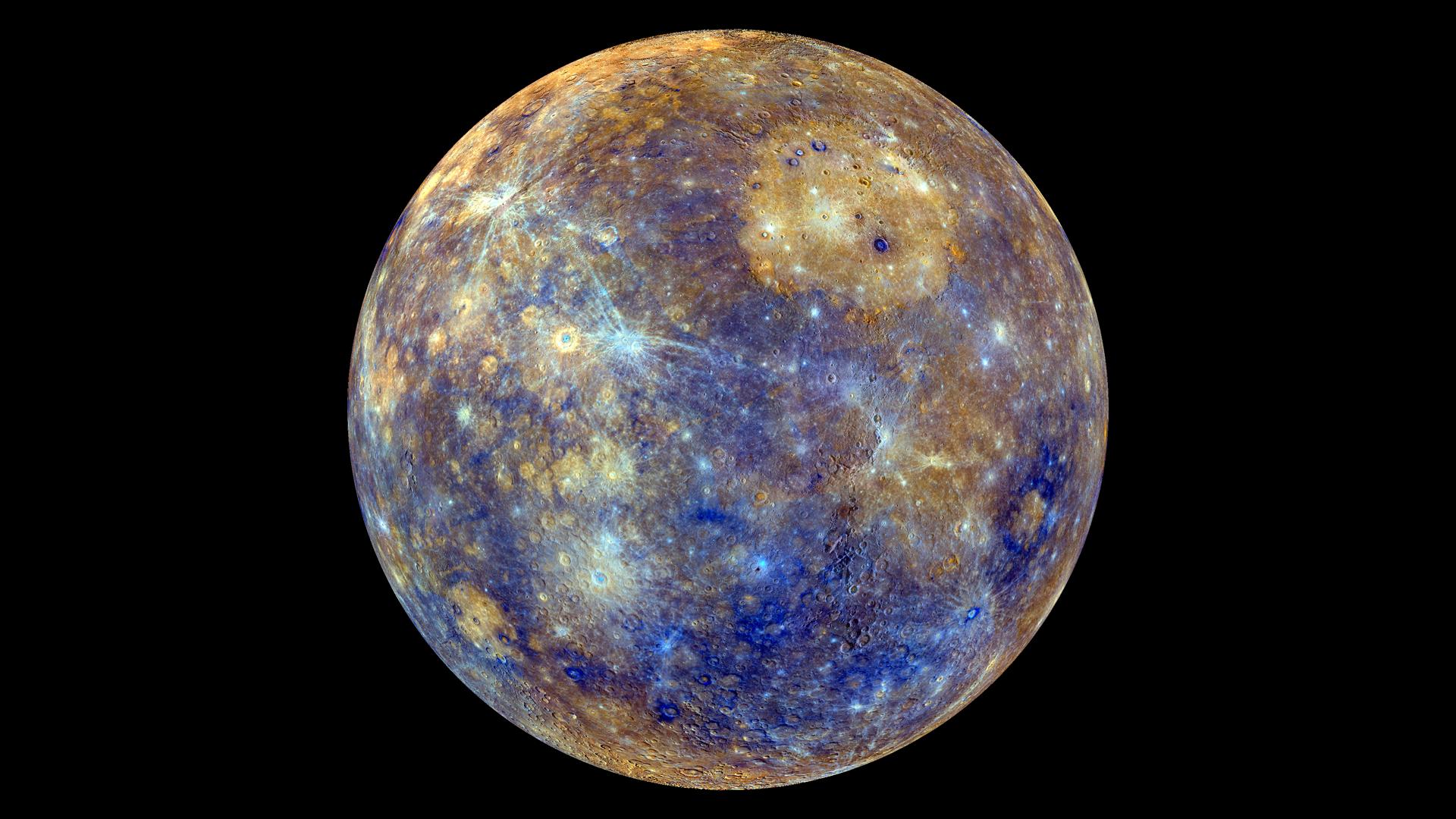
A false color image of Mercury obtained by the MESSENGER orbiter on 3/1/2013. See Notes and Sources.
Mercury is visible low on the eastern horizon just before sunrise. It is near the star Spica and Venus.
Early Missions
Being close to the sun, Mercury is a difficult target for space craft. There have been two missions to Mercury; a third is on the way. Mariner 10, launched on November 1, 1973, attained solar orbit by mid-1975. It flew by Venus on its way into orbit. Mariner 10 flew by Mercury three times and mapped 45% of its surface. It also detected, in a bit of a surprise, a magetic field much like that of Earth.
The MESSENGER space craft was launched in August of 2004. It made gravitational slingshot flybys of Earth (February 2005), Venus twice (October 2006 and October 2007) and Mercury three times (January and October 2008 and September 2009) before achieving orbit around Mercury in 2011. Out of propellant, it crashed onto Mercury’s surface on April 30, 2016.
The spacecraft’s name shows NASA’s love of acronyms – the full name of the probe was MErcury Surface, Space Environment, GEochemistry and Ranging. Whatever its name, the mission was successful and returned about 10 terabytes of formatted data. Among its notable discoveries – water ice at Mercury’s north pole.
A model of the BepiColombo probe now on its way to Mercury. If successful, the probe will insert two satellites in orbit around Mercury, sometime in December 2025.
BepiColombo
The European Space Agency in cooperation with the Japan Aerospace Exploration Agency lauched the BepiColombo probe to Mercury on October 20, 2018. It will achieve orbiit around Mercury in December 2025 after gravitational slingshot flybys of Earth (once), Venus (twice) and Mercury (six times). It will then release two small satelittes, in different orbits, to study the planet.
By the way, the probe is named after Guissepe “Bepi” Colombo (1920 – 1984), a mathematician from the University of Padua. He proposed the slingshot flyby manuever as first successfully implemented by Mariner 10.
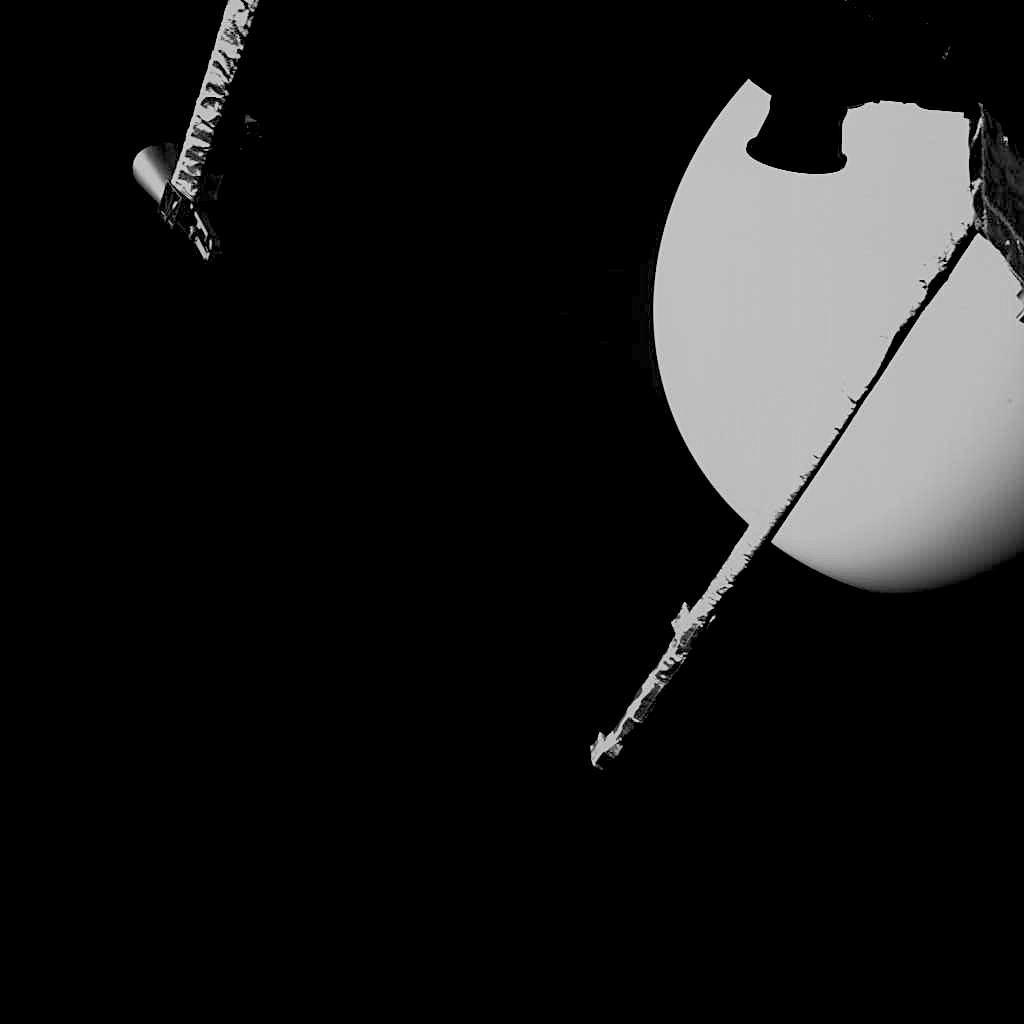
An image of Venus from the BepiColombo spacecraft, October 15, 2020. BepiColombo is getting a gravitational assist from Venus on its way to Mercury. If all goes as planned, it will achieve orbit around Mercury in December 2025.
Venus
Like Mercury, Venus is visible low on the eastern horizon, just before dawn. It is a little higher than Mercury, and a bit to the right.
Image of Venus as originally received from Mariner 10 in February 1974 (left) and after the image was processed using current techniques, 2020 (right). The clouds are about 40 miles above Venus’s surface and are composed of droplets of sulfuric acid.
Early Missions
Venus has been the target for multiple space probes: 18 in the 1960s, 11 in the 1970s, seven in the 1980s, one in the 2000s and five in the 2010s. That is not to say all have been successful – during the 1960s, five missions were successful, and 13 failed for one reason or another – explosions on the launch pad, communications failures, etc.
The Russians had an early interest in Venus. The Venera 4 probe (launch June 1967) sampled Venus’s atmosphere; Venera 7 (August 1970 launch) was the first spacecraft to make a soft landing on another planet. The lander Venera 9 (June 1975) was the first to transmit images from the surface of another planet. Check here for a full list of missions and comments on their success/failure.
The volcano Sapa Mons (0.9 miles high) dominates the horizon in this computer generated view of the surface of Venus. The imaging technology used information from the Venera 13 and 14 landers, and radar imagery from the Magellan mission.
Surface Conditions
Venus, named for the Roman goddess of love, is anything but hospitable. The atmosphere (96.5 % carbon dioxide, 3.5 % nitrogen, traces of other gasses) is dense – surface pressure about 92 times that of earth, and hot – surface temperatures of 860 F. Venus is seismically active, with current volcanic activity. NASA and other enginners are beginning to design a Rover of some sort for a Venus landing. It is a daunting task – just keeping the thing cool enough for the electronics to function will be difficult.
Mars
Mars is visible in the evening sky. It will be near the waxing gibbous moon during the week of November 25.
Early Missions
There have been 46 missions to Mars – three more are on the way, all launched during the favorable July 2020 launch window. I’ll focus on those. Click here if you want to review the missions, with comments as to success and failure.
Map of Mars showing location of probes/rovers, as of early 2017. Elevations are color coded – blues are lowest, brown and white the highest. The elevation data is from the Mars Orbiting Laser Altimeter mission.
United Arab Emirates Space Agency (UAESA)
Image of the UAE probe Hope, launched on July 19, 2020.
The United Arab Emirates created UAESA in 2014 to foster expertise in the space industry. In 2015, it established partnerships with the French and UK space agencies. It has overseen the launch of commercial communications satellites from EADS, Boeing, and others. On September 25, 2019, an Emeriti astronaut was lauched to the International Space Station from the Baikonar cosmodrome.
The 2020 mission to Mars is the USAEA’s first effort at exploring another planet. The Hope orbiter, built by a unit of the University of Colorado with several subcontractors, was launched on July 20, 2020 and will attain orbit in February of 2021. It is designed to study seasonal and localized weather patterns, and will make measurements to try to understand why the Martian atmosphere is losing oxygen and hydrogen to deep space.
China National Space Administration (CNSA)
The Mars orbiter, lander and rover of the Tianmen-1 mission of the Chinese National Space Agency. It will achieve orbit in Mid February 2021; the lander and rover should reach the surface about two months later.
The CNSA used a Long March 5 heavy rocket to launch the ambitious Tianwen-1 to Mars from its Wenchang launch site, on July 23, 2020. The mission includes an orbiter, a lander, a rover, and a detachable camera. The orbiter should achieve orbit by mid-February 2021, the lander should reach the Martian surface by April, and the rover should begin its work shortly thereafter. It will study the Utopia Planita region, in an area near the 2003 Beagle mission (see the Mars map above). Click here for a well-done simulation of the mission.
NASA
The Mars 2020 Perserverance Rover launched from Cape Canaveral on July 30, 2020. It is now in its cruise phase. This is another in NASA’s on-going robotic explorations of Mars.
Schematic of path of the NASA 2020 Perserverance Rover mission. The UAE Hope and the CNSA Tainwen-1 are on similar trajectories.Representation of the Perserverance Rover just before landing on the Martian surface. This should occur on February 18, 2021, in the Jezero Crater.
The Perservance rover is an impressive piece of technolgy. It is the size of a small car – it weighs about 2,260 Earth lbs, is about ten ft long, nine ft wide and seven ft high. This is quite an advance from the first Mars rover – the Sojourner (landed July 4, 1997) – which was about the size of a microwave oven. Click here for a NASA video showing the rover’s features.
Perserverance should land in the Jezero Crater on February 18, 2021. The crater, about 30 miles wide, is near the Martian equator in the Isidis Basin. The crater was apparently a lake at one time as there are inlet and outlet structures and what appears to be an alluvial fan within the crater. Mission scientists think this is an excellent place to find evidence of early life on Mars – in fact, astrobiology is the dominant theme of the whole Mars 2020 mission.
Helicopter on Mars?
And the Perservance is carrying a small helicopter, named Ingenuity. The 4 lb drone is a technology demonstrator – it carries no instruments. The goal is to see if and how it works in the thin Martian atmosphere.
NASA has an excellent website with all sorts of information about the mission. And you can sign up for Mars Newsletters, delivered via email. I wish, with apologies to Ray Bradbury, NASA had named them The Martian Chronicles. Another PR opportunity missed.
Jupiter and Saturn
The two giant planets are near each other, to the south west, in the evening sky, They are now near the waxing crescent moon.
Missions to Jupiter
There have been eight missions to Jupiter – six flybys and two orbital insertions – all managed by NASA. Pioneers 10 and 11 flew by Jupiter in the early 1970s, as did Voyager 1 and 2 in 1979. The Galileo orbiter, launched from the Space Shuttle Atlantis, attained orbit on December 8, 1995. The probe lasted for eight years, burning up in the Jovian atmosphere in September, 2003.
The Ulysses (1992) passed Jupiter on its way to a heliocentric orbit; the Cassini-Huygens (2000) on its way to Saturn. In 2007, the New Horizons passed nearby on its way to deep space.
The Juno orbiter, launched on August 5, 2011, entered orbit around Jupiter on July 4, 2016. Juno was suppossed to stay in the original orbit – with a period of 53 days – and then, after a course correction burn, move into an orbit with a 14 day period. However, NASA engineers, prior to the second burn, discovered faults in two helium valves. Mission scientists then decided to maintain Juno in the 53 day orbit.
The higher orbit means that Juno is in a less severe radiation environment., thus allowing the mission to be extended. It is now planned to end it in 2021, with a fatal dive into the Jovian atmosphere.
Artist rendition of Juno perfoming the orbital insertion burn, July 4, 2016. The spacecraft is still in orbit, with a period of 53 days.Image of upper atmosphere clouds on Jupiter. Juno acquired tthis image on February 23, 2018.
You can follow the Juno mission by visiting NASA’s Juno website here.
Missions to Saturn
I wrote about this in an earlier post. If you missed that example of erudition and wit, shame on you. You can make amends by clicking here now.
Uranus, Neptune, Pluto
Uranus will rise this afternoon on the horizon to the north-north west and will be best visible about 10 30 PM, here is San Juan. Neptune is visible low in the northwest sky, early in the evening.
By the way, click here for an excellent, interactive website that gives directions and best time to view objects in the sky.
Voyager 2 is the only spacecraft to visit both Uranus and Neptune.
Uranus (left) and Neptune in images obtained by the Voyager 2 mission, launched August 20, 1977.
Both Voyager 1 and 2, now in interstellar space, are still active. Click here for their current status.
Conclusion
We are living in an unprecedented era of planetary exploration – something we’ve begun to take for granted. I think it is good to get excited about some of this stuff – just like I was back in high school.
If you are interested in a telescope, consider this: sales of telescopes increased by 400 – 500 % over last year. This is undoubtedly due to the covid pandemic. Here’s my plan: wait a year or two and, as things get back to normal, I suspect there will be slightly used telescopes of all sorts for sale. Keep checking Craigslist or other such venues – I’m sure you’ll find a good deal.
Notes and Sources
The Mercury image and many others can be found here.
The image of the BepiColombo probe is from this site.
The election results are in and it is fair to say the results demonstrate a diversity of political opinions here. As I mentioned in my previous post, most races attracted candidates from five parties, and sometimes an independent as well. So here are the results for a few of the races and an overview of some others.
Late Breaking News
The election commission here, on 11/11/2020, reported finding 184 ballot containers filled with uncounted ballots. Given the closeness of some of these races, one wonders how these ballots will reflect the results I present below. Stay tuned.
Governor
Governor-elect Perdo Pierluisi.
Pedro Pierluisi of the New Democratic Party (NDP) barely defeated former Isabela Mayor Carlos Delgado Altieri of the Popular Democratic Party (PDP). Here are the results by percentage of the total turnout of about 1,200,000,
Juan Dalmau Rodriguez (Puerto Rican Independence Party (PIP)) 13.72%
Cesar Vazquez Muniz (Project Dignity) 6.9%
Eliezer Molina Perez (Independent) 0.69%
So the pro-statehood NDP retains the governorship, but not by much. In a bit of a surprise, all five parties received enough votes to be registered. That means they have an assured place on the next ballot.
I ran into my friend Eduardo after the election. As usual, he provided me with interesting insights. I asked if there would be a runoff election given that no candidate won a majority. He said not under current law but that is being considered.
Resident Commissioner
Re-elected Resident Commissioner Jennifer Gonzalez.
The incumbent Jennifer Gonzalez was reelected with 40.85% of the vote. She, like the Governor, is a member of the pro-statehood NDP. In this election, the pro-Independence party candidate, Luis Roberto Pinero, received 6.37% of the vote, last among the five candidates.
Statehood
The non-binding referendum on statehood passed, with Yes votes coming in at 52.34%. Prior to the election, the NDP promised to promote statehood if the referendum passed. It will be interesting to see how this plays out – the invitation for statehood has to come from the U. S. Congress. Given that the House will be majority Democrat and the Senate will (most likely) be majority Republican, it would seem statehood will not be high on anyone’s agenda. And if statehood in general is up for discussion, one wonders how the issue of Puerto Rican statehood meshes with statehood for the District of Columbia.
Tennessee was the 16th state to join the union, and the first state to have been a territory prior to statehood. It seems that Puerto Rico is in a somewhat similar position, I wrote about the so-called Tennessee Gambit in an earler post.
I’m going to check and see how many other former territories had the option of independence or statehood. Texas and California come to mind. I’ll have to research that.
Again, my friend Eduardo has an interesting perspective. He is pro-independence and suggests there should be an island wide referendum with three choices: statehood, independence, and the status quo. The top two choices would then be on the final, binding referendum.
As a San Juan native, Eduardo is full if useful information. One time I asked why a particular stretch of beach, popular with surfers, was called Playa de Ocho, Beach Eight. He told me it was because it was the eighth stop on the street car line leaving San Juan.
Surfers at Playa de Ocho, election Day 2020. I’m sure they voted early.
I have heard San Juan natives say something is near stop (Parada) 15 even though stop 15 no longer exists. It is a code known only to San Juan natives.
Parada 18 was apparently an important interchange point, and there is a building there named Parada 18. The Parada 18 bar and restaurant is close by, on Avenida Ponce de Leon.
There is, at least the last time I was there, a Parada 18 restaurant in San Francisco, on Haight Street past Amoeba Music heading towards the east end of Golden Gate Park. Check it out the next time you’re in San Francisco. I’m sure they serve Puerto Rican specialties.
Senate and House
Every seat in the Commonwealth is up for election every four years and so every Senator and Representative faced reeelection.
In the Senate, the New Progressive Party lost their 2/3 majority, dropping to nine seats of the 27 in the senate. The Popular Democrats gained seats, to a total of 13. The senate is the most diverse in history with five parties represented: Citizens Victory Movement – two, one each for Project Dignity and the Puerto Rico Independence Party. In addition, there is one senator not affiliated with any party.
The situation is similar in the House, with all five parties represented. The Popular Democrats have 26 of the 51 seats, the New Progressives 21, with two to the Citizens Victory Movement and one each to Project Dignity and the Puerto Rican Independence Party.
And there is always the sceptre of corruption. One NPP representative, Nestor Alonso Vega, has resigned since the election. Vega was indicted by a federal grand jury and faces nine federal charges, including receiving illegal commissions (aka kickbacks), wire fraud, and theft of federal funds from the government of Puerto Rico. He was arrested by the FBI.
No one would be surprised if other arrests were to occur, with similar charges against other individuals.
Mayor of San Juan
Miguel Romero of the New Progressive Party is the Mayor-elect of the capitol city of San Juan. Romero was elected over four other candidates and recieved 36.22% of the votes cast. He is a political veteran, having held several offices. Romero once served as Chief of Staff to a governor, and twice represented Puerto Rico at the Democratic National Convention.
Conclusion
Puerto Rico faces a challenging time with a diverse, divided government. It will be interesting. But I am looking forward to the Inauguration, on New Years Day. In the past it has been a festive time, with music, a procession from the Capitol to the Governor’s Mansion, etc. It will be interesting to see how covid will affect the event.
A scene from Inaugration Day 2013. I wonder how covid concerns will affect this years event.
I know you are all anxiously waiting the results of the 2020 election. I am too but since I’m here in San Juan I have the Puerto Rican elections to follow as well. Elections here occur every four years, and every office is up for grabs. And this year there is a plebisicite on the question of statehood.
This year’s political season has clearly been affected by last years upheavals during which, amid several days of protests, Governor Ricardo Roselli Nevares was forced to resign as governor. The local newspapers had unearthed and printed a trove of emails (the dump became known as RickyLeaks) showed Roselli Nevares and his advisors as sexist, misogynist, and generally dismissive of the Puerto Rican people. Click here for an earlier post on that subject.
Graffiti left from anti government protests during the summer of 2019. The protests caused Governor Ricardo Rosselli Nevares to resign.
Roselli Nevares tried to ram his choice for successor, Pedro Pierluisi, through the legislature but the Puerto Rican Supreme Court blocked that. Wanda Vazquez Garced, the next in line, became interim governer even though she claimed to not want the job. Vazquez Garced seemed to grow into the job but was defeated during her party’s primary by Pedro Pierluisi, who is one of six candidates running for governor.
Roselli Nevares, Pierluisi and Vazquez Garced belong to the New Progressive Party (NPP), a conservative party with members affiliated with both the mainland Democratic and Republican parties. The NPP generally favors statehood. The Popular Democratic Party (PDP) is more centrist and aligns mostly with the mainland Democrats. It generally favors maintining the commonwealth status. The Puerto Rican Independence Party (PIP) is more social-democratic and advocates for independence from the United States. In recent elections, the NPP and PDP were pretty evenly matched, with PIP garnering about thee percent of the vote.
It remains to be seen how the events surrounding RickyLeaks will affect this years election.
Governor
So here are the candidatates for governor.
Charlie Delgado Altieri – PDP. Mr. Delgado is a long time mayor of Isabela, a toewn on the on the northwest coast. Delgado Altieri defeated San Juan Mayor Carmen Yulin Cruz in a messy primary characterized by missing ballots and delays in ballot counting.
Pedro Pierluisi – NPP. Mr. Pierluisi beat interim governor Wanda Vazquez in the party primary. Mr. Pierluisi had previously served for eight years as Resident Comissioner, Puerto Rico’s non-voting representative to Congress.
Juan Dalmau Ramirez– PIP.
Alexandra Lugaro – Citizen Victory Movement Party.
Cesar Vazquez Muniz– Dignity Project.
Eliezer Molina – independent,
Sign for Puerto Rico Independence Party candidate Juan Dalmau.
Local political commentators have much to say about the candidates. Political Science Professor Jose Rivera Gonzalez sees Delgado Altieri as “a bland candidate, who does not have much charisma.” Political analyst Jorge Goldberg Toro sees Delgado Torres’s twenty year tenure as mayor as a positive, especially since he acculumated a budget reserve over those years.
Goldberg Toro notes that NPP candidate Pedro Pierluisi, although experienced by virtue of his service as Resident Counselor, “must drag everything that has happened with the NPP during his four-year term.” Rivera Gonzalez says of Pierluisi: “His unsuccessful moves in the summer of 2019, trying to usurp power by imposing himself as the obvious person to replace Governor Roselli Nevares, having been appointed as Secretary Of State without confirmation, left a bad taste in my mouth.”
Of PIP candidate Juan Dalmau, Colberg Toro says he was a “good, serious and respected senator.”
Resident Commissioner
The nominees for the position of Resident Commissioner are as follows. The Resident Commissioner represents Pueto Rican interests in Congress as a non-voting member,
Jenniffer Gonzalex Colon, NPP, incumbent,
Anibal Acevedo Vila, PDP
Luis Roberto Pinero, PIP
Zayaira Jordan Conde, Citizen’s Victory Movement
Ada Norah Henriquez, Project Dignity
Statehood
Street sign urging voters to vote for statehood. The phrase on top translates as The Colony Kills You.
Another island-wide vote is a referendum on statehood. As noted above, the NPP has generally been pro-statehood. One has to wonder if the NPP drama of last year spills over into this vote. One thinks it might, given this statement by Interim Governor Vazquez: “The only party that will lead us to statehood is the New Progressive Party. Statehood is the only alternative that guarantees permanent union with the United States of America and our U. S. citizenship.”
The referendum is a simple yes – no vote. Here is a summary of the process. Congress is given the authority in Article IV, Section s, clause 2: “The Congress shall have Power to dispose of and make all needful Rules and Regulations respecting the Territory or other Property belonging to the United States…”
Typically, Congress has adopted the following steps:
The territory holds a referendum to determine the people’s desire for or against statehood.
If a majority votes for statehood, the territory petitions Congress
Both the House and the Senate agree to statehood via a simple majority vote.
The President signs the resolution granting statehood.
So it sounds simple. The referendum in non-binding (since the power lies with the U. S. Congress, and not the Puerto Rican voters), and many observers see this as a ploy by the NPP to get support in the elections, My Puerto Rican friends are split on this subject. I have no idea how this vote will go. I do know that the current governor is all set to follow up on the results, and within 30 days. It should be interesting.
A political statement on a wall In Santurce, San Juan. I won’t bother to translate but it does show a lack of trust in the current governor and, by implication, her efforts to achieve statehood.
Local Elections
Someone once said all politics is local. In San Juan, that means the vote for mayor. There are five candidates running for that office:
Miguel Romero Lugo (NPP)
Rosanna Lopez Leon (PDP)
Adrian Gonzalez Costa (PIP)
Manuel Natal Albelo (Citizen Victory Movement)
Manuel Palomo Colon (New Progressive Party).
Street signs for four of the five candidates for the mayor of San Juan.
Conclusion
So watch for the results right here. Be ready to turn off CBS, ABC, CNN, MSNBC, FOX or whatever and check back here to the results of the Puerto Rican elections.
Notes and Sources:
The quotes are all from the San Juan Star edition of November 2, 2020. The photos are all mine.
I suppose everyone has felt, at one time or another, that they were being watched. I sometimes feel that way in my walks around San Juan. I’ve decided to share some of the wall art that may have caused that paranoid feeling.
If you’re a regular reader of this blog, you’ve seen some of these before. But there are some new ones as well.
The images have been minimally edited. I’ve cropped them and adjusted levels. I’ll share a more completely edited image at the end.
Unadorned Eyes
I’ll start with an old favorite of mine – Woman witn Green Face. She is gone, having been painted over. But she is still evocative.
Woman with Green Face, once adorned a wall in the Sagrado Corazon neighborhood of San Juan.
Here is a recent find. She iseems to be wearing the uniform of the Puerto Rico national team. Perhaps she is a well know local athlete.
I found this pugilist on a wall in Santurce, near Condado.
Here’s a somewhat sterner face.
I found her on a wall along Avenida Fernandos Juncos in Miramar.
The woman below seems to be curious about something.
I found the Woman with Red Hair on a wall along Avenida Fernandos Juncos in Miramar.
I don’t get the next one. If anyone can tell me the significance of a woman holding a rooster with a key dangling from his beak and a pineapple in her other hand I’d like to hear it. I very much like this. Perhaps some day I’ll devote some time to editing it – removing the wires, etc. I think it would be worth the effort.
The Girl witn Rooster and Pineapple overlooks Avenida Fernandos Juncos in Miramar.
I’m not quite sure what the next woman is holding. Is it a conch shell? A piece of fish? Some kind of fruit? Any ideas? Let me know.
I found the Lady Holding Object on a wall in Santurce, near Condado.
A friend of mine calls the next one Proud Woman. I like that name for her. She does have much to be proud of.
I found the Proud Woman in Calle San Miguel, just off Calle Loiza in Santurce.
I really like the next one, except for the window in the upper left. Reto y Resistencia means challenge and resist; the art probably dates from the anti-government demonstrations in August of 2019.
I found this anti-government work on Calle Cerra in Santurce.
I have to admit I don’t recall where I first saw the Woman on Blue Background. I’ll have to go through my notes and see if I can find a reference to her.
A stern looking Woman on Blue Background. I can’t remember where I first saw her.
Finally, to end this section, another stern woman, this time on a colorful background.
A stern but colorful woman. I found her on Avenida Fernando Juncos in the Miramar section of Santurce.
Bespectacled Eyes
Some eyes peer out through spectacles. Here are a few examples.
I found the Woman with Fashionable Glasses on Calle San Miguel. A resident there saw me taking pictures and graciously came out and moved his car out of the way,
Woman with Fashionable Glasses on Calle San Miguel, just off of Calle Loiza.
This guy looks pious enough. I first thought he was a priest but I think the jewelry and tattoos signify another type of concentration. I’m not sure what – any ideas?
I found this guy along the bus lane in Puerta de Tierra, very near to the building we live in.
This old guy is probbly glad he has a fixed income pension, and that happy hour is approaching.
I found Old Smiley near Placita de Mercado in Santurce.
I found the next example on the door of a shop on Avenida Juan Ponce de Leon in Santurce.
The Girl with Fower Glasses in on the door of a shop in Santurce.
Here is another recent find. He looks like he is getting ready to say something important
This gentleman is on a wall just off of Avenida Juan Ponce de Leon in Santurce.
I’ll finish this section with an image suggesting everything is OK.
This guy is on a wall off of Calle Cerra in Santurce.
Non-Human Eyes
Here are a few examples of alien eyes I found.
I don’t quite get the space suit and the candle, or the three eyes. I suppose it could have something to do with the corona virus but the painting predates that.
She is found an Calle San Miguel, just off Calle Loiza in Santurce.
I suspect people walking along a pedestrian mall in Rio Piedras get nervous when they see the next example.
T found Orange Creature with Black Eyes in Rio Piedras.
The next example is also from Rio Piedras.
I found this guy on a wall near the entrance to the urban train station in Rio Piedras.
The last one in this section reminds me of something that you might see in an old Indiana Jones movie, guarding the entrance to some archaeological wonder.
I found this just off of Calle Loiza in Santurce.
Disembodied Eyes
Every once in a while I see wall art featuring eyes with little reference to a body. Here are a few examples.
T found the Eye with Candles on a street in La Perla, a section of Old San Juan.
The next eample is more of a disembodied head. This certainly does capture the agony Puerto Ricans felt during the political demonstratons of the summer of 2019.
This is on a wall in Old San Juan.
I like the way the Puerto Rican flag is used in the eye below.
This is on a shutter protecting a shop entrance on Avenida Juan Ponce de Leon in Santurce.
Flower Power
Every once in a while an artist uses flowers as eye cover. Here is one example.
She lives on a wall just off of Avenida Fernando Juncos in Santurce, close to Parada 18.
Eyes Wide Shut
One final example. I found this character in a wall in Santurce. Maybe he is dreaming of a plantain.
I found this guy on a wall just off of Avenida Juan Ponce de Leon in Santurce.
Editing
As I said in the beginning, these images are minimally edited. I wanted to show one example of more extensive editing. I’ll show the origianal as obtained from my camera, and the final after I worked on it.
I was interested in the work on the third story of a building off Calle Cerra in Santurce. My final (maybe) version of the image above, Please leave a comment if you have any ideas as to the the symbols in this work – the lamb, bird, oar, bag on head.
Conclusion
I had great fun putting this together. And I have plenty more. Stay tuned.
Notes and Sources
The images are mine. I use a Sony point and shot digital camera and Adobe Lightroom and/or Photoshop for post processing.
As I’ve written before, the street art in San Juan is fanciful, colorful, and ever-changing. I’ll be showing some new works. They may be newly created, or maybe they are just new to me. These images are minimally edited – I’ve cropped them and adjusted the levels. That’s all. I’ll show you an example or two of fully edited images at the end of the post.
The Puerto Rican Flag
Some of the works use the Puerto Rico flag, sometimes optimistically, sometimes not. Here are a few examples.
The second and third stories of a building on Calle Cerra, in the Santurce neighborhood of San Juan.
A face in the flag. Happy? Sad? Ironic? You tell me. This is on a wall in Old San Juan.
RIP flag, and also Puerto Rico? This is on a wall in Old San Juan.
An exhortation asking police to unite, found on a wall in Old San Juan.
The flag adorning the front of a building. This is in the La Perla section of Old San Juan.
The flag used as a child’s cape. This is on a wall in Old San Juan.
The flag in vegetation. This is on a wall in the Puerta de Tierra section of San Juan. The wall will likely be torn down soon.
Sports
A relatively few examples of street art show sports figures. Here are a few.
A catcher in the colors of the Puerto Rico national team. He is on a wall in Santurce, on Avenida Ponce de Leon.Also in Santurce, and next to the catcher, this fielder is in the uniform of the Puerto Rico national baseball team.A somehat more abstract representation of a sports figure, this time from a wall on a gym in Condado.Another image from the wall in Condado.
Animals
Street art frequently employs representations of animals, sometimes realistic, sometimes more fanciful. Here are a few examples.
A bird of prey watches over an empty lot along Calle Cerra, in Santurce. It covers a two story building.A rabbit on a wall along Calle Cerra, in Santurce.A goat, again along Calle Cerra in Santurce.
An ape along Calle Cerra in Santurce. The helpful sign translates as “Caution Slips.”
Faces
Next I’ll show some examples of street art featuring faces – some beautiful, some ironic, all interesting.
What is her expression trying to convey? She is on a wall on Calle San Miguel, just off Calle Loiza in Santurce.She is also on Calle San Miguel, in Santurce.Her three eyes seem focused on the candle. This is also along Calle San Miguel in Santurce.This is from a side street off of Avenida Ponce de Leon in Santurce. If you look closely you will find various puzzles on his face, including word searches, Those are, you recall, square grids of seemingly random letters in which you have to find words like despot, scalawag, idiot, trump.A colorful face found along Calle Cerra in Santurce.This is on a wall in Santurce, on a side street off of Avenida Ponce de Leon. The level of detail convinces me this started as a photograph. I don’t know how the image was transferred to the wall.Perhaps she is being taught to paint. This is on the side of a two story building along Calle Cerra in Santurce.This is on a wall along Avenida Fernando Juncos in Santurce.
Miscellaneous
There are always things that are difficult to categorize. Here are two examples.
This is on a side street off of Calle Loiza, in Santurce.
Yeah, man, everything is cool. He is along Calle Cerra in Santurce.
Edits
I mentioned in the beginning that these were minimally edited. I’ve been working on converting some examples of wall art to black and white. I’ll show two before and after examples.
This was along Calle San Muguel in Santurce.My black and white version of the wall art immediately above.This is on the bridge pier that carries the highway that separates Condado from Santurce. The artwork has been there for some years. This is the only example of non-recent work in the post.Here us my edited version of the image immediately above. I think this would make a great notecard.
Final Thoughts
So there is some of the street art I’ve encountered in the past two months or so. There’s a whole lot more – stay tuned.
Notes and Sources
I took and edited all of these images. I use a small digital point and shoot camera and edit with Adobe Lightroom and/or Photoshop.
Puerto Rico has a professional winter baseball league. This past year, there were five teams from around the island – the Indios de Mayaguez, the Gigantes de Carolina, the Criollos de Caugus, and the Atenienses de Manati, and one from San Juan. The San Juan team is the Cangrejeros de Santurce. Their home field is the Hiram Bithorn Stadium in Santurce. We can see the lights of the night games from our balcony. The Puerto Rican league ends its season with a playoff, and this year the Cangrejeros were league champions.
Other coutries around in the Caribbean area also have their winter leagues. As in Puerto Rico, each league ends its season with a playoff that determines the champion. In early February, the league champions from six winter leagues play in the Serie del Caribbe. This year, San Juan hosted the series. This meant there were baseball fans from five countries here during the first week of February, attending the games and otherwise having a good time.
The Teams
This year, there were teams from Colombia, Venezuela, Panama, Mexico, and the Dominican Republic. Colombia replaced the Cuban team as it would have been difficult for the Cubans to obtain visas in time for the series.
The series is intense. The first five days is a round-robin with each team playing each other once. There are three games a day – one at 10:30 AM, one at 2:30 PM, and another at 8:00 PM. As host, the Puerto Rican team plays each of their games at night (exception: they played Sunday afternoon); since Santurce won the Puerto Rican league it had the further advantage of playing on its home field.
Two teams are eliminated after the five day round-robin. The remaining four play on the sixth day, and the two winners meet the next night in the final. So the whole tournament takes a week.
New street art appeared in honor of the series.
The Venue
All the games were played at Hiram Bithorn Stadium, in the Santurce section of San Juan. The stadium can hold about 19,000 fans. In fact, the stadium was sold out the night the team from the Dominican Republic played the Cangrejeros de Santurce. The home field did not help the Cangrejeros; they lost 5 to 4.
Some History
By the way, Hiram Bithorn was the first Puerto Rican to play in the major leagues. A right-handed pitcher, he played for the Chicago Whie Sox and Cubs during the early and mid 1940s. He was a big man -200 lbs, six feet one inch tall, and threw with a strange windup.
Hiram Bithorn using his unusual windup.
Bithorn had an overall record of 34 wins and 31 losses, with an earned run average (ERA) of 3.16 in 106 innings pitched. He went 18 and 12 in the 1943 season, with an ERA of 2.60. He finished 19 of his 30 starts and led the league with seven shutouts.
Like so many others, Bithorn went into the military and spent two years in the service. After the war, he was ineffective, perhaps because his weight had ballooned to 225 lbs. He died in Mexico in 1951, at age 35. Bithorn was pitching in the Mexican Pacific League, trying to make a comeback. He was shot by a Mexican policeman who was susequently convicted of murder.
Portrait of Hiram Bithorn in the stadium bearing his name, Santurce, San Juan, Puerto Rico.
Other Puerto Ricans have played major league baseball, including Roberto Clemente, Carlos Beltran, Ivan Rodriguez, Bernie Williams and Jorge Posada, to name a few.
A painting of Roberto Clemente in the Hiram Bithorn Stadium. Clemente played for 18 seasons as the right fielder for the Pittsburgh Pirates. He had a lifetime batting average of 0.317, and was an All-Star fifteen times. He died at age 38 in a plane crash as he was delivering aid to earthquake victims in Nicaragua.
A walkway into Hiram Bithorn Stadium, Santurce, San Juan.
The Games
We went to three games. We saw the morning and afternoon games on the third day of the tournament, and the first semi-final on the sixth day. The games were close and well-played. I’d say the level of play was roughly equivalent to triple-A minor league baseball in the states.
In the 10 30 AM game, the seventh of the tournament, the team from Mexico beat the team from Panama 6 – 1. The Mexican team showed good pitching and defense, and timely hitting.
A player from Panama takes a strike in his game against Mexico.
The 2 30 PM game, the eighth of the tournament, pitted the teams from the Dominican Republic and Colombia against each other. Colombia’s starter, a crafty left-hander, kept the opposing batters off stride. However, he was relieved in the sixth inning while the score was tied at zero. The Colombian reliever promptly gave up a double and then a home run, all the runs the Dominican Republic team needed. They won 4 -0, making the best of their five hits. They also pulled off a triple play inf the eighth, on a failed sacrifice bunt with two on and no outs.
A player from the Dominican Republic tries to bunt for a base hit. He was thrown out at first.
The Semi-Finals
At the end of the five game round-robin, the teams from Mexico and Venezuela stood at 4 -1, the Dominican Republic team was 3 – 2, and the Cangrejeros were at 2 -3. These four advanced; the teams from Colombia and Panama were eliminated.
I’m not sure how the semi-finals pairings were decided. It seems to me Mexico should have been the top seed, as it had defeated Venezuela during the round-robin. Likewise, the Congrejeros should have been seeded last. But the baseball gods thought differently, and the first semi-final had the two 4 – 1 teams play each other.
It was a close game. Venezuela won 1 – 0, avenging its earlier loss to Mexico.
A Venezuelean batter hits a ball into the dirt in front of home plate during their semi-final game. He was thrown out at first.
In the second semi-final game, the Dominican Republic team scored two runs in the bottom of the eighth and held on to beat the Cangrejeros 4 – 3.
The next day, in the finals, the Dominican Republic team won 9 – 3 and thus became the champions of the fiftieth Serie del Caribbe.
The Fans
Latin American fans love their baseball. They are knowledgeable, fun-loving, and noisy. And really noisy. Fans come with wooden noisemakers, various percussive instruments, and fog horns. And they use them throughout the game, but especially if something is happening on the field.
The Serie del Caribbe was great fun. I hope it comes back to San Juan soon.
Notes and Sources
See the Wikipedia articles on Hiram Bithorn and Roberto Clemente for more information on them.
All the images are mine except for the image of Bithorn in his windup. That is from the Wikipedia article about him.
The fiftieth Festival de la Calle San Sebastion started this past Wednesday. It is a street festival in Old San Juan named after a street – Calle de San Sebastian. Apparently, 50 years ago now, the upper end of that street was home to a number of artists. They started a festival as a means to sell their art. It has morphed into a huge event with closed streets, multiple sound stages, all kinds of street vendors, and huge crowds.
It almost did not happen this year. In view of the recent earthquakes that caused damage in the southwest part of the island, Governor Wanda Vazquez asked the mayor of San Juan to postpone the festival. San Juan Archbishop Roberto Gonzalez joined with the governor in this request, stating that the dispute as to whether the festival should go on was causing divisions among the people.
San Juan mayor Carmen Yulin Cruz Soho, herself a gubernatorial pre-candidate for her party, disagreed. She noted the Destination Marketing Organization had published ads stating Puerto Rico was open for business in all but the southwest part of the island. She said
“The Tourism director is telling visitors that the quakes damages are concentrated in one part of the island. You cannot have one government office saying something different from what the government is saying. No one has told the cruise ships not to come. We are going to have over 902 artists and power in San Juan has been fully restored.”
San Juan Mayor Carmen Yulin Cruz Soho as quoted in the San Juan Star, January 14, 2020, page 2.
So the festival started as planned.
Preparations
It takes several days to prepare for the festival. Soundstages were constructed around the city, traffic had to be diverted, tents had to be erected, and beer had to be delivered. Here are some images of the preparations.
The festival was stocked with copious amounts of beer.Fountains were fenced off.The King of Fried Meats set up his stand in Plaza d’Armes.Portable generator powered beer coolers appeared.A sound stage was erected in Plaza d’Armes.
This is the soundstage in the Plaza of Five Centuries. Castle El Moro is in the left background.
Enterprising bar owners used various educational tactics to entice visitors into their establishments.
Parades
The festival features parades. Some are planned; other more impromptu. They always have music and often have people on huge stilts. Dancing on stilts on the rough brick streets certainly takes a lot of skill.
A percussion and trombone band lead a parade in Calle de San Sebastian.This parade included several effigies, one of which seemd to be San Sebastian.’An effigy of San Sebastian (Saint Sebastian).
Aside: Saint Sebastian
Saint Sebastian was tied to a tree and shot with arrows by minions of the Roman emperor Diocletian. This was a part of Diocletian’s persecution of the early Christians during the third century AD. According to legend, Sebastian survived, having been nursed back to health by Saint Irene of Rome. Shortly after his recovery, Sebastian went to Diocletian to warn him of his sins. Diocletian had him clubbed to death for his troubles. Both the Roman Catholic and Orthodox branches of Chrstianity revere him as a saint.
Dancers on stilts follwed the effigies.A stilt dancer oo Calle de San Sebastian.People wearing huge masks followed the stilt dancers, one of whom is in the background.More people in masks. I have no idea as to who or what they may represent.Different day, different parade, another pair of stilt dancers.
Music
There was music everywhere, both on the sound stges and by impromptu groups along the streets
A small soudstage in the La Perla section of Old San Juan.An informal band making its way up Cale San Francisco.A salsa band performing at Plaza Colon.Musicians on Calle de San Sebastian.This group specialized in Caribbean music as influenced by African slaves and immigrants.
Food
There was street food everywhere – almost all of it fried. But is was good.
A cook pours batter onto hot oil. The result is like a garlic bread. Most delicious.Fried foods of various sorts available at the King of Fried Meats tent.
Random Thoughts
I’ve been to San Sebastian festivals several times in the past, though this was my first time in the last three years. The festival seemed a bit less crowded than I remember. There was more of a corporate presence in years past – bands sponsored by banks, hand out samples of medicines and other things, corporate banners in the parades. It also seemed a bit subdued. Perhaps that is because of the ongoing earthquakes in the southwestern part of the island.
The southwestern coast of Puerto Rico has been experiencing an earthquake swarm. It started in December and the U. S. Geological Survey and other agencies have recorded over 1,495 earthquakes of magnitude 1.5 or greater in the last 30 days. Click here for the most recent statistics.
Most earthquakes are small, recorded by seismographs but not felt. Here is a brief description of magnitudes and potential for damage.
Magnitude less then 2.5: Not usually felt
Magnitudes between 2.5 and 5.4: Usually felt, minor damage.
Magnitudes between 5.5 and 6.0: Felt, slight damage to buildings and other structures
Magnitudes between 6.1 and 6.9: May cause widespread damage in populated areas.
So far, the largest magnitude earthquake was a 6.4 which occurred about 4: 20 AM on January 7. It caused widespread damage in communities along the southwest coast: Ponce, Yauco, Guanica. We felt it in San Juan, about 70 miles from the epicenter. We also felt two aftershocks that same morning. Fortunately, San Juan is too far from the epicenter to experience any damage.
Earthquakes: The Big Picture
I remember, as a bored second or third grader, staring at the world map in our classroom. I was sure Africa and South America fit together. Of course, I wasn’t the only one to notice this. The German atmospheric scientist Alfred Wegener had noticed the same thing, in the late 1800’s and early 1900’s. Wegener mustered geologic, fossil, and other data to theorize that the continents were once connected, and had somehow moved to their current position. Click here for a short lecture on Wegener’s evidence.
The map below shows the current configuration of the 17 major tectonic plates. Note that the Caribbean plate adjoins the North American, South American and Cocos plates.
Schematic showing plates in their current positions. Note the small but important Caribbean Plate. See Notes and Sources
Pangaea – The Supercontinent
So what was the position of the plates in times past? It is now accepted that the super continent Pangaea began to break up about 250 million years ago. The map below shows Pangaea with the modern continents labelled.
Pangaea about 250 millions years ago, before the super continent began to break up. The current land masses are labelled.
Massimo Pietrobon wondered how modern political boundaries related to Pangaea. Using a good bit of cartographic license, he created the map below. The map shows a representation of Pangaea with current countries (which of course did not exist 250 million years ago) overlain. Visit the artist’s website here.
The super continent Pangaea as it existed 250 million years ago. The current coutries are overlain for illustrative purposes. See Notes and Sources.
The Break Up of Pangaea
By about 200 million years ago, the pates had separated into two super continents – Laurasia and Gondwana.
The two mega continents, 50 million years after Pangaea started to break up. Africa and South America are just splitting, Madagascar has separated from Africa and India, and the Indian subcontinent has started its rapid movement to the north north east, Australia and Antarctica have not yet separated. See Notes and Sources.
Plate tectonics explains a lot of disparate data. As shown above, Madagascar had separated from Africa and India as early as 200 million years ago. Lemurs evolved on that isolated island, and nowhere else.
Note also that the Indian subcontinent was separated by 200 million years ago. It moved rapidly to the north north east before crashing into the Asian plate, and causing the uplift that created the Himalaya mountains and the Tibetsn plateau. During its travels the Indian subcontinent sometimes moved at a speed of 5 to 6 inches per year.
For a short video of the plate movements click here. For an animation of the movement of the Indian subcontinent, complete with music from India, click here.
Plate Boundaries
It stands to reason that if tectonic plates are moving, they are separating (diverging), colliding (converging) or moving parallel to each other. It makes sense that earthquakes and volcanoes occur at the borders of plates. In fact, that is the case – for the most part. The schematic below depicts these situations.
Schematic showing effects of plate movements. See Notes and Sources
Diverging Zones
If two plates separate and the area of divergence is under the ocean, an ocean ridge forms. If the divergence is on land, rift valleys form.
A map of the earth’s mid ocean ridges. The North American plate is moving west; the African plate is moving east. New crust is fromed at the ridges by accretion of lava and, sometimes, volcanic eruptions. The ridges are seismically active, as you might suspect. Plate tectonics does much to explain the geothermal springs, earthquakes, and volcanoes in Iceland.
A nineteenth centruy British expedition used cable soundings to map some of the bottom of the Atlantic Ocean. They were the first to find the mid ocean ridge system. After World War II, sonar and other exploration techniques provided greater detail and led to the idea that new crust was being formed as the plates moved away from each other.
As noted above, if land masses are spreading, the result is a rift valley system.
The East African rift sytem with descriptions laid over a Space Shuttle radar image.
Converging Zones
Plates moving into each other create converging zones. One plate sinks under the other in a process called subduction. If the convergence occurs under the ocean, a trench is created along the leading edge of the plate being subducted. Again, these zones are seismic and volcano active regions. In addition, earthquakes sometimes cause tsunamis.
A schematic of two plates converging under the islands of Japan.
Transform Plate Boundary
Two plates sliding against each other form a transform plate boundary. The crust is deformed and sometimes pulverized but, unlike the other two boundaries, no new crust is formed.
The San Andreas fault in California is a famous example of this type of boundary. The North American plate to the east is moving approximately southeast; the adjoining Pacific plate to the northwest.
The Situation in Puerto Rico
The Caribbean plate, as noted above, is surrounded by four other plates. Each one is moving relative to the others. That creates a complex environment. In addition, Puerto Rico might be on its own microplate, itself moving with respect to both the North American and Caribbean plates. (This is further proof to what I have said many times: Puerto Rico is its own unique self).
Map of the Caribbean plate showing relative motion with respect to the South American, North American, Cocos and Nazca plates. See Notes and Sources
As shown in the map above, the Caribbean plate, moving eastward, is converging with and overriding the North American plate which is moving westward. This explains the volcaones in the Lesser Antilles volcanoc arc. To the north, nearer to Puerto Rico, the boundary between these two plates transitions from a converging zone to a transform boundary. Note the faults that cross the Dominican Republic and Haiti. It was one of these faults that ruptured and caused the devastating Haitian earthquake (magnitude 7.0) of 2010. Puerto Rico is in the area where the boundaries transition from converging to transform. In addition, it is near the edge of the Caribbean plate. The fact that Puerto Rico is its own microplate makes for a very complex earthquake environment.
The recent earthquake swarm has been centered off the southwest coast of Puerto Rico. (Google earthquakes pr – that will take you to a USGS site with information on recent earthquakes). The Puerto Rico microplate is being squeezed from both the north and the south.. To the north, the North American plate is sliding under, in an oblique direction, the Puerto Rico microplate. The North American plate in effect lifting and moving the Puerto Rico microplate onto the much larger Caribbean plate.This creates the possibility of seismic activity to both the north and south of Puerto Rico. It is the southern fault that has generated the current sequence of earthquakes.
And the earthquakes have occurred in a so-called swarm – a series of events of about the same size, as opposed to one large event followed by smaller aftershocks.
So will there be more earthquakes here? Count on it. Just like it is a sure bet there will be earthquakes in California, or Japan. It is also possible that the volcanic activity will return to the Lesser Antilles. But anyone who tells you they can predict these things with great certainty is a charlatan. One has to assume the Caribbean attitude: Be happy, don’t worry.
Whatever the cause, the earthquakes have been disconcerting. Here in San Juan, we can barely feel them – they feel, if you were in a flimsy building, like the vibrations caused by a large truck passing nearby. Never the less, the earthquakes will not stop the SanSe20 street festival in Old San Juan this weekend. More on that later.
Notes and Sources
The schematics of the plates and actions along the plant boundaries were taken from the geology.com website. Visit that site here.