Puerto Rico – Some Hopeful Signs

Late February 2022

Introduction

Puerto Rico has been through a tough time. Hurricanes Irma and especially Maria battered the island in the fall of 2017. Earthquakes caused damage in the southwest of the island in January 2019. And then the covid pandemic slowed the economy here to a crawl. The ongoing debt crisis has been a drain on everybody.

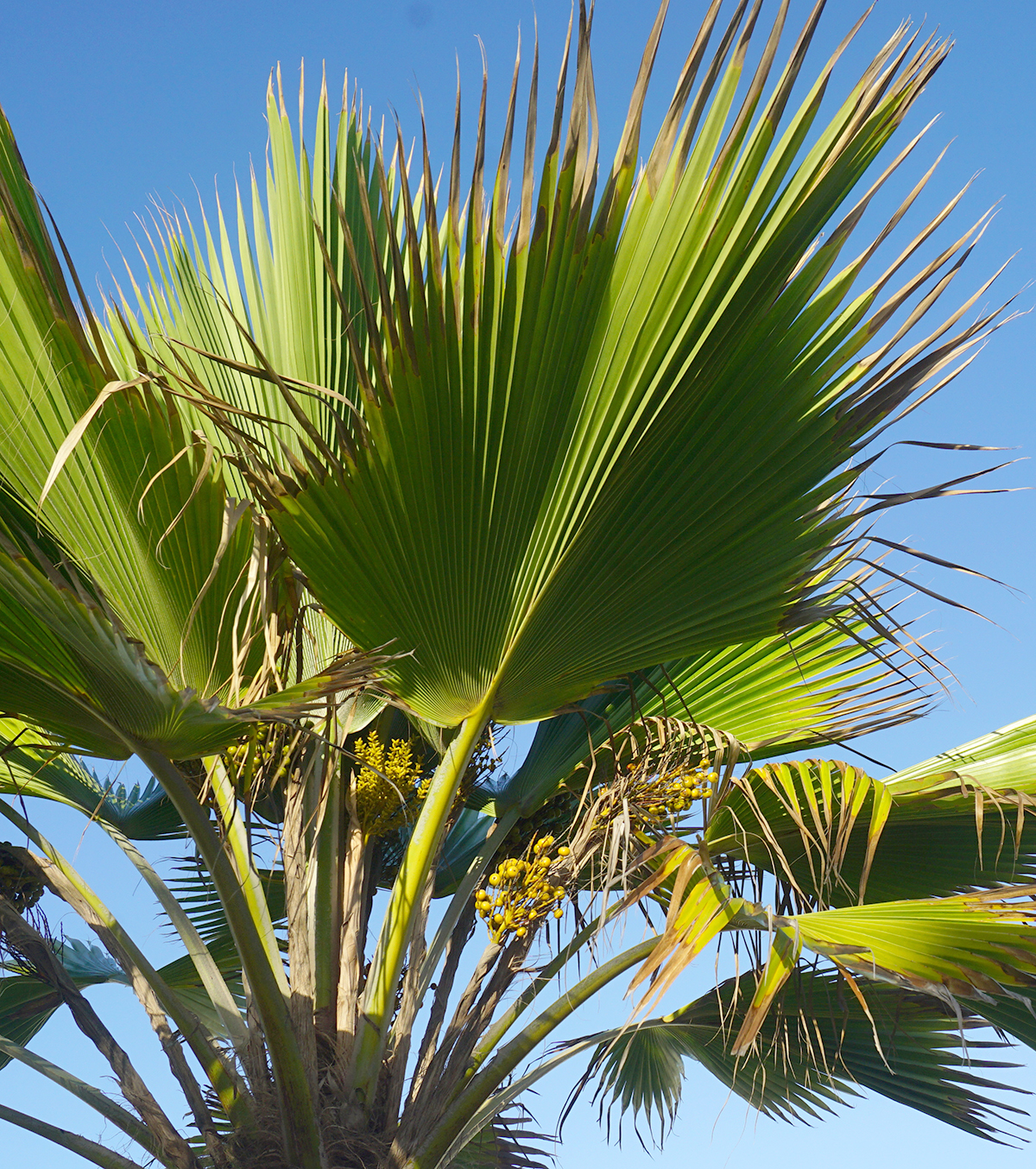
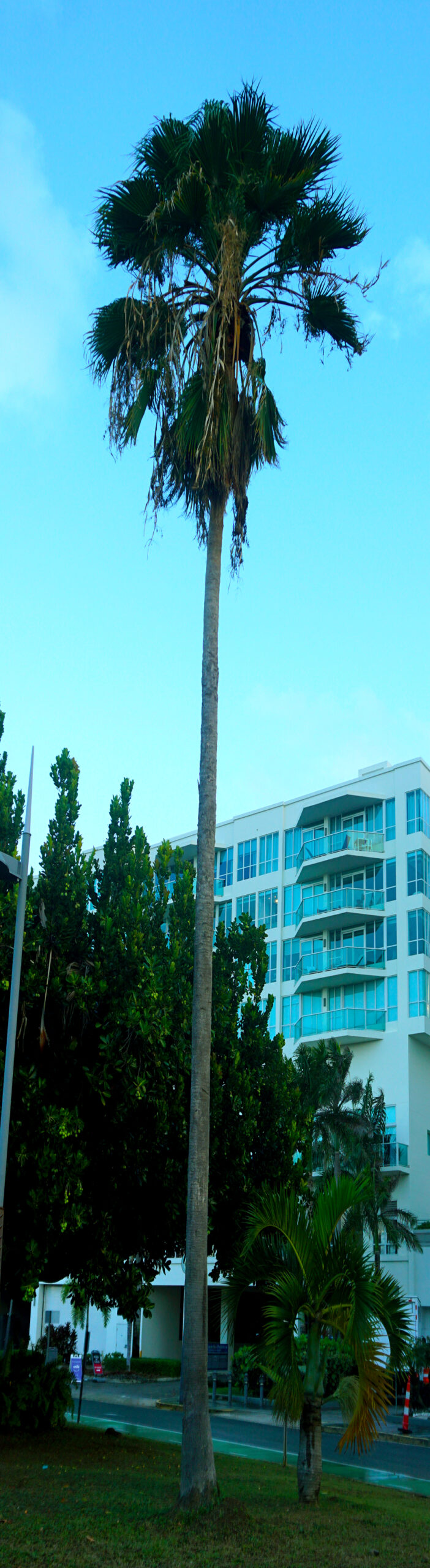
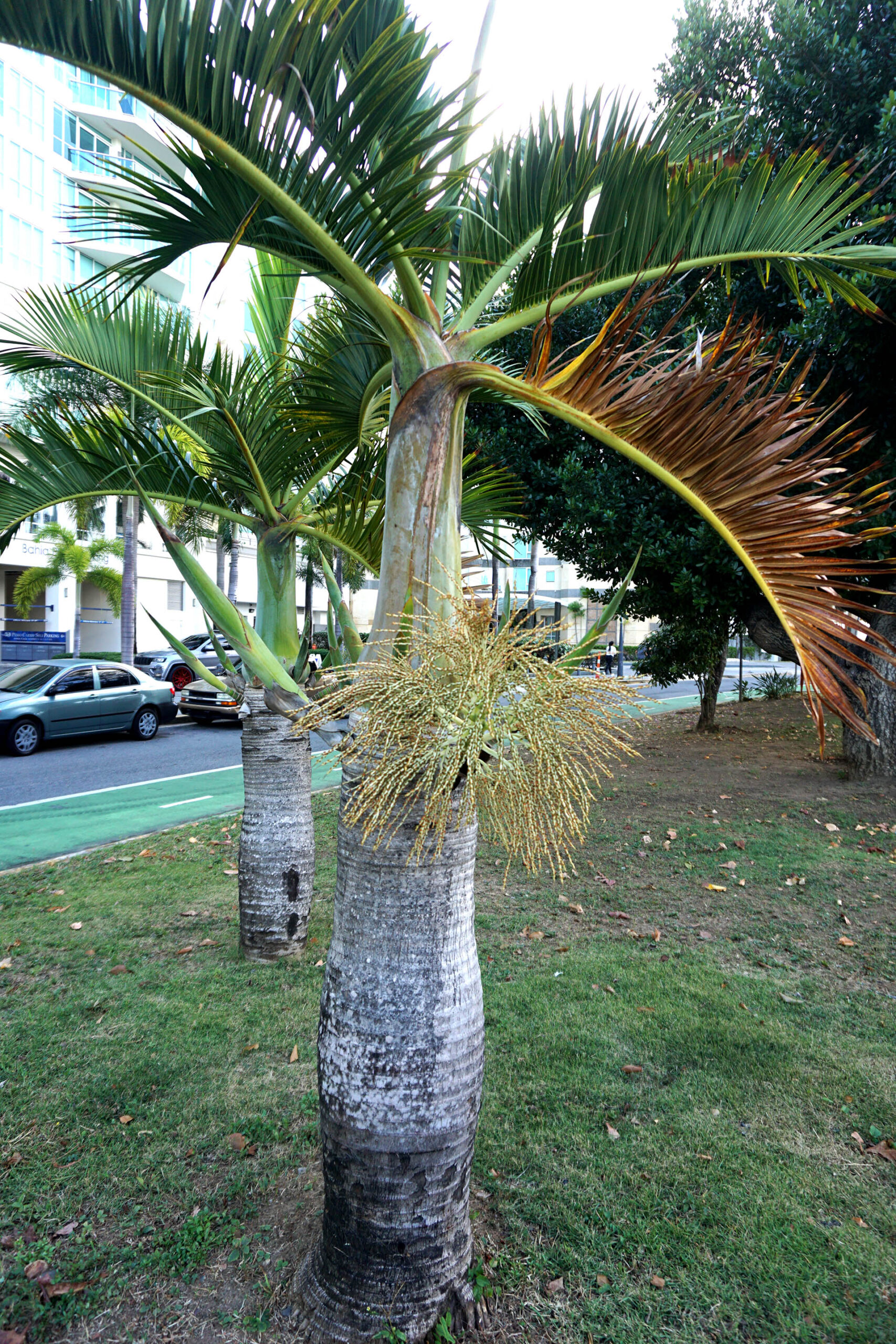
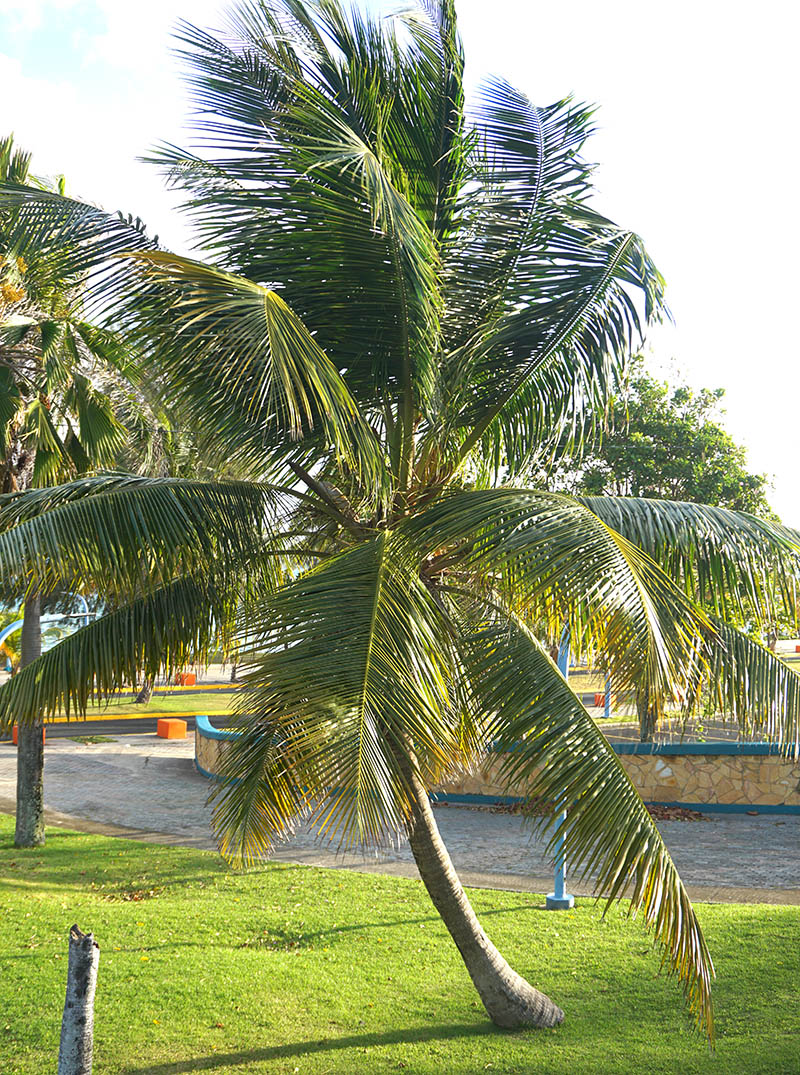
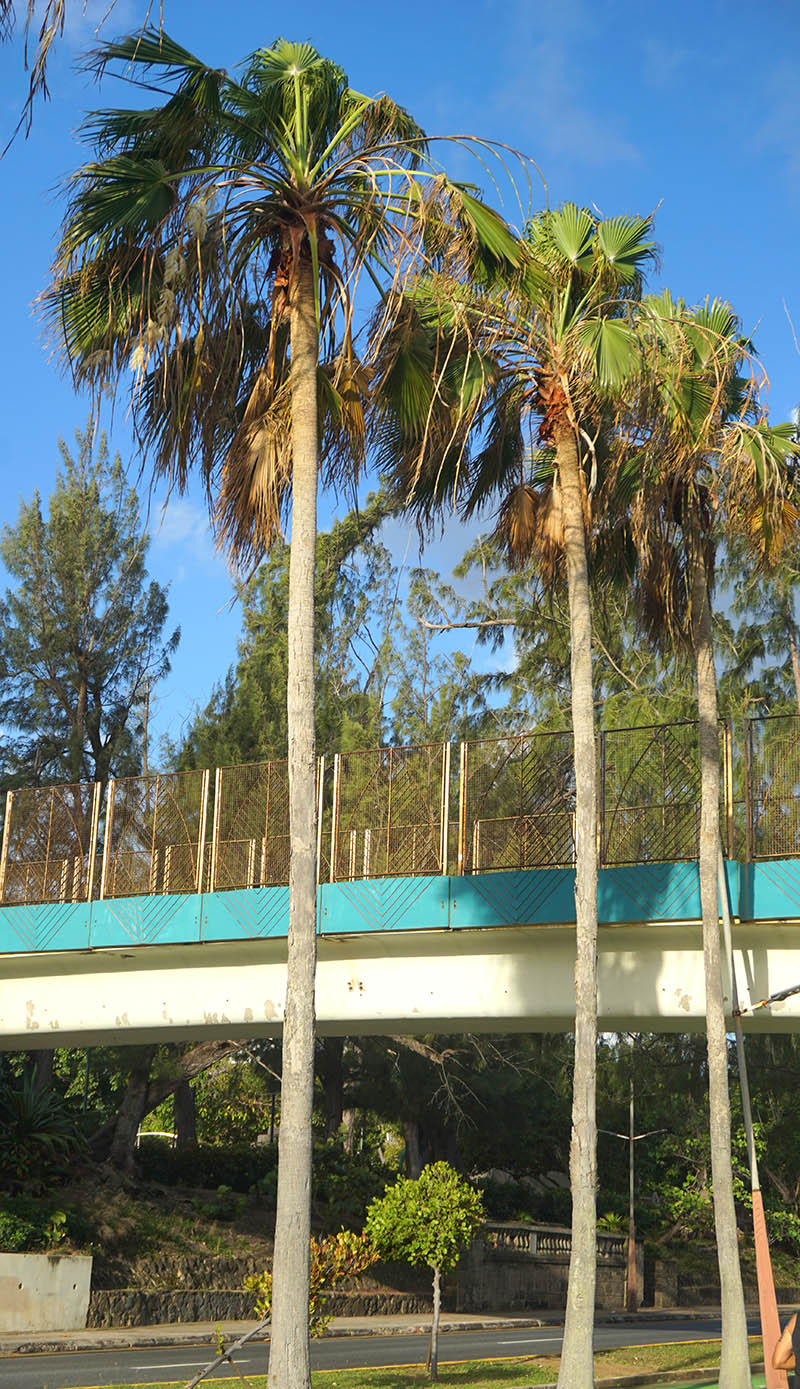
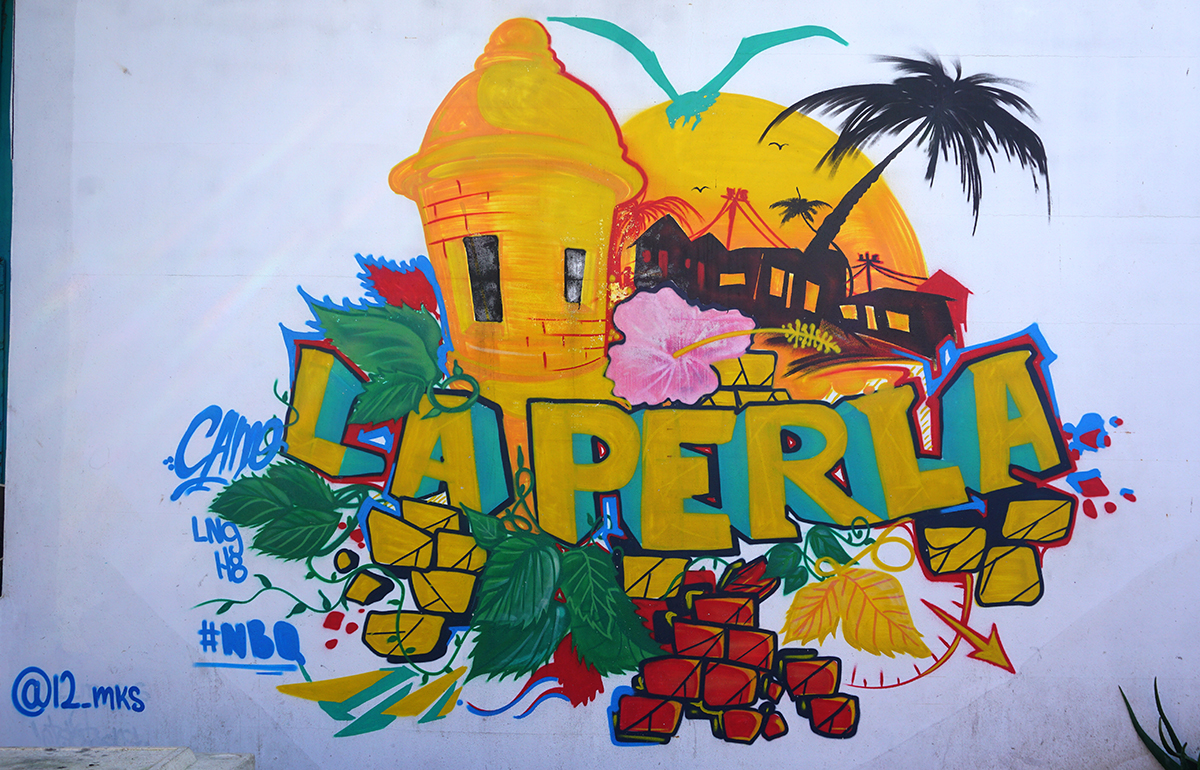
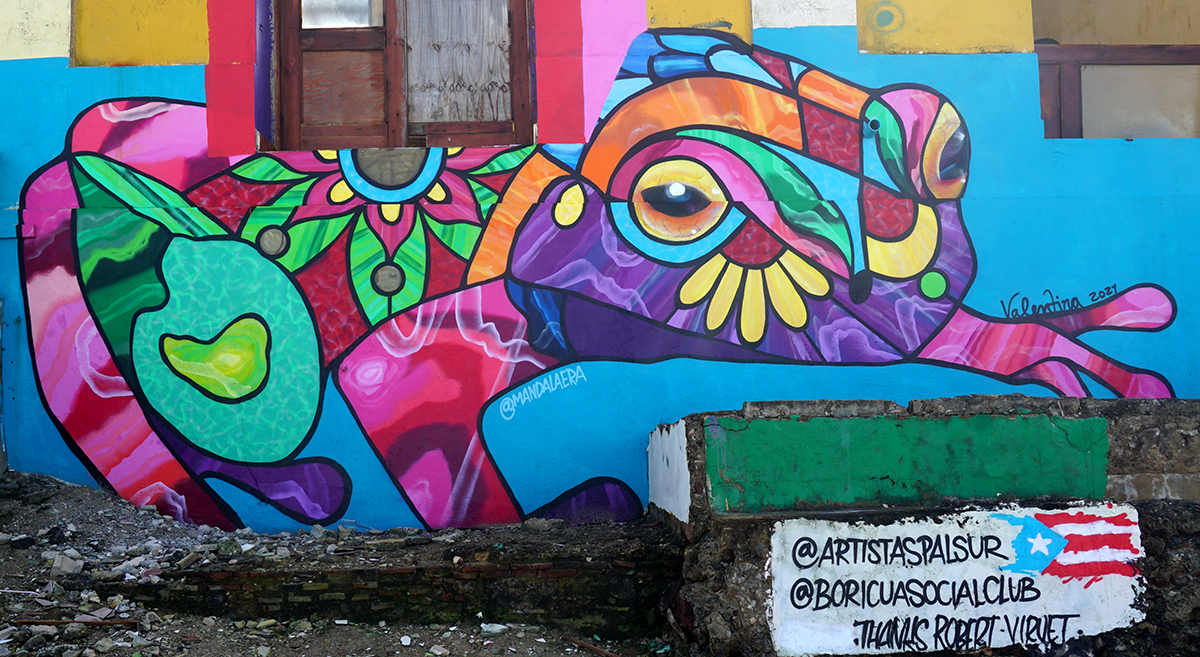
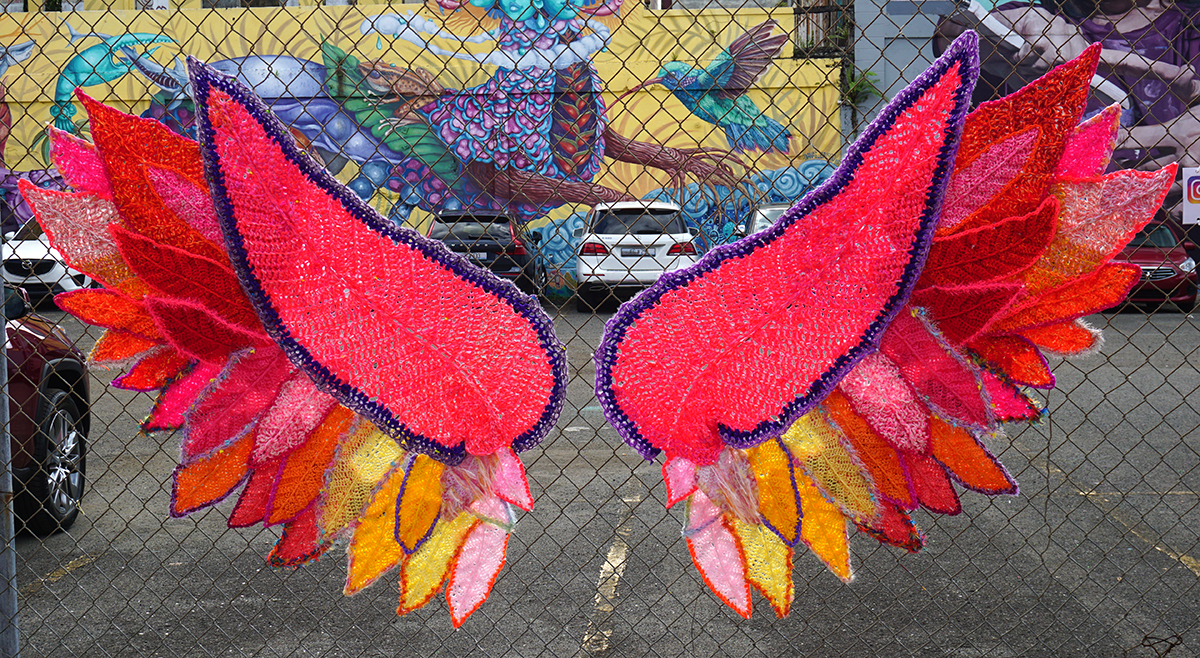
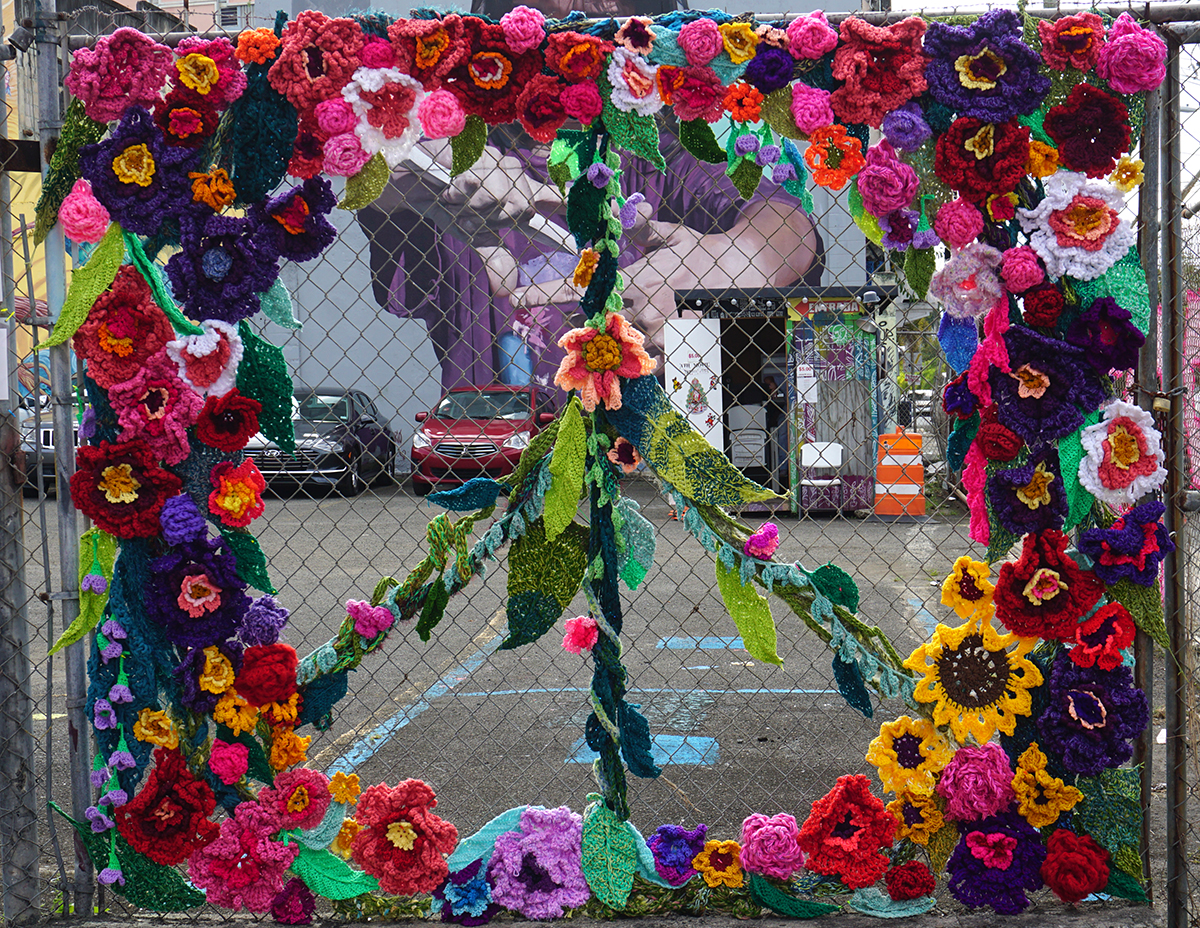
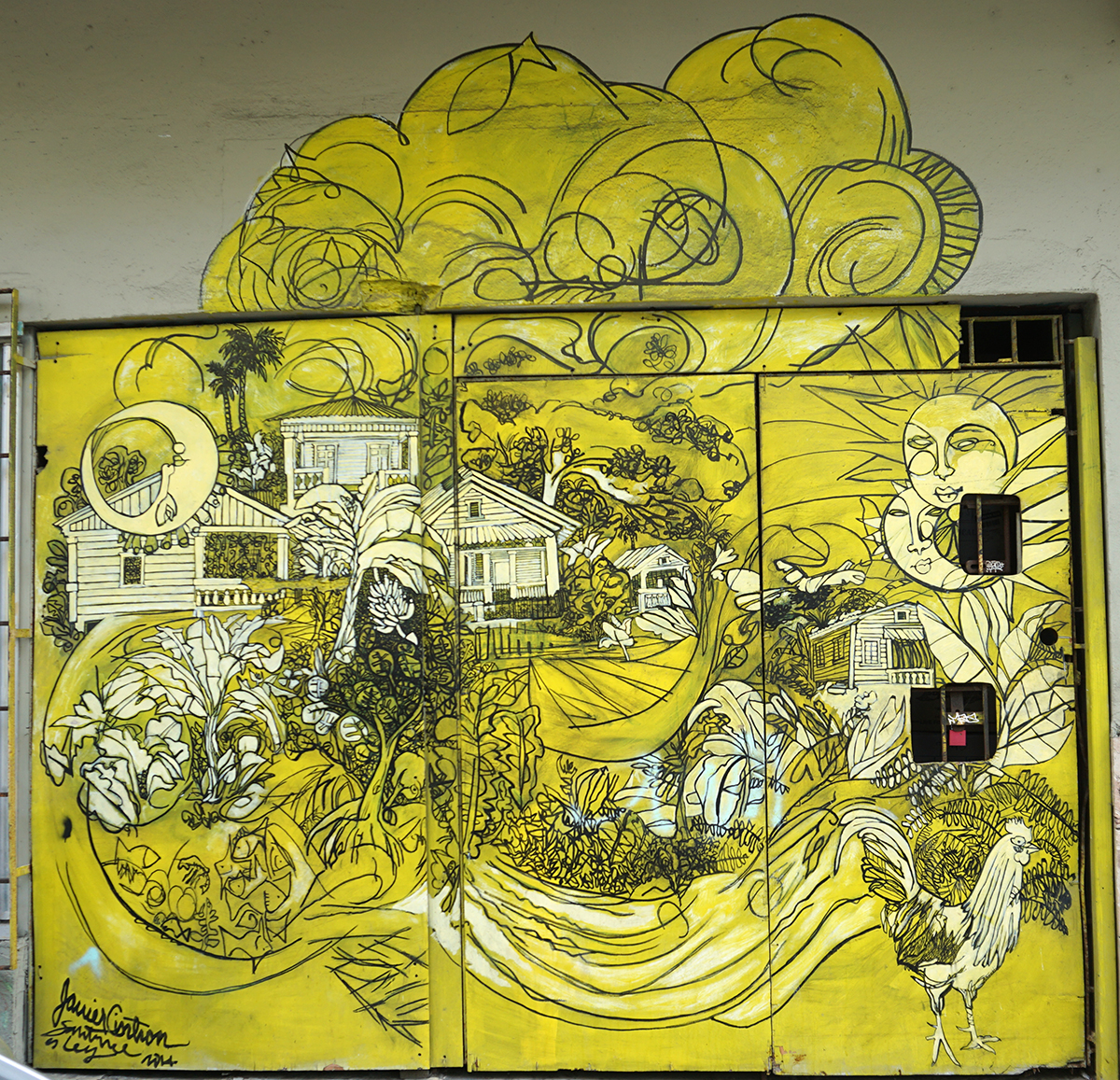
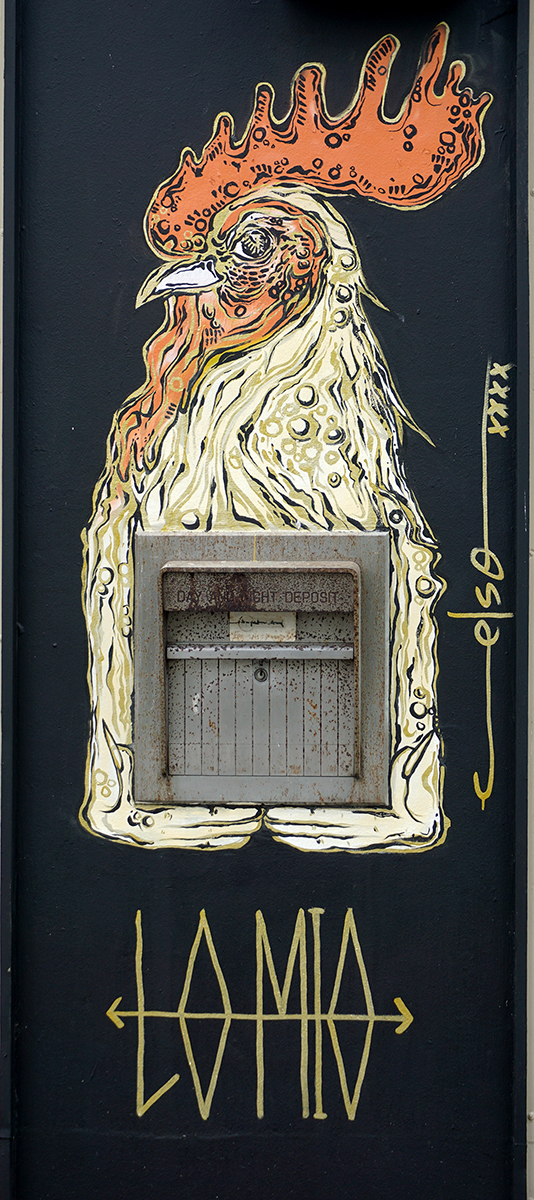
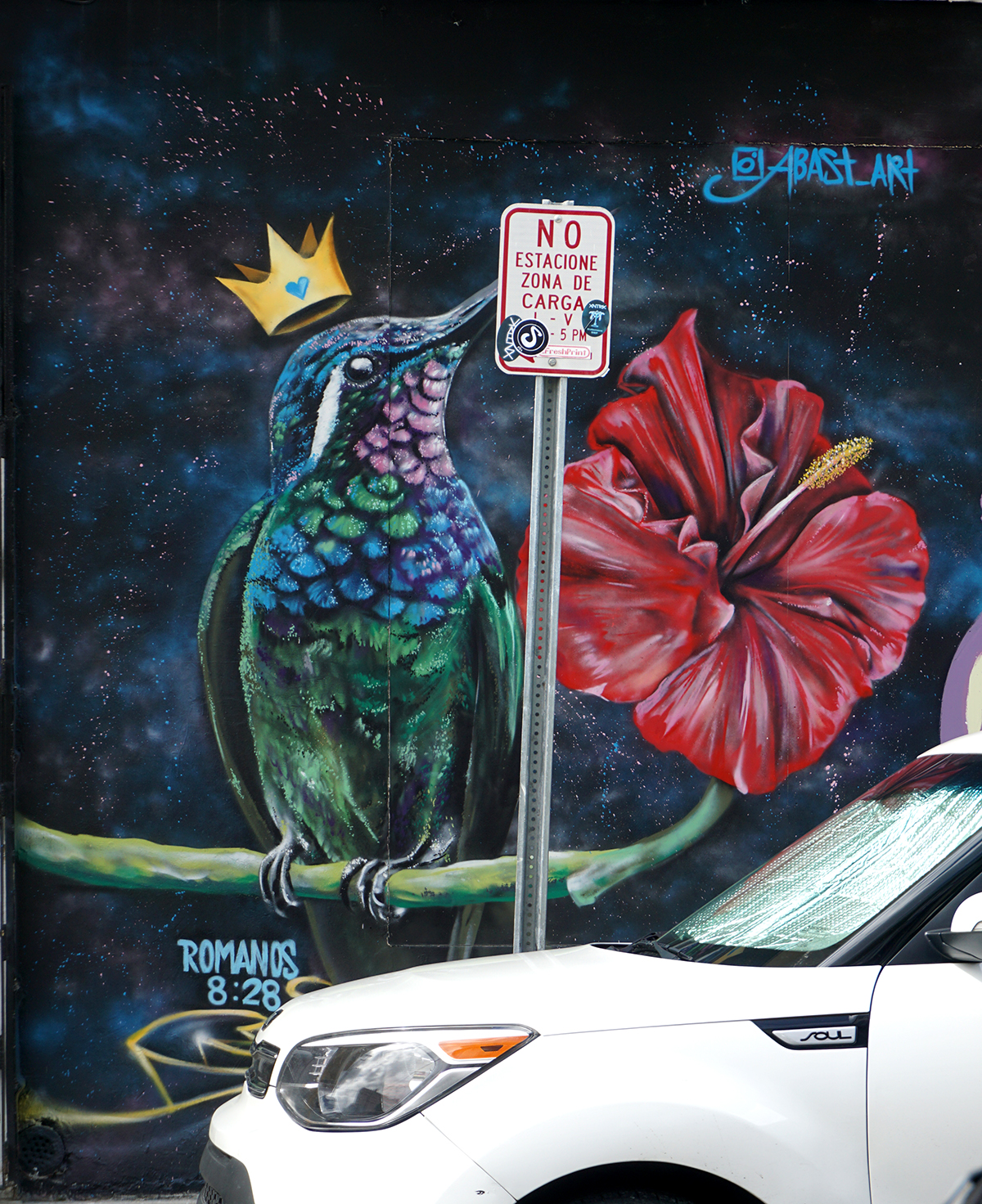
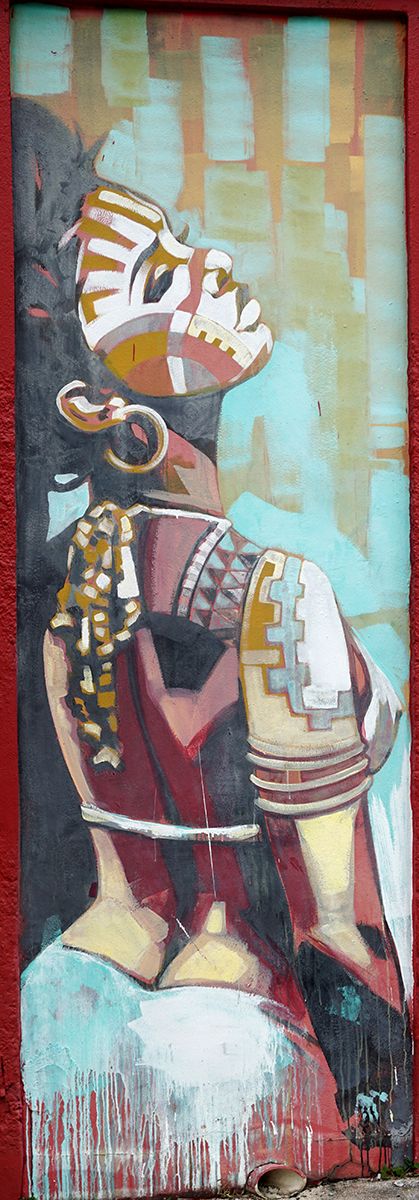
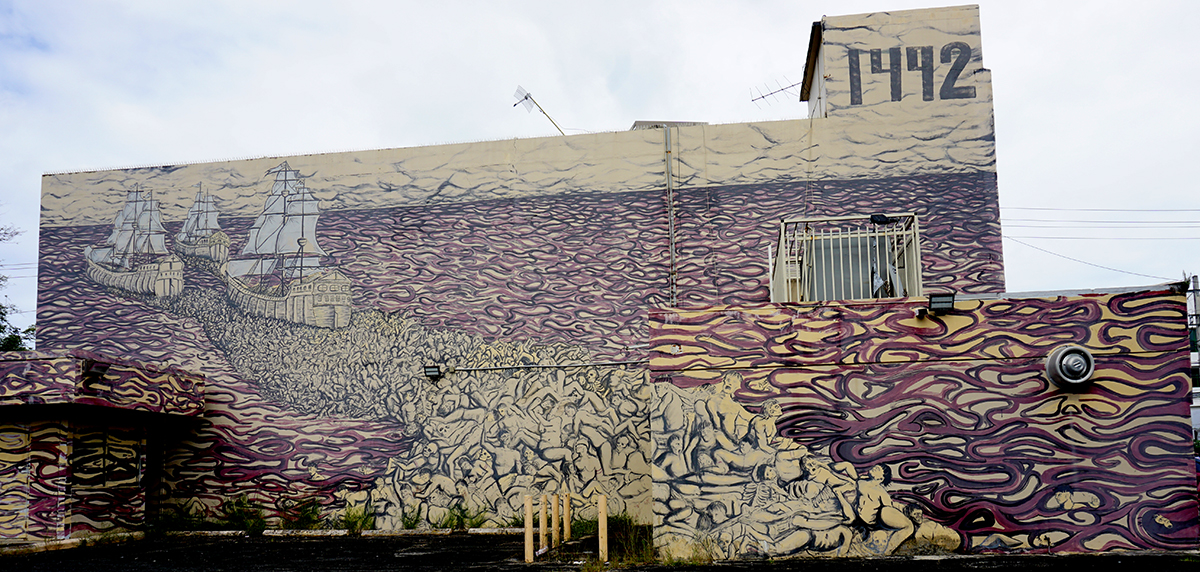
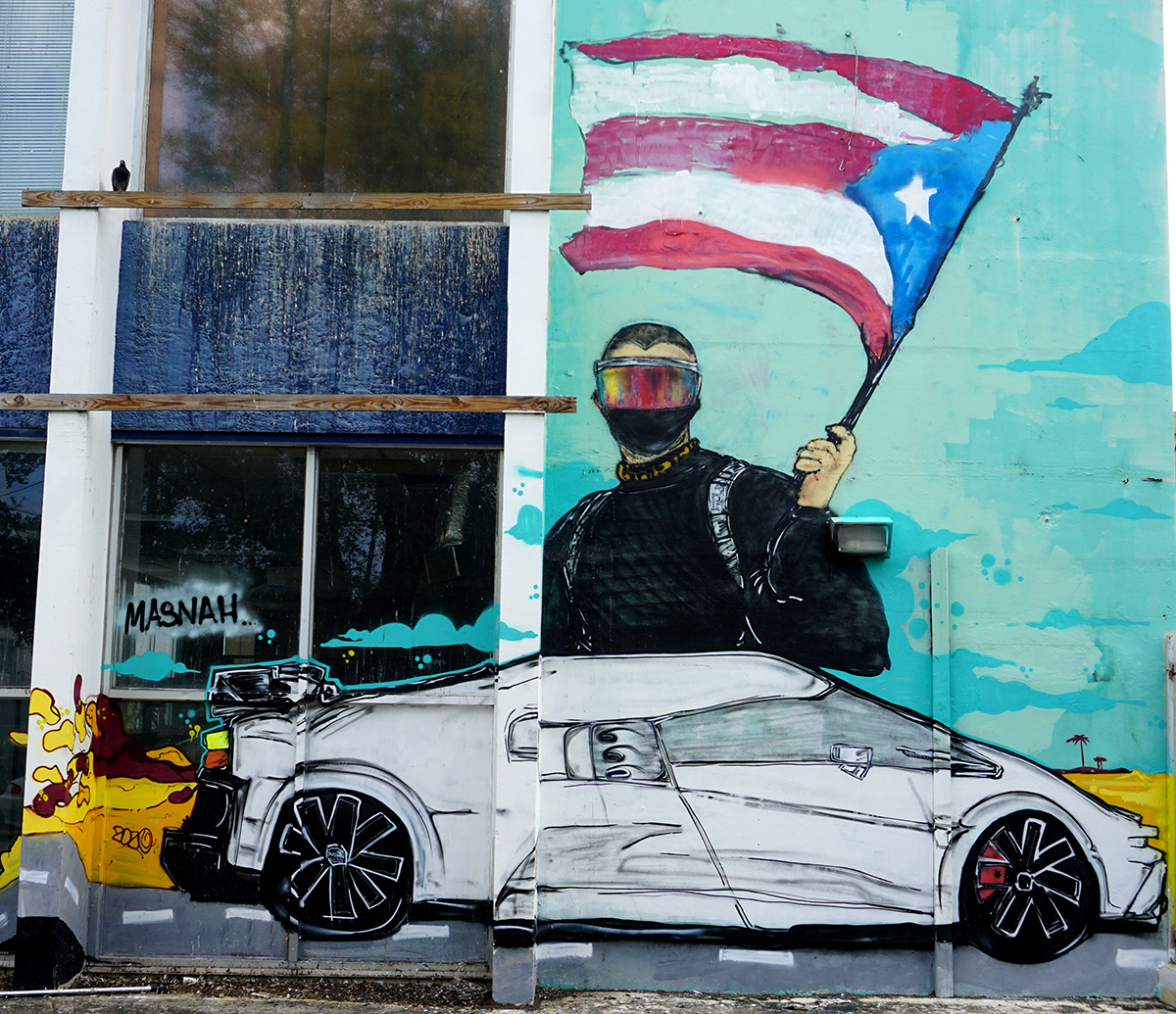
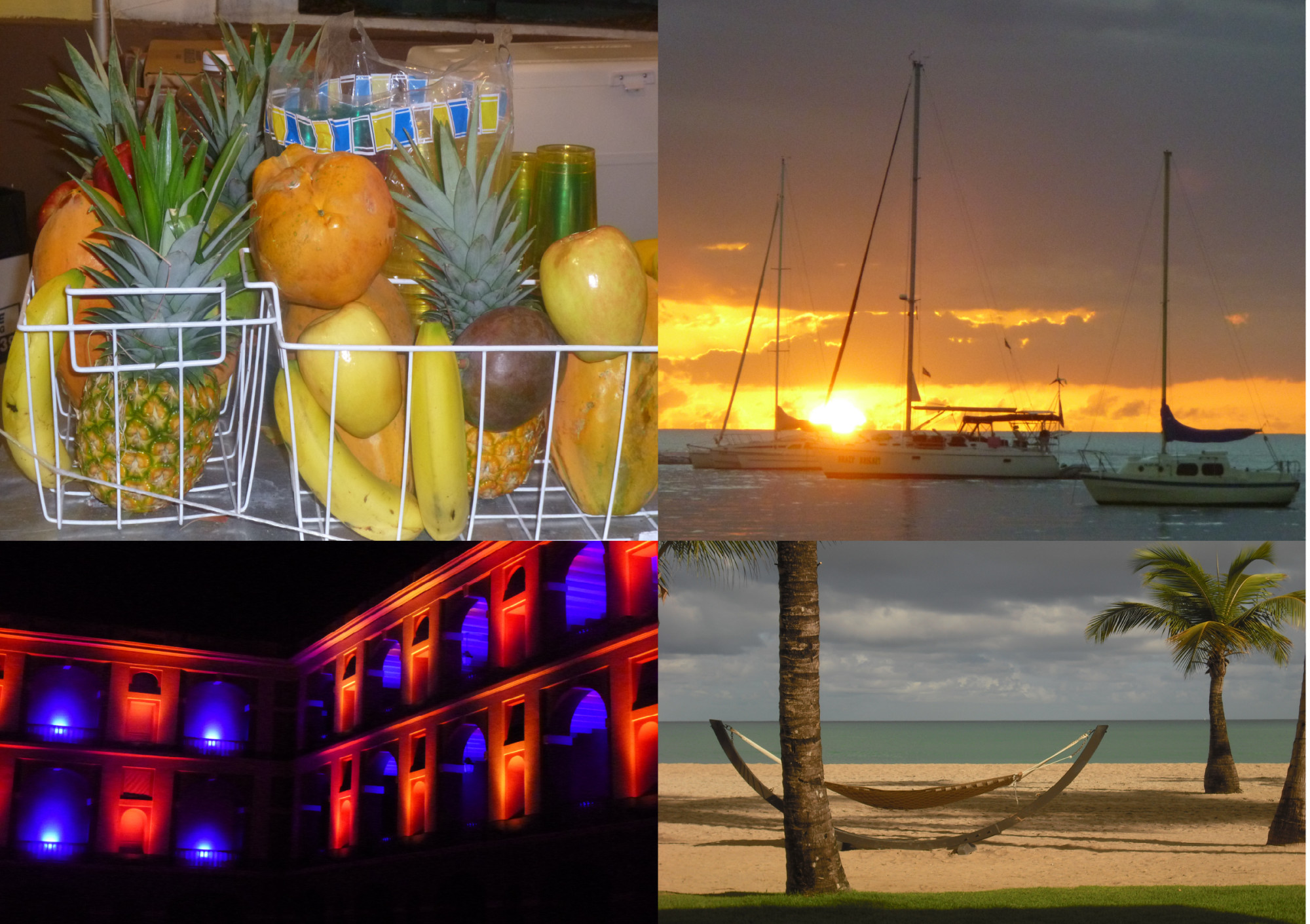
Perhaps I’m an optimist, but I see hopeful signs. I’ll mention some of them in this post. To break things up, I’ll include images that may or may not relate to the things I write about. I’ll leave that for you to figure out.

The Debt Crisis

The on-going debt crisis pretty much dominates the news. Briefly, President Obama signed the Puerto Rico Oversight, Management, and Economic Stability Act (PROMESA) into law in 2016. The law created the Financial Oversight and Management Board (FOMB) which, with its seven presidentially-appointed members, can designate an entity (territory or territorial financial instrument) as a “covered entity”. Once so designated, the “covered entity” is subject to court supervised negotiations or a court-ordered process similar to a bankruptcy.

This past fall, the FOMB filed a proposed eighth amended Commonwealth Plan of Adjustment that, it claimed, would reduce Puerto Rico’s debt to $7.4 billion, down for $33 billion. That plan included freezes, but not cuts, to public service retirement benefits. Cases were heard in a Title III Bankruptcy court under the gavel of federal judge Laura Taylor Swain.

Much of the news this past fall has been about the Plan of Adjustment.

October 20, 2021

The Puerto Rico Sales Tax Financing Corporation confirmed that it had deposited $472.6 million with Bank of New York (Mellon). The payment, current for the third straight year, was in accordance with the entity’s Third Amended Title III Plan of Adjustment as managed by the U. S, District Court for the District of Puerto Rico.

October 25, 2021

Miguel Romero Lugo, Mayor of San Juan, announced $26 million street repaving program.

October 26, 2021

Judge Laura Taylor Swain of the Southern District on New York threatened to dismiss Puerto Rico’s 5 -year bankruptcy case if the parties could not come to an agreement. She ordered U.S. Bankruptcy Judge Barbara House to lead mediation efforts.

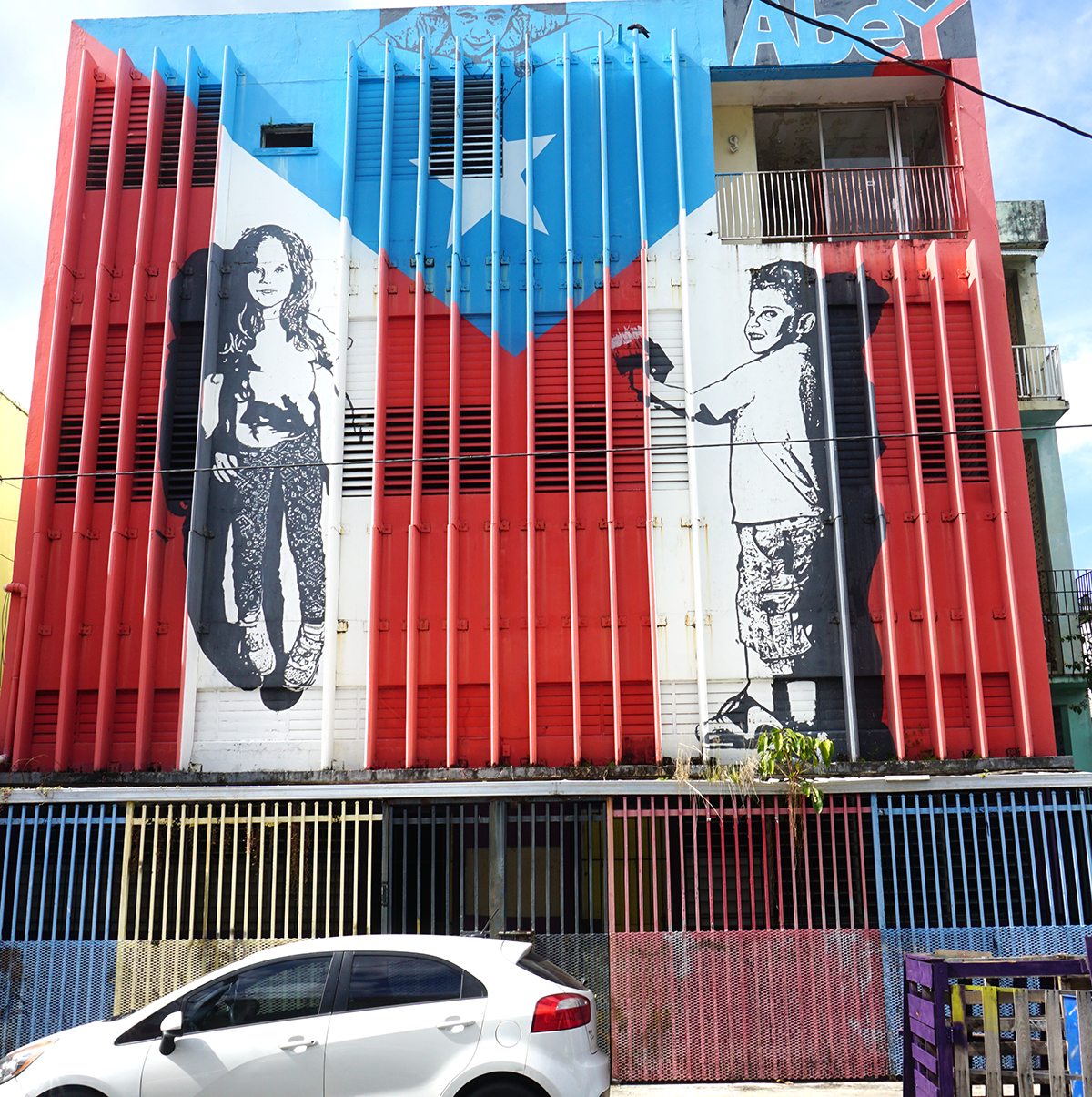
Street art just off Calle Loiza in Santurce.

October 29, 2021

A new health clinic opened on Vieques, one of Puerto Rico’s two off-shore islands. The 9,000 residents there now have access to a modern facility. The clinic is funded by the US government under the Public Service Health Act.

A view from Vieques’s south coast, looking west towards Puerto Rico.

November 2, 2021

A Puerto Rican senator introduced legislation to repeal Act 53-2021. That law, passed earlier this year, bans retiree pension cuts. The senator, Maria de Lourdes Santiago of the minority Puerto Rican Independence Party, claims Act 53 is merely an attempt to fool people.

November 3, 2021

Eight hundred people were arrested by Puerto Rican police working in conjunction with the Organized Crime Division of the Department of Justice. The anti-drug operation had lasted for over 45 days.

November 5, 2021

The FOMB filed a proposed eighth amended Commonwealth Plan of Adjustment (POA). In accordance with Act 53, the plan does not include pension cuts for active or retired government employees. However, as noted Victor Bonilla Sanchez, president of the Puerto Rico Teachers Association, the plan does not preclude pension freezes.

November 8, 2021

Judge Swain initiated confirmation hearings for the POA. The complex instrument includes compensation for creditors, a strategy to build reserves for pension funds, and contingencies if the Puerto Rican economy performs better than anticipated. If Puerto Rico has to borrow funds, they will be subject to the laws of New York, the court’s location.

Christmas lights along the base of the wall, Paseo de Princessa, Old San Juan.

November 9, 2021

The University of Puerto Rico received a grant worth nearly $1 million to train students in agricultural sustainability and resilience.

November 10, 2021

The U. S Supreme Court heard oral arguments in U.S. vs. Vaello-Madero, The plaintiff was a resident of New York City and while there collected SSI benefits. He later moved back to Puerto Rico. The U.S. sued to recover more than $20,000 in benefits he received while in Puerto Rico. SSI benefits are available to residents of the 50 states, Washington, D.C. and the Northern Mariana Islands, but not to residents of Puerto Rico, the U.S. Virgin Islands, or Guam. In February 2019, the First Circuit affirmed a lower court decision that excluding U.S. citizens from SSI was unconstitutional. The U.S. appealed that decision to the Supreme Court.

Perhaps he is dreaming of SSI benefits and not plantains.

November 23, 2021

In their closing arguments, the FOMB claimed again that the proposed Plan Of Adjustment would not cut public pensions.

November 24, 2001

Judge Swain took the issue of confirming the POA under advisement. This was after hearing arguments since November 8. The case is the largest bankruptcy ever in the history of municipal markets.

Pinones, east of San Juan.

November 25, 2021

Judge Swain heard arguments by the FOMB as to how to restructure the bond debts of the Puerto Rico Infrastructure Financing Authority ($1.9 billion) and the Convention Center District Authority ($383 million). The restructuring is under Title VI of PROMESA which means it is a mediated and not court based process.

December 2, 2021

Puerto Rico Secretary of State Omar Marrero Diaz announced he will lead a trade mission to the Dominican Republic.

December 3, 2021

Minnesota health officials confirmed the second covid case with the omicron variant in the U.S.

Wall art in Vieques.

December 9, 2021

Governor Pierluisi announced that Unit 6 at the Costa Sur power plant will return to service by December 30. A blade in the turbine failed last August. The unit had to be shipped to New York-based Mechanical Dynamics and Analysis for repairs, which cost $2.8 million.. When Unit 6, rated at 400 megawatts capacity, comes back on line, less efficient units in San Juan and Catano can be shut down.

December 14, 2021

San Juan Mayor Miguel Romero Lugo announced a three year, $209.5 million program to improve the city’s infrastructure. The work will include improvements to parks, bus stations and stops, and the connector walkway between Miramar and Condado. The funding is from various federal grant programs.

Lights in Parc Luis Munoz Rivera, across from our building. They were on for the first time since Hurricane Maria.

December 15, 2021

Judge Swain told the FOMB that their proposed Plan of Adjustment was “problematic” and needed modifications to address her concerns. The FOMB had wanted to displace various Puerto Rico laws, mostly having to do with public sector retirement benefits, to execute the POA. Judge Swain found that matter “problematic”.

Judge Laura Taylor Swain

December 17, 2021

Jobs in the tourism sector rebounded to near pre-pandemic levels, as indicated by October job statistics. Data from the U.S. Bureau of Labor Statistics showed 79,200 jobs in that sector, slightly below the 80,500 jobs pre-pandemic.

December 20, 2021

The U.S. Senate passed a bipartisan bill to prevent conflicts of interest by persons arguing PROMEAS bankruptcy cases under Title III. Previously, bankruptcy advisors and consultants did not have to make disclosures that may have shown conflicts of interest.

A new Executive Order requires proof of vaccination to attend mass events. The Order was issued in response to rapidly rising number of covid infections caused by the omicron variant.

Night lights, San Juan Harbor.

December 21, 2021

The New Years Eve Party is Old San Juan was cancelled, as were live performances scheduled for the San Sebastian Festival, scheduled for the third weekend in January. The artisan shows at the Festival will be held as scheduled.

December 22, 2021

The FOMB sued Governor Pedro Pierluisi Urrutia and various government agencies. The FOMB claims certain Puerto Rico laws, mostly dealing with retirement benefits, are unsustainable and “will reinstate the fiscal mismanagement that existed before PROMESA . . .”

Meanwhile, the Governor announced that retired police officers can participate, for free, in the island’s Vital health insurance plan, starting January 1, 2022

December 24, 2021

The FOMB called Governor plan for retired police officers “fiscally irresponsible.”

Wall art along Avenida Juan Ponce de Leon, Santurce, San Juan.

December 27, 2021

A law suit between several unions and the FOMB and the Puerto Rico government will be heard by the U.S. Supreme Court. In essence, the plaintiffs argue they suffered harm because the FOMB preempts local laws.

December 29, 2021

The government and the FOMB reached an agreement on retirement benefits. The government will repeal certain laws guaranteeing such benefits. In return, the FOMB agreed to, within 60 days, provide enhanced retirement benefits for police officers, and, within 120 days, for teachers, all consistent with the proposed Plan of Adjustment.

December 30, 2021

All face-to-face activities at the Juana Diaz Three Kings Festival, scheduled for January 6, 2022, are cancelled.

January 5, 2022

The San Sebastian Festival, scheduled for the third weekend in January, was cancelled.

A parade group generating thoughts of cold beer in an earlier San Sebastian Festival.

January 7, 2022

Judge Swain dismissed a lawsuit brought by six Puerto Rican credit unions against the government. The plaintiffs argued they were coerced into buying government bonds even though the government knew the bonds could not be paid back.

Another view of Pinones, just east of San Juan.

January 13, 2022

The Federal Aviation Agency announced grants worth $8 million for capital improvements at the island’s airports. The funding is part of the Biden administration’s infrastructure package.

January 14, 2022

Governor Pierluisi Urrutia announced a $3.8 million grant to upgrade Calle Fortalezza, a main street in Old San Juan.

January 19, 2022

Judge Swain entered an order to implement the Plan of Adjustment. The order ends five years of bankruptcy, reduces the debt burden of the central government from $33 billion to about $7 billion, and will restructure some $50 billion in unfunded pension debt.

double rainbow over the Port of San Juan.

January 20, 2022

The U. S. Army Corps of Engineers announced that it had allocated $163 million to restore the Martin Pena channel. The channel connects the San Juan Bay with the San Jose Lagoon, near the airport. Once a broad channel, it has filled in with sediment and debris to the extent it is less then a meter wide in some areas.

This walkway leads along a channel from Hato Rey into San Juan Harbor. The Martin Pena Channel continues from Hato Rey into the San Jose Lagoon. The walkway has been closed since Hurricane Maria.

January 21, 2022

The visitor center at the El Yungue National Forest reopened. The center, rebuilt with $20 million allocated to the U.S. Forest Service, had been closed since Hurricane Maria.

A waterfall in the El Yunque rain forest.
Vegetation in the El Yunque rain forest.

A group of investors bought the Normandie Hotel, located near the Caribe Hilton on Isletta de San Juan. The investors promise to return the hotel to its former glory.

The Hotel Normandie was one of the premier hotels in San Juan in the 1920’s and 30’s.

January 22, 2022

King Felipe VI of Spain arrived for a two day state visit.

January 23, 2022

FEMA approved $554 million to rebuild and repair damages in 275 public housing complexes. The damages were caused by Hurricane Maria which struck the island in September 2017.

January 24, 2022

The FOMB held a public board meeting during which it officially certified the Plan of Adjustment. During their announcement, the Board revealed they estimated the PR government won’t face a budget deficit until 2048 both because of an improving economy and federal assistance.

February 4, 2022

Architect Fernando Pabon Rico, in testimony before a Puerto Rico Senate committee, told senators the sea level would rise by about 10 feet by the end of the century. This will endanger shore line homes and businesses as well as freshwater aquifers, the latter from salt water intrusion.

February 7, 2022

A stationary low pressure system dumped record rainfall on the island over the weekend. The San Juan area received between six and ten inches of rain. Low lying areas experienced flash floods; no loss of life was reported.

Storm clouds approaching Old San Juan from the east.

February 9, 2022

The governor issued an executive ordering declaring a state of emergency in 15 towns hit by record rains. Most of the towns were in the greater San Juan area.

February 10, 2022

Teachers from around the island walked off their jobs and demonstrated in front of the Capitol. They demanded salary justice and the opportunity for a dignified retirement.

Teachers and other public servants preparing to march to the Capitol.

February 11, 2022

FEMA announced an allocation of $1.9 million for repairs to Family Service Centers in Hato Rey, a San Juan neighborhood and Arecibo. The sites suffered damage during Hurricane Maria.

February 14, 2022

San Juan Mayor Miguel Romero Lugo announced a $63 million program to improve parks and public spaces in San Juan. The efforts will include repair of baseball fields and recreational areas, fence and sidewalk repairs, lighting improvements, and repainting as necessary.

February 17, 2022

Tourism data for January showed that hotel reservations for the upcoming high travel season were 17% higher than the pre-covid January 2020 figures. In addition, current short term rentals were up 329% compared to the pre-covid figures. Discover Puerto Rico CEO Brad Dean said the figures showed Puerto Rico to be a resilient travel destination.

February 22, 2022

A 12 year old boy drowned after being swept to sea by a rip tide. This occurred on the beach along Condado, the main tourist area is San Juan.

Condado Beach, San Juan

February 24, 2022

The FOMB approved the updated fiscal plan put forth by the Puerto Rico Highway Authority. The plan calls for toll increases of 8.3% a year. In addition, the Urban Train will be transferred to another entity. The FOMB said the plan will stabilize the authority’s finances and will allow it to exit from bankruptcy.

February 25, 2022

The governor said he will do what he can to mitigate or cancel the toll increases in the FOMB plan announced yesterday.

President Biden announced Puerto Rico will get $900 million in federal aid for highway and bridge repair. The funds, from the administration’s infrastructure plan, will be spread over five years.

Conclusions

So there you have a brief description of some of the news that we’ve read about while here this winter. As you can see, federal monies are flowing to the island, the economy has rebounded, and a debt management plan is in effect. While no one is entirely happy with the plan, most agree it is a better alternative than the others, i.e., unmanaged bankruptcy.

Notes and Sources

We subscribe to the San Juan Star, the English language newspaper. I used that source for my items.

With the exception of the image of Judge Swain, all the images are mine. I edit them with Adobe Lightroom and/or Photoshop. I downloaded the image of Judge Swain from the web.

Street Art: New Finds, Goodbyes

Early February 2022

Introduction

I enjoy finding, photographing and sharing images of street art I find. In this post, I’ll share some new findings, revisit some not so new works, and say good bye to a few more. I’ll arrange the images more or less by location this time.

Calle Loiza

The Calle Loiza neighborhood is undergoing gentrification, changing from a gritty urban neighborhood to one with boutique bars, coffee shops, upscale restaurants. It is an ongoing process, slowed by Hurricane Maria and its aftermath, and then the covid pandemic. Still, many of the start up businesses have survived and the process, while slowed, is still happening.

And the area is rich with street art. Here are a few examples.

Two by theamazingske

Street art just off of Calle Loiza, in the Santurce neighborhood of San Juan.

The work above dates from 2021, so it is new to me as of this year. It replaced another work, shown next.

This example, once found on the same side street as the artwork above, has been painted over.

Compare the two works above. Both are signed by the same artist, theamazingske. I looked the name up on Instagram. The artist is a woman, and has exhibited works locally and internationally. If you have access to Instagram, see some of her work at @theamazingske. While you’re on Instagram, check out some of my images at @jmilohas. By the way, I notice common elements between the two works. Do you?

Billiards

Another example of street art along Calle Loiza, Santurce, San Juan.

I really like the work above. It has aided me with my Spanish vocabulary. I now know that billar means billiards. I won’t soon forget that. And it is nice to have a strong visual image to better understand the idiomatic expression to be behind the eight ball. Again, go to Instagram and see other works by this artist at @Kau.Tvrs.

Build Your Dream

Another example of street art, Calle Loiza, Santurce, San Juan.

I wasn’t able to identify the artist for the example above. I do like the wide ranging palette and the upbeat message.

Plantain?

Someone dreaming of a plantain.

The work above, just off Calle Loiza, is similar to one I had seen earlier, just off Avenida Juan Ponce de Leon in Santurce. I think it is in my post about eyes in street art. Check it out here.

Three on Screens

A rooster protecting a business on Calle Loiza, Santurce, San Juan.

The colorful rooster is on a screen that opens and closes as the business it protects does. These screens are often a good place to find street art. Of course, you have to be there when the business is closed and the shutter is down. Here in San Juan, that is less of a problem than you might think.

Here are two more examples of street art on screens.

Street art in Condado, San Juan.

I found the example above in Condado. It has since disappeared.

Pineapple protecting a business on Avenida de Diego.

The pineapple shown above is on Avenida de Deigo, near Avenida Juan Ponce de Leon. The business it protects has changed; the pineapple remains.

Calle San Agustin

Calle San Agustin is a side street that parallels the main routes in and out of Old San Juan. I sometimes walk along it as I go to and from the old city. While not rich in wall art, it does have some interesting examples.

A face watching over Calle San Agustin, Puerta De Tierra, San Juan.

I found the disembodied face above along Calle San Agustin, near our apartment building.

Street art, Calle San Agustin, Puerta de Tierra, San Juan.

I discovered this mural along Calle San Agustin. The Spanish translates roughly as The Union Makes the Force.

Condado

Condado, the main beachfront tourist area in San Juan, is not rich in street art. However, I have found an occasional example.

Street art, Condado, San Juan.

This is one of the rare examples of street art in Condado. That it expresses a clear political message might well be the reason it is there.

Parc Escambron

Parc Escambron is a public park in the Puerta de Tierra section of San Juan. It has a fine beach, protected by off shore reefs. It is also home to an underwater park, in a section of the ocean protected by Punta Escambron and the remnants of Spanish fortifications.

Two fantastical animals.

The two examples above are on retaining walls near the abandoned Hotel Normandie. They promote the underwater marine park in protected waters in Parc Escambron.

Goodbyes

Street art is anything but permanent. I’ll now show a few examples no longer exist – painted over, on walls torn down, whatever. I won’t comment on them. They speak for themselves.

Conclusion

There you have it – more examples of street art. Stay tuned – plenty more where these came from.

Notes and Sources

All the images are mine. I use a Sony digital camera and edit the images with Adobe Lightroom and/or Photoshop. These images are minimally edited. I’ve cropped them when necessary and adjusted levels and sometime brightness and contrast.

The R/V Atlantis

Late December 2021

Introduction

The research vessel Atlantis (R/V Atlantis) was in port for a few days last month. She is an interesting ship and is a current example of a long line of oceanographic research vessels. The United States Navy owns the Atlantis, and she is known officially as the RV Atlantis (AGOR – 25). She is operated by the Woods Hole Oceanographic Institution for the benefit of the oceanographic commuity.

The R/V Atlantis in San Juan, November 2021.

The Atlantis has three sister ships: the R/V Thomas G Thompson, operated by the University of Washington, and the R/V Roger Revelle, by the Scripps Institution of Oceanography. Only the Atlantis is equipped to operate the deep submersible Alvin. The third sister, the NOASS Ronald H. Brown, is operated by the National Oceanographic and Atmospheric Administration.

The deep submersible Alvin preparing to launch from the R/V Atlantis.

It was an unexpected port call. The Alvin suffered some damage during its 5,075th dive, to a record depth of 17, 513 ft. She came into port to allow the submersible to be evaluated.

By the way, the deepest part of the Atlantic is a bit northeast of San Juan, in the so called Puerto Rico Trench. The deepest part of that feature, the Milwaukee deep, has a depth of 5.373 miles (28,370 ft.)

Details of Current Atlantis

The Atlantis was launched in 1997 and modified to support the Alvin that same year. She has a length of 274 ft, a beam of 52.5 ft, and draws 19 ft. The Atlantis has a crew of 22 and room for a science party of 34 (without Alvin) and 24 (with Alvin). She is equipped with lab spaces, undersea mapping facilities, and precision navigation technologies. The lab spaces include a variery of wet chemcal, computer, and electronic facilities.

The Atlantis performs missions for both the US Navy and research funcded by the National Science Foundation. In the last year or so, Atlantis completed 13 projects funded by the navy, and 14 by the NSF. There are 32 pending NSF projects. The NSF projects included studying and mapping undersea volcanoes in the Pacific Ocean.

The First Atlantis

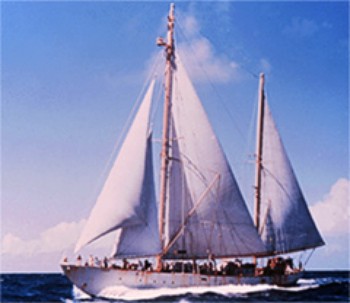
The sailboat R/V Atlantis served the Woods Hole Oceanographic Institution from 1931 to 1996. She was built specifically to support research in marine biology and geology and physical oceanpgraphy. The design of the 460 ton ketch favored stability over a speed. She carried a crew of 17 with room for five scientists. She sailed over 700,000 miles while under the control of the WHOI.

The first R/V Atlantis.

In 1966, she was sold to Argentina. After a refurbishment, she was renamed El Austral and, crewed by the Argentine navy, did oceanogrphic research for CONICET, the Argentine equivalent of the NSF. In 1996, she was transferred to civilian status, refurbished again, and renamed Dr. Bernardo A. Houssay. To date, she has sailed over 1,300,000 miles in support of marine research and is the longest serving research vessel.

She is the namesake for both the current R/V Atlantis, and also the space shuttle Atlantis.

Atlantis II

Built in 1962, the R/V Atlantis II served the WHOI until her retirement in 1996. She supported the Alvins expeditions, including, most famously, Dr. Robert Ballard’s exploration of the HMS Titanic.

The Atlantis II – Alvin combination had other adventures. In 1966, the Alvin found a 1.45 magaton hydrogen bomb. It was at a depth of 2,990 ft and subsequently revovered. A year later, the Alvin, at a depth of 2,000 ft, was attacked by a swordfish which became entangled in the submersible’s skin. After an emergency surface, the crew untangled the fish and ate it for dinner. That happened on July 6, 1967.

The R/V Atlantis II in 2007.

The R/V Atlantis II was retired in July, 1996. After sitting idle for a while, she was sold to an advenure company. She is apparently still on the market. Follw this link to see a yacht broker’s description of her. Maybe you can make an offer. If successful, bring me along on one of your trips.

Conclusion

I have a suggstion for the US Navy and the WHOI. I suggest they do a survey of the South China Sea and produce a detailed map the the ocean bottom there. Why? Beacuse last October the USS Connecticut, a nuclear-powered Seawolf – class fast attack submarine, collided with an unknown undersea object in that body of water. Of course, it is possible such maps are readily available. Perhaps that explains why the Commander, Executive Officer and Chief of the Boat were all relieved of duty. I suspect we’ll never know for sure.

Notes and Sources

The image of the Atlantis at port here in San Juan is mine. All the other images were culled from the web and are in the public domain, as far as I know.

I used several Wikipedia articles for the bulk of my information.

Wall Art: New Findings, Old Friends

Mid December 2021

Introduction

I had occassion to visit the La Perla section of Old San Juan the other day, with a friend of mine. We paid particular attention to the wall art there, as well as a few local beers. Here is some of what I found. I’ll also include some art from other locations, some of which have been painted over. Note: I’ve used some of these images in earlier posts. But they are worth a second look.

La Perla

La Perla sits outside the wall of Old San Juan, on the northern coast. Many of the buildings have been freshly painted, and it seems to be undergoing a bit of a revival. It is a rich area for wall art.

Wall art in the La Perla neighborhood of Old San Juan.

The art above reminds me of a work along Avenida Fernandez Juncos, in the Santurce neighborhood.

Wall art along a main street in the Santurce neighbood of San Juan.

I suspect the two examples above are by the same artist. I have not yet tried to find out who that is. I’ll work on that later.

Another example of wall art in La Perla.

The image above reminds me that the words canoe, barbeque, and hurricane were borrowed by the Spanish from the native Tainos. I have not yet figured out the symbols on the side of the canoe, nor do I know what the white swirl to the left means.

A fanciful sea creature on a wall in La Perla.

A red octopus watches over La Perla. I have not yet followed up on the artist’s name.

Another sea creature in La Perla.
Two women in La Perla.

I like the portrayal of the two women above. Note that they are both have scarfs with the Puerto Rican flag.

More La Perla wall art.

The work above seems to depict native life in the area before European settlement.

Two more from La Perla.

The two images above are undoubtedly Puerto Rican musicians. I don’t know who yet – I’ll have to work on that.

Another face on a wall in La Perla.

The image above is one part of artwork along a retaining wall. It is rare to find a section without a car parked in front.

Other Findings

La Perla is certainly not the only location for wall art. Here are a few from other locations around the city.

A face on a wall in the Santurce neighborhood.

The image above is just off Calle Cerra in the Santurce neighborhood. I had not seen it before.

A wall mural just off Calle Cerra, in Santurce.
The mural above after extensive editting.

The art above is by Danae Brissonnet, a French-Canaduan artist. I showed this in an earlier post. Click here to see that.

A face on a wall just off Calle Loiza.

The image above is in the Calle Loiza area of Santurce. It is a neighborhood in transition.

Mural on a bridge in Condado.

The work above is one of a series of figures painted on a bridge pier in the Condado section of San Juan. They are gone, painted over.

Conclusion

There you have some of my images of wall art in San Juan.

I once received a comment asking if I had copyright permission from the artists. The answer is no. The images are in public spaces and fair game for any photographer. I edit them as a hobby. I do not sell any of my images and therefore I am not profitting from the creative work of others.

However, I can see a business opportunity. I think some of the art work would make exceptional post or note cards. Tourists, and even locals, represent a market for them.

I would have to negotiate an agreement with each artist. Any one have any thoughts as to how to do that?

Notes and Sources

The images are mine. I edit them, more or less extensively, with Adobe Lightroom and/or Photoshop.

Happy Anniversary San Juan!

Early December 2021

Introduction

San Juan turned 500 this year. Or perhaps it was last year. The historical ambiguity is of little concern. It just affords another opportunity for a festival.

Puerto Ricans love their festivals. A friend told me, one evening in a local bar, of a street in Santurce, a San Juan neighborhood. Every year the residents block the street and have an impromptu festival. They are celebrating the anniversary of the first potholes on their street. Coolers appear, filled with ice and Medalla, the local beer. Music machines show up. Locals place flowers in and around the potholes. People dance in the street, being careful not to trip in the potholes. Older folks play endless games of dominoes.

The city recently announced a plan whereby 126 miles of city streets will be repaved. I asked my friend what would happen to the street festival. He said, “No problem. They will celebrate the anniversary of the paving, if it happens.”

Early History

Columbus

Christopher Columbus discovered and landed on the island he called San Juan Bautista (Saint John the Baptist) on his second voyage, on November 19, 1493. Columbus had mounted a formidable expedition – 17 ships and about 1200 men. including about 200 conquistadores. The gentlemen soldiers were looking for new adventures, having defeated the Muslim forces of the Emirate of Granada the previous year.

Columbus started his explorations with a mandate. In April of 1492, King Ferdinand and Queen Isabella signed the “Capitulations of Santa Fe”. They promised Columbus, if successful in his upcoming expedition, would be given the rank of Admiral of the Ocean Sea. In addition, he would be appointed Viceroy and Governor of all lands he claimed for Spain. The King and Queen would soon regret the broad nature of the agreement.

Columbus’s armada sailed on to what is now the Dominican Republic. Columbus had left 40 men there the year before, in a community called La Navidad. It was soon apparent there were no survivors, the 40 having died either of disease or at the hands of the native Tainos.

Juan Ponce de Leon

Ponce de Leon distinguished himself in the ensuing battles against the natives, and was awarded a leadership role in the colony of Hispanola. In recognition of his military efforts, and with help from his influential family still in Spain, Ponce de Leon was authorized to explore San Juan Bautista in 1508, and became its first governor in 1509.

The governor needed a capital, and de Leon chose a site inland from the harbor, in what is now Guaynabo. The location offered pleasant breezes and a flat topography ideal for buildings. The site, officially established in 1508, was named Caparra or La Cuidad de Puerto Rico. By 1512 a small chapel had been built and the population had increased to 320.

Diego Colon

By this time, Diego Colon, son of Christopher Columbus (Colon in Spanish) had brought suit in Spanish Court seeking to inherit the rights granted his father via the Capitulations of Santa Fe. He won his case, and the King appointed him Governor of San Juan Bautista in 1511. Ponce de Leon, at the urging of the King, mounted an expedition to La Florida.

It was soon apparent the Caparra site was not ideal. It was separated from the harbor by a mangrove swamp, was rich in mosquitoes, subject to native attacks, and sometimes experienced floods. The capital was moved, unofficially at first but officially in 1521, to its present site in San Juan. By the way, the Caparra site is a National Historical Site and worth a visit.

The Festivities

It has been pretty much a year long celebration, with music events, fairs, and other attractions.

Band playing in Plaza d’Armes, Old San Juan.

There are frequent band concerts. I went to one in Plaza d’Armes, in the middle of Old San Juan. It was just before Thanksgiving and the music mingled into the Christmas season. It was fun to watch people dancing to a salsa version of Jingle Bells. Quite a cosmic discordance for an upstate New Yorker.

A fair set up in the Plaza de la Barandilla.

There was, for a couple of weeks, a street festival in the Plaza de la Barandilla, at the intersection of Calle Tanca and Calle San Francisco.

The Future

It seems there will be a new park in Old San Juan, celebrating the 500th anniversary of the city.

Location for new park in Old San Juan.

I have noticed a sign along an open lot indicating it will be the location of the Parque de los 500. As you can see from the image above, it is adjacent to the Sheraton Old San Juan (the yellow building to the right) and across the street from the cruise ship piers. The space is used now for storage of construction material.

I have not seen any plans for the park. I have heard of an overall master plan for the urban area around and including Old San Juan. I’ll write another post when I learn more about either the park itself or the overall master plan.

Notes and Sources

I used Wikipedia entries for Caparra, Ponce de Leon. and Christopher Columbus (Colon).

The images are mine, minimally edited with Adobe Lightroom and/or Photoshop.

Puerto Rico Potpourri – January – mid March 2021

Mid March 2021

Introduction

We subscribe to the San Juan Star, an English language newspaper here, in an attempt to keep up with local news. In this post, I’ll summarize some of the news piece that caught my attention. I’ll also put in some images that may or may not be related to the stories. That’s for you to figure out.

January 5

The new governor, Pedro Pierluisi, promised a new executive order that would ease the one in place. That order, imposed by the former governor, imposed a 10 pm to 5 am curfew, closed the beaches, and closed everything on Sunday but supermarkets, pharmacies, and hardware stores. Restaurants were open for take out only.

Governor Pedro Pierluisi.

In addition, the governor asked to education department to plan for in-person schooling by March.

January 6

Several government agencies failed to pay interest on bond obligations. These included the Puerto Rico Public Buildings Authority, the Highways and Transportation Authority, and the Puerto Rico Electric Power Authority (PREPA). Insurers paid some of the money due; all this is in the context of ongoing attempts to restructure Puerto Rico’s debts.

Jaunary 7

The government announced that the November net income to the General Fund totaled $656.1 million, about $127.1 million (24%) above forecasts. Most of the money comes from sales taxes. The government did note that the authority that oversees sales taxes, the Puerto Rico Sales Tax Financing Corporation, had completely paid down its debt obligations in October. Thus all revenues went to the general fund.

I note in passing that we got here in early November, so we helped generate some of this revenue.

Pundits wondered how the Democratic majority in the US Senate would affect Puerto Rico. Statehood proponents think a Democratic majority in both the US House and Senate will help their cause.

Sunrise through coconut palm trees.

The National Science Foundation announced that the crippled Arecibo Observatory will not be closing. Work will continue on analyzing archived data while funds are sought to rebuild and modernize the radio telescope facility.

January 8

Health Secretary Carlos Mellado Lopez stated that a March school opening did not mean schools could open on March 1. Schools could not re-open until certain vaccination goals were met. Spoiler alert: Some schools opened for the first time on March 11.

Jose Tirado, head of the Puerto Rican Firefighters Union, met with the governor and urged him to find the funds to pay for an authorized pay increase.

The old firehouse in Ponce.

January 11

The Ambac Assurance Corporation, a major insurer of Puerto Rico’s bond debts, filed a motion in the U.S. District Court in Boston to seek information concerning government bank accounts. The government claims much of the $20 billion has restrictions as to its proper use; Ambac wants to review those restrictions.

The energy situation remains muddled. The island’s energy oversight agency (PERB – Puerto Rico Energy Bureau) met with PREPA and FEMA officials to review PREPA’s ten year plan. Meanwhile, LUMA, the company selected to privatize PREPA’s assets, and PREPA continue to be at odds. PREPA has refused to pay $32 million in variable expenses that LUMA has charged. PREPA has paid the fixed fees. Meanwhile, both the Puerto Rican House and Senate plan to investigate all aspects of the PREPA-LUMA contract.

Fountains in front of La Casita, in Old San Juan.

January 12

Miguel Romero of the New Progressive Party was sworn in as mayor of San Juan. Outside, protestors called his victory “an attempt against democracy.” They were upset by various irregularities in the voting in San Juan.

LUMA Energy officials insisted their contract with PREPA was lawful and promised to go before the Legislature to make their case.

January 13

The investigation into a carjacking that left three police officers dead continued. The tragedy occurred on the Baldiorty de Castro Expressway in Santurce, San Juan. A body, later identified as Ponce resident David Emanuel Rivera Batiz, was found in the Llorens Torres public housing complex. The body held a note that said “I am responsible for the murder of the police. Here it is.” The police were gathering security camera footage and awaiting the results of an autopsy.

January 14

Governor Pedro Pierluisi announced he would travel to Washington to attend President Biden’s inauguration. While there, he would advance the issue of statehood, given that a clear majority voted for that option in a referendum conducted as part of the November general election.

The new mayor of San Juan announced that 154 tons of rubble and garbage had been collected the previous day. The announcement was met with great cheer and the odor of diesel fumes from the trucks used in the garbage offensive.

Wall art in the La Perla neighborhood of Old San Juan.

Janurary 18

Three parties asked U. S. District Court Judge Laura Taylor Swain to schedule oral arguments on issues deemed crucial by the Puerto Rico’s Employees Retirement System (ERS). The parties – the Committee for Unsecured Creditors, the Committee of Retired Employees of the Commonwealth of Puerto Rico, and the Financial and Management Oversight Board for Puerto Rico – wish to argue the status of $3 billion worth of bonds ERS issued in 2008. Some argue the bond issue was invalid as the ERS had no statutory authority to issue them.

Federal Judge Laura Taylor Swain.

January 15

More than two hundred Puerto Rico National Guard soldiers head to Washington, D.C. to help provide security during President Biden’s inauguration. They are members of the 92nd Brigade’s military police unit.

PREPA and PRASA, the water and sewer authority, announced the agency that runs the capitol, the Capitol Superintendency, owes about $2.5 million for energy usage and $830,000 for water and sewage fees. Both agencies said no payments had been made over the last four years. Rafael Hernandez Montanez, the Speaker of the House, promised that a payment plan was in place.

January 20

The Puerto Rico Funeral Organization charged that municipal cemeteries in Mayaguez have neither enough workers nor enough plots to meet the demand there. Spokeswoman Lynette Matos said this hurts poor families and creates a backlog of unburied corpses.

Wall art in the Puerta de Tierra section of San Juan.

January 21

Jorge Haddock, the President of the University of Puerto Rico, announced that the university will receive $128.5 million from the federal government. The funds are from a program to help mitigate costs associated with covid.

Angel Figueroa Jaramillo, president of the union representing PREPA workers, predicted in a radio interview that the PREPA – LUMA agreement would further increase energy prices. He noted the current increase is because of an increase in oil prices; other increases will follow.

Street art under a bridge in the Miramar section of San Juan. The painting is signed in the upper left. I don’t know anything about this artist.

January 22

San Juan Superior Court Judge Anthony Cuevas Ramos ruled that the three minor parties – the Puerto Rican Independence Party, the Citizen Victory Movement, and the Dignity Project – could retain their election franchise. This means there will be five recognized parties going forward and will probably lead to the end of the historic domination by the two major parties. See my earlier post here.

Pete Buttigieg, President Biden’s designated secretary of transportation, said he supported the Jones Act. The US territories and Alaska and Hawaii believe the act artificially inflates the cost of shipping goods between US ports.

January 25

In a written statement, the Financial Oversight and Management Board for Puerto Rico (FOMB) justified the $858 million it has charged so far for legal fees. The board noted Puerto Rico’s debt is large and extraordinarily complex.

Resident Commissioner Jennifer Gonzalez Colon, Puerto Rico’s non-voting representative in the US Congress, sent a letter to President Biden outlining her goals. They included considering Puerto Rico as a site for domestic medical equipment manufacture, seeking equality under the Medicaid program, and statehood, among others.

Parc Escambron in San Juan.

January 25

The government announced that more then 200,000 Puerto Ricans had received their covid vaccinations. It claimed Puerto rico ranked sixth in the world in doses per 100 residents,

FEMA announced it had allocated $153 million to Puerto Rico to strengthen the island’s covid vaccine campaign.

January 26

In their first meeting, the Governor, Senate President Jose Luis Dalmau and House Speaker Rafael Hernandez Montanez disagreed on the matter of Puerto Rico’s political status. The representatives informed the governor that both houses were introducing legislation to repeal three pro-statehood laws, all passed under the last governor.

February 1

Governor Pierluisi said he is ready to submit his Fiscal Year 2022 plan for review by the Financial Oversight and Management Board (FOMB). He stated his plan is inconsistent with previous plans because he used updated data. FOMB Executive Director Natalie Jaresko noted that projections made by McKinsey & Co., the board’s consultant, differed from the government’s projections, in some cases by a billion dollars. FOMB has paid McKinsey & Co. a total of $130 million in fees.

February 2

The island’s ferry services began their transition to a contract service provider. The government runs three ferry routes: San Juan – Catano, Ceiba – Culebra, and Ceiba – Vieques, the latter two with both passenger only and vehicle only service. The residents of Culebra and Vieques had long complained of inefficient government services, with missed sailing and breakdowns. HMS Ferries, a company based in Bainbridge, Washington, will gradually take over operation of the three routes, starting with the San Juan – Catano route.

The Amelia, one of the San Juan to Catano ferries, backs away from Pier Two in San Juan on her way to Catano, across the harbor. It is a 10 – 15 minute trip.

February 3

Governor Pierluisi announced that Puerto Rico will receive $6.2 billion in funding from the US Department and Urban Development. The money will be used to develop disaster-proof infrastructure.

A freshly painted building near the Placita de Mercado in Santurce.

February 5

Hotel registrations (down 61.1%), gasoline consumption(15.6%) and payroll consumption (8.0%) were all lower in the third quarter of Fiscal Year 2020 as compared to the previous year’s third quarter. Revenues from corporate income taxes went down by 39.8%. Somewhat inexplicably, revenues from sales taxes increased by 31.5%.

The governor revealed his Fiscal 2022 budget for $10.7 billion. This is $700 million more than FOMB’s budget proposal.

February 5

San Juan Mayor Miguel Romero Lugo issued an executive order to curb noise pollution in the city. He cited vehicles modified to be noisy as one target. The mayor said no new laws were needed; his order renewed emphasis on this problem.

February 8

Caguas Mayor William Miranda Torres once again urged the government to fix the state highways in his town.

Professors at the University of Puerto Rico School of Law demanded the University administration add three teaching positions. The professors said the law school’s accreditation is in jeopardy.

The wall in Old San Juan, as seen from Paseo de Princessa.

February 9

The education department announced their plan for school reopening. It will start at selected schools with kindergarten through third grade, twelfth grade, and special education.

The Health Department announced it is expecting an additional 16,000 corona vaccine doses per week, bringing the weekly total to 57,450 doses per week.

February 10

As expected, U. S. Attorney for the District of Puerto Rico W. Stephen Muldrow tendered his resignation, effective February 28. President Trump appointed Muldrow.

February 11

Francisco Pares Alicea, Puerto Rico Treasury Secretary, asked the U. S. Treasury to exempt Puerto Rico from proposed Federal Tax Credit regulations. Apparently, Puerto Rico, in certain tax situations, is considered a foreign jurisdiction. Alicea claims the proposed regulations would prevent companies from here from claiming their Puerto Rico excise taxes as a credit on their federal taxes as they do now. The proposed rules are aimed at foreign jurisdictions.

Covid-responsible wall art, Santurce.

February 12

The education department announced that each private school on the island will be able to decide when and how to reopen.

February 15

PREPA, the island’s public power authority, submitted a list pf projects it said could generate up to 150 megawatts of renewable energy. Laws passed in 2019 require PREPA to reach a goal of 40% renewable energy by 2025; it is currently at 3%. Last year, the FOMB required PREPA to put most of the projects on hold.

February 16

The Puerto Rico Court of Appeals overturned a lower court ruling and reinstated a challenge in the San Juan mayoral election. The election commission certified that Miguel Romero Lugo won by 3,165 votes; challenger Manuel Natal Albelo claims at least 6,593 votes from one specific ward are suspect. The case now goes to the Puerto Rico Supreme Court.

Banners above Calle Fortaleza in Old San Juan leading to the Governor’s mansion.

February 17

The government confirmed the fist covid case with the UK coronavirus variant B.1.1.7. The patient arrived from Europe on a stopover flight. She is hospitalized and said to be responding to treatment.

February 18

The maritime terminal operator Luis Ayala Colon Sucrs, Inc. announced it is raising its cargo-handling fees on March 1. This will likely cause consumer prices to increase.

February 19

Severe winter storms in the US disrupted the supply of covid vaccines, delaying some appointments until early March.

February 22

Tote Maritime, one of the four Jones Act US – Puerto Rico shipping companies, announced it is raising its shipping fees. By some estimates, Tote, with its affiliate Luis Ayala Colon Sucrs, Inc., controls over half of the business in the Port of San Juan. The El Faro, a Tote ship, sank with all hands when it encountered Hurricane Joaquin on a Jacksonville – San Juan run. Read about it here.

A Tote Maritime ship leaving San Juan for its trip to Jacksonville.

February 23

The FOMB threatened to take the island government to court if it enacts House Bill 120, the so-called Dignified Retirement Act. The bill would eliminate all pension reforms proposed by the FOMB, including pension cuts. The FOMB claimed the bill would be annulled by the Title III Bankruptcy Court.

February 24

After months of US District Court sponsored mediation, the FOMB announced an agreement with some creditors that would reduce a portion of the island’s debt from $18.8 billion to $7.4 billion. The agreement relates to some government General Obligation bonds, as well as some bonds issued by the Public Buildings Authority.

February 25

The governor says he has to review the Dignified Retirement Act and would not commit to signing it.

February 26

PREPA started a request for proposals process for renewable energy projects of 1,000 MW and battery energy storage projects of 2,000 MW hours.

La Perla street art.

March 1

Resentment against the FOMB boiled over. Rafael Hernandez Montanez, speaker of the Puerto Rico House, announced he and other members of the lower chamber filed a petition with the United States District Court. They claim the FOMB is overriding decisions of both the executive and legislative branches which undermines democracy here. The petition, while recognizing FOMB’s powers, argues the federal entity cannot file legislation that deviates from the fiscal plan budget.

March 2

The U. S. Supreme Court agreed to hear arguments in the United States versus Jose Luis Vaello Madero. Madero received SSI disability payments in New York and continued to receive them for three years after moving to Puerto Rico in 2013. The U. S. sued for $28,801, arguing that, once he moved to Puerto Rico, he was no longer eligible for the benefits. Both the U. S. District and First Circuit Courts found in Madero’s favor, stating that excluding Puerto Rico residents from the SSI benefit is “not rationally related to a legitimate government interest.” By the way, Puerto Ricans do pay Social Security taxes.

Meanwhile, the Puerto Rican Justice Department sued the Texas Armoring Corporation for $224,100 with interest and legal expenses. Tne government paid for an armored SUV that was never delivered.

Wall art in Old San Juan.

March 5

The PR Supreme Court declined, by a 6 -2 vote, to overturn a suit brought by a San Juan mayoral candidate. Manuel Natal Albelo, of the citizen Victory Movement party, can now take his claims of election fraud to the Superior Court, where Judge Anthony Cuevas Ramos will review the case on its merits.

March 5

The U. S. District Court will hear arguments regarding $3 billion in bonds issued by the Employees Retirement System. If the court finds the ERS did not have the authority to issue the bonds, the entire debt would be wiped out and the bonds would be worthless.

March 8

LUMA Energy refused to turn over documents detailing expenses related to transitioning PREPA’s assets to private ownership. PERB asked for the documents. LUMA argued that they answer to the Public Private Partnership (P3), which administers the contract, and not PERB.

March 9

Governor Pierluisi announced he could see no reason to delay LUMA’s work. LUMA is scheduled to take control of PREPA’s transmission and delivery system on June 1. PREPA’s board noted that the hurricane season begins on June 1 and LUMA has no employees. LUMA has not yet made any job offers to PREPA employees.

Cool wall art in La Perla.

March 10

Angel Figueroa Jaramillo, president of the union representing PREPA workers, demanded that the island House of Representatives nullify LUMA’s contract. The demand came in the midst of a 24 hour work stoppage by union members.

March 11

Governor Pierluisi said he will not be intimated by union promises to contest the LUMA contract.

March 12

San Juan Mayor Miguel Romero Lugo announced that his garbage initiative had picked up 7.500 tons of garbage through the city, from parks, clandestine landfills, and by removal of abandoned vehicles.

A mural in the new Doug’s Pub, on Calle San Sebastian.

March 15

Mara Perez resigned as director of the Maritime Transportation Authority. This came after difficulties in delivering gasoline to Vieques. The government chartered the deck barge Marilin H to carry supplies to Vieques, including four tank trucks, each with 10,000 gallons of gasoline. However, the ship’s deck was higher than the dock and the gasoline trucks could not disembark safely. Dock workers constructed a temporary dirt and stone ramp; the gasoline tankers rolled off the Marilin H on Sunday, ending the gasoline shortage on the island, at least for now.

Sunset in Vieques. We had access to gasoline on our pre-Maria trip there. We could not get gasoline during our earlier trip to Culebra.

Conclusions

Puerto Rico is facing two large, interrelated issues – the debt crisis and the privatization of the energy system. Both are multi-billion dollar issues, and both are scrutinized by a variety of parties from a variety of perspectives.

One might think the Puerto Rican people are despondent. They are not. Based on my admittedly limited interactions with my Puerto Rican friends, they remain politically astute, informed, and passionate. All that mixed with a tinge of cynicism. A healthy mix, I’d say.

Note and Sources

I got the pictures of Governor Pierluisi and Judge Swain from the web. I took all the others during various jaunts around the island.

Street Art: Identified Artists

Early March 2021

Introduction

The street art I see is usually anonymous – that is, unsigned, or at least signed in a way I cannot understand. But that is not always the case. Some artists sign their work with Instagram tags, web addresses, Facebook identifiers. In this post, I’ll show a few works with identifiable artists and then provide some information about them.

David Zayas

I’ve noticed two works by this artist. I’ll show each before editing, and then after.

A David Zayas mural on Calle Cerra, Santurce, San Juan. The top is as the camera captured it; the bottom after extensive editing.
Another David Zayas work, as from the camera (top) and edited (bottom). The woman with rooster and keyed pineapple is on a wall along Avenida Fernando Juncos, in the Miramar neighborhood of San Juan.

The artist David Zayas, not to be confused with the actor of the same name, received his Bachelor’s in Painting from the Escuela de Artes Plasticas de Puerto Rico in 2003. He is now a professor at the Universidad Metropolitan in San Juan. He teaches a course in Urban Art, probably the only course of that type offered in all of Puerto Rico.

Here is another example of his work. I’m not sure where it is physically located. Google ‘David Zayas art’ to see more.

Another David Zayas work. This one has a title: ‘El Artesano Mayor.’ I’m not sure where it is located.

If you want to see more of his work, click here. The link will take you to a another blog post (not mine).

The Museo de Arte de Puerto Rico celebrates Puerto Rican and other Hispanic artists. They devote a page on their website to David Zayas. They quote Zayas on that page:

I feel the responsibility of reaching (impacting) the people, to educate, and not only educate, but let them see my reality, what I think, what is happening, of how I see it… It is as if it was my own newspaper… I try to represent the times I live in.

Click here for the source of the quote.

Aside: Museo de Arte de Puerto Rico

By the way the Museum of Art, located on Avenida de Deigo in the Santurce section of San Juan, is well worth a visit. Originally a hospital, it was built in 1917. The high ceilings and large rooms made the transition to a museum seamless.

The Museum of Art of Puerto Rico. See the museum’s web page here.
A display in the Museum of Art of Puerto Rico. This celebrates Puerto Rican life in New York City as a part of an examination of the Puerto Rican diaspora.

Danae Brissonnet

The French-Canadian artist Danae Brissonnet created this mural as seen on Calle Cerra, in Santurce, San Juan (top). The second image is my edited version.

Ms. Brissonnet, from Quebec, Canada, is internationally known for her colorful, fantastical folk inspired public murals. In addition, shes does illustrations, mask making, and puppetry. She is also generous with her gifts – she frequently conducts workshops for local children when she is creating a mural. Click here to see more of her work.

A Bissonnet mural in New Taipei, Taiwan. I got this from here.

Ms. Bissonnet is currently working on (it may be completed by now) a large mural on an Embassy Suites Hotel in the arts section of New Orleans. Click here to learn more. I’d love to see that – it features Mardi Gras, Louisiana snapping turtles, and oak trees, among other New Orleans icons. All, I’m sure, in her colorful, fanciful style.

Senkoe

The Mexican artist Senkoe created this fanciful coqui in La Perla, Old San Juan.

The Mexican artist Senkoe studied pedagogy at the National Autonomous University of Mexico, located in the Coyoacan borough of southern Mexico City. He also studied graphic design and attended art workshops at the Academy of San Carlos, which was founded in 1781 and was the first major art academy and museum in the Americas. He now works full time and favors projects that support the recovery of public spaces.

Senkoe has an active Instagram presence. You can check that out here. If you do, you’ll see colorful, fantastical works often influenced by pre-Hispanic art. Here is one more example of his work.

A female jaguar as realized by the Mexican artist Senkoe. This is in Tulum, Mexico, at the Kiras Beach House.

Bronik

Woman with Purple Face Holding Rooster, in the La Perla section of Old San Jan.

I took the image above on one of my walks through La Perla. I cropped it for display; when I examined the whole image I noticed the name Bronik in the upper left hand corner.

Bronik is an artist whose work started in Lima where she was inspired by pre-Hispanic Incan art. She has since moved to Barcelona and is currently in Australia. Here is another one of her works.

Bronik created this work in Medellin, Colombia, in 2019. Click here to see more of her work.

Conclusion

I started writing these pieces so I could learn something about the things I see here. I’ve learned about bulbous bows, brown algae, and cement, among other things.

But I have to admit I have lot to learn about street art. How is that a French Canadian, a Mexican, and a Peruvian by way of Spain all have works here in San Juan? What is the network that connects them? Is there a brokerage somewhere, where rights to walls are bought and sold, with the price in bitcoin per square meter? Are the brokers old men, and does the room smell of smoke from cheap cigars? How is it that Danae Brissonnet comes to work on the wall of an Embassy Suites in New Orleans? I’m not questioning her talent – that is obvious and manifest, and I look forward to seeing her creation. I just have no idea as to how these connections are made, and who is responsible for them, and who pays for them.

Guess I’ve still got a lot to learn.

Notes and Sources

The images are mine except where noted. Google the artists’ names for more information.

​

Pier One

Early March 2021

Introduction

Pier One is the western-most pier in Old San Juan. The United States Coast Guard station is immediately to the west, at the end of La Puntilla, the point. The pier for the ferry boat service to Catano is just to the east.

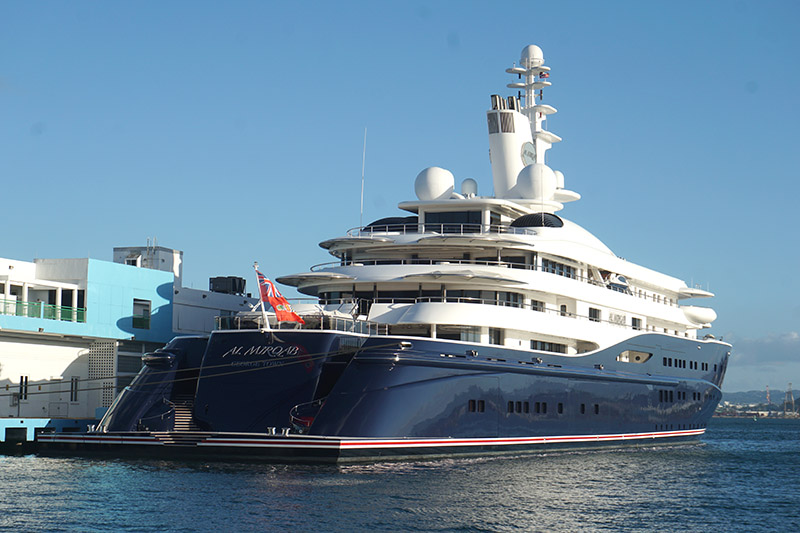
Pier One is usually used for visiting naval vessels and, when they are able to visit, small cruise ships. The Al Mirqab, a super yacht, is moored there now.

The Al Mirqab

The super yacht Al Mirqab tied up to Pier One, Old San Juan, March 2021.

The Al Mirqab is one of the twenty largest private yachts ever built. It is 437 feet long with a beam of 63 feet and displaces about 9,500 tons. Built in 2008, the yacht belongs to Qatar’s former Prime Minister Hamad bin Jassim bin Jaber al Thani.

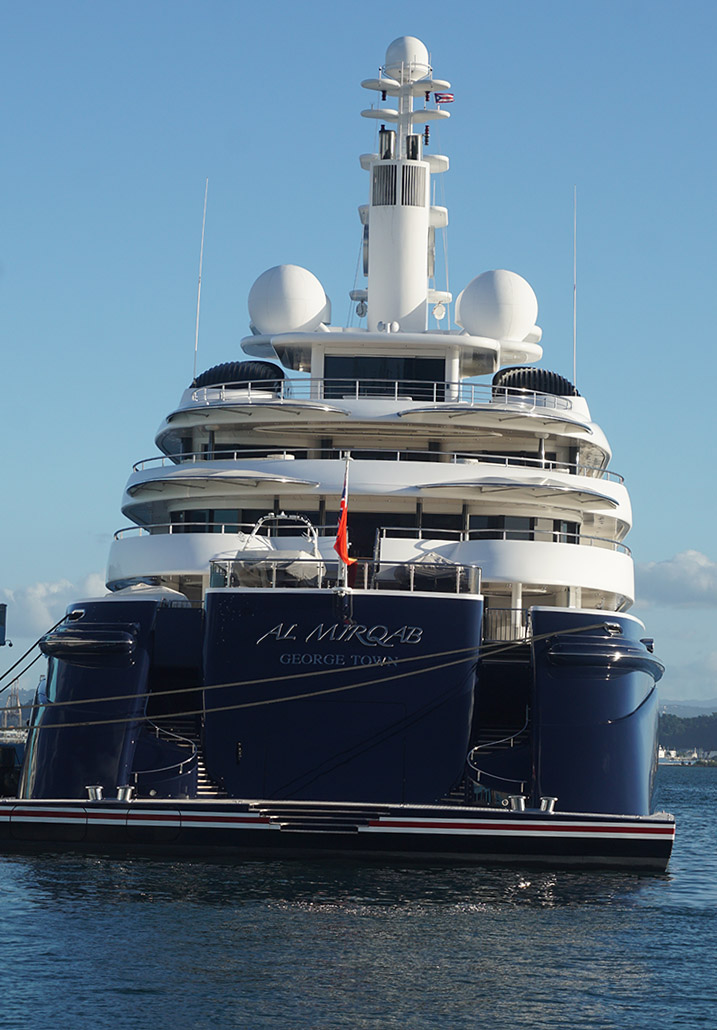
Stern view of Al-Mirqab.

Launched in 2008, the yacht was built in Germany, at the Peters Schiffbau Wewelsfleth shipyard, in Kiel. It was, during construction, mostly hidden from view and known only as Project May.

Tim Heywood was the ship’s architect; Andrew Winch Designs managed the interior design. The interior is spacious and opulent, as befits a yacht costing a third of a billion dollars. There are 10 guest suites capable of hosting 24 guests. Each suite has its own bath, living room, and double bedroom. The owners and special guests have two VIP suites for their use.

Guests can do more than look for whales. Al Mirqab has a cinema, indoor pool, outdoor jacuzzi, and various bars to keep people entertained. Guests can use the private helicopter for shore excursions. I suppose a helicopter pilot is one of the 60 crew members. Maybe he/she doubles as the cinema operator or a bartender. One has to cut corners somewhere.

I’ve seen mega yachts in port before, especially the stunning A and the huge Eclipse, both owned by Russian oligarchs. I’ve written about them – see my posts here and here and here.

The USCGC Stone

The Stone, a Legend Class ship of the US Coast Guard, at Pier One in January, 2021.

The Stone, a new ship of the Coast Guard, was in port for a few days during January, after having been delivered to the government on November 10, 2020. She left Pascagoula, Mississippi, on December 22, 2020 for a patrol into the South Atlantic. Her mission was to search for illegal fishing activities. The covid pandemic caused changes in the planned schedule. For example, the crew was not able to disembark in Montevideo, Uruguay because of covid fears.

But they were able to disembark in San Juan, and the alcohol supplies were the worse for it, at least at the kiosco in Plaza Darsena where I sometimes enjoy a cold one in the late afternoon. The crew seemed young, happy, and energetic. And they were a mixed group, both by gender and ethnicity. And they did seem glad to be ashore, at least for a couple of days. Good luck to them all.

FS LA COMBATTANTE P735

The French patrol ship La Combattante (P735) at Pier One, November 2020.

The new French naval patrol craft La Combattante was in port for a few days last November. She entered service in 2020. The French realized, after Hurricane Irma in 2017, that they did not have an adequate naval presence in the French Antilles to respond to such disasters. In response, they ordered new patrol craft in 2017. La Combattantte and her two sister ships make up the Patrollers Antilles Guyane (PAG) with responsibilities for patrolling in the French possessions in the Caribbean and Guyana. She was probably in port here after joint training exercises with the Coast Guard. Unfortunately, the crew was not able to disembark – I saw them doing physical training on deck, the poor sods.

HNLMS Zeeland (P841)

The Netheralands patrol ship Zeeland at Pier One, sometime in 2018.

Sometime during the fall of 2018, the Royal Netherlands naval patrol craft Zeeland was in port. Like the French, the Dutch maintain a naval force in the Caribbean to support their possessions, including the ABC islands, Aruba, Bonaire and Curacao.

The Zeeland was in the Caribbean during Hurricane Irma, and afterwards played an important role in providing relief to the residents of Saint Maarten and Saba.

I rather like the lines of this ship, and I think it is very sporting of the Dutch to keep their radar mast lit up like a Christmas tree. That must certainly give would-be smugglers and pirates pause.

Conclusion

All three of these warships are considerably smaller than Al Mirqab. The Stone is 418 feet long and displaces about 4500 tons; the Zeeland 336 feet and 4,130 tons; the La Combattante 132 feet and 750 tons. And I bet none of them have a pool, or even a jacuzzi.
Note and Sources

See the Wikipedia entries for each ship for more information.

The photos are mine.

Palm Trees

Late February 2021

Introduction

The walkway along the ocean into Old San Juan was rebuilt a few years ago. The Paseo de Puerta de Tierra, as it is called, includes signage. One can read about the historical sites along the path – the first, second and third lines of defense, the powder magazine in Parc Luis Munoz Rivera, the ruins of a Spanish observation post.

Some of the signs identify vegetation. I find those informative but intimidating. I realize how little I know about tropical vegetation. So I decided to learn something about palm trees. It is at least a start.

There are palm trees everywhere here. Of course, one would expect that, given the tropical environment. Street vendors sell fresh coconuts. They use machetes to lop off the top to get at the liquid inside. The coconut water is a local treat.

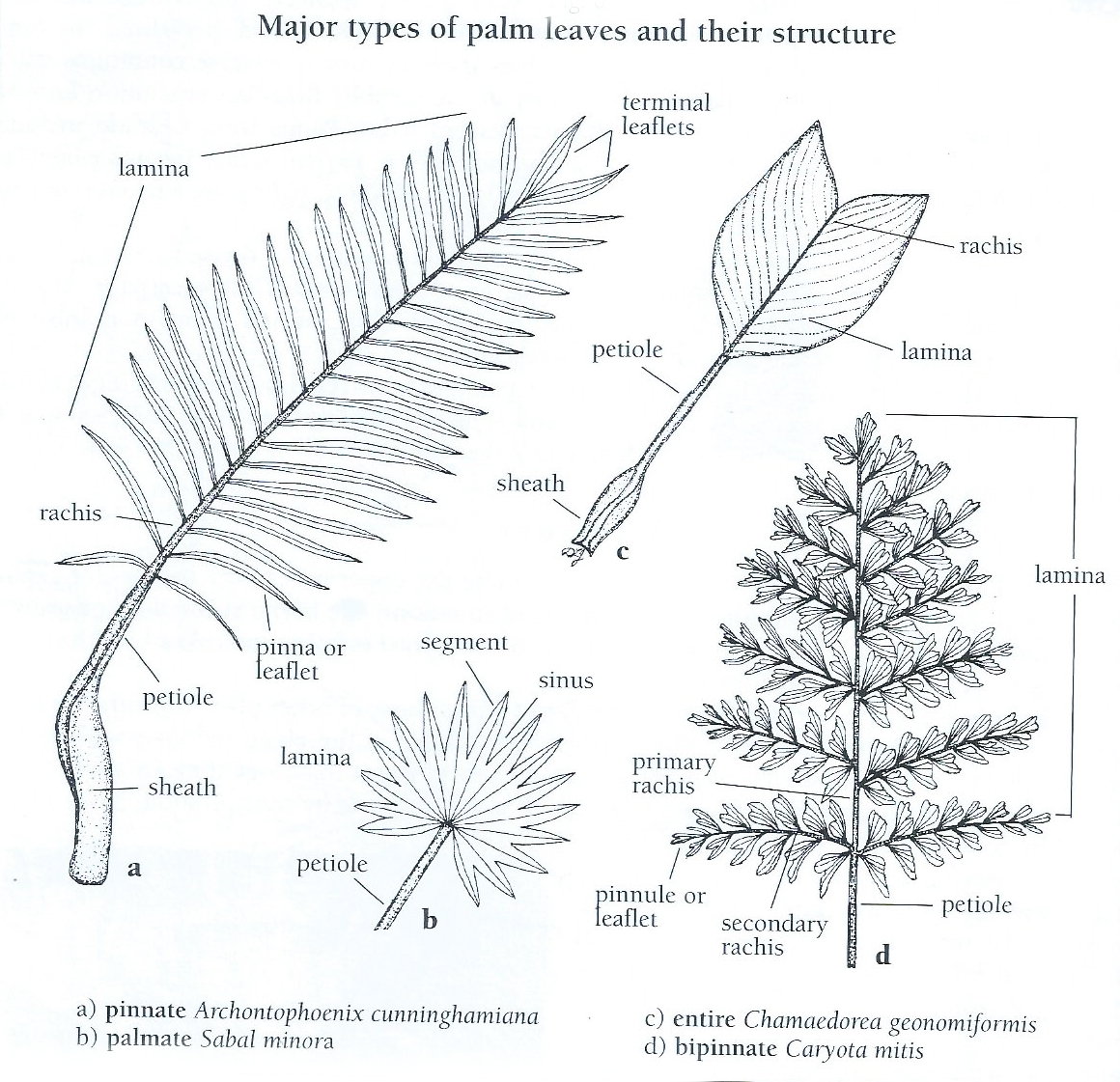
I looked to buy a field guide to help identify palm trees. I couldn’t find one. So I went online. There are resources but I found them difficult to use. For one thing, you need a specialized vocabulary. The leaves (technically fronds) can be pinnate or palmate, or maybe entire or bipinnate. And then there are the trunks. And the roots.

Sunrise as seen through palm trees near the Caribe Hilton.

Palm Trees: Background

Palm trees evolved about 80 million years ago, during the late Cretaceous. Some survived the mass extinction that marked the end of the Cretaceous era, an abrupt event marked by the K-Pg boundary. Since then, the Arecaceae have evolved into about 181 genera and 1200 species with most found in tropical and sub-tropical climates.

Palms (known more technically as the Arecaceae) are perennial, woody, flowering plants. They usually have a prominent trunk. The Arecaceae are, like the grasses, monocotyledons – that is, a seed produces one shoot with one leaf. They can take the form of trees, climbers, shrubs, or be stemless.

Palm trees, like other monocotyledons, do not exhibit the secondary growth common to woody plants. The wood does not have growth rings. So-called anomalous secondary growth does occur, but to a lesser extent that woody plants. This gives palm trees their slender appearance.

Palm Trees: Structure

Generalized structure of a typical palm tree. See Notes and Sources.

Identification of palms starts with the features noted above. One looks at the fronds first, then the details of the trunk. That usually provides a pretty good start.

Most palm trees exhibit either pinnate or palmate leaf structure.

Most common palms exhibit either pinnate or palmate structure. See Notes and Sources.

Palm trees are widely used in ornamental plantings. I suspect landscapers planted almost all the palm trees I see in San Juan. That means some are native species, some are not. That makes their identification that much more challenging.

Palm trees with pinnate fronds. Note the prominent crownshaft.
This palm tree exhibits fronds with palmate structure. Note the ripening fruit.

Specific Palm Trees

Here are some of the palms I’ve identified. I confess I’ve made liberal use of the signage along the Paseo de Puerta de Tierra. But I did also use other sources. Please refer to Notes and Sources.

Puerto Rican Hat Palm – Palma de Sombrero (Sabal causiarum)

An example of the Puerto Rico Hat Palm. Most examples I’ve seen have a thicker trunk.

This palm tree is native to Puerto Rico and Hispaniola. It is characterized by a thick, straight trunk with a small crown of palmate fronds. In fact, the crown often seems too small given the tree’s height, often over 35 feet.

The fronds were used to manufacture hats, an industry centered in Joyuda, in the southwest part of the island. The industry went into decline in the early twentieth century.

Puerto Rico Royal Palm – Palma Real (Roystonea borinquena)

A Puerto Rico Royal Palm found in Parc Escambron.

Another Puerto Rico native, this palm is closely related to royal palm trees in Cuba, Hispaniola, Honduras, Guyana, and Florida, among other West Indies locations. These are tall, stately palms with a graceful crown of feathery fronds and often used in ornamental plantings. Note the prominent crownshaft.

Spindle Palm – Palma Botella (Hyophorbe verschaffeltii)

Spindle palms along the road leading into Old San Juan.

These slow-growing palms are native to the Mascarene Islands where they are in danger of becoming extinct. They exhibit a smooth trunk that can bulge in the middle, and a distinct crownshaft. The fronds are pinnate. The inflorescences are prominent and covered in a spathe. Spindle palms are often grown in large containers.

This inflorescence will produce intensely fragrant bright orange flowers. Note the spearleaf as well; this spindle palm seems to be doing well.

Fiji Palm – Palma de abanica (Pritchardia pacifica)

A stand of Fiji palms in Parc Escambron.

Pritchardia is a genus of 37 species, with most found on the Hawaiian Islands. They are solitary fan palms with full, dense crowns of large, stiff palmate fronds. They do well when planted in groups, and grow up to 35 feet high.

The Fiji palm is found, as its name implies, on the Fiji Islands. Some experts think it originated on Tonga before being introduced to the Fijis. It is said the fronds were used as fans for the Fijian royalty.

Manilla Palm – Adonidia (Veitchia merrillii)

A Manilla palm found in Parc Escambron.

The genus Veitcha includes eighteen species, all located in the Western Pacific – the Phillipines, New Hebrides, and Fiji. They exhibit feathery pinnate fronds and a prominent crownshaft.

The Manilla Palm is native to the Philippines. It produces clusters of bright red fruit around Christmas time; the tree is sometimes known at the Christmas palm. It can grow to a height of 25 feet.

Ripening fruit on a palm tree. I took this image on 12/22/2019.

The fruit of the Christmas palm is edible, though said to be not pleasant. I wonder if it could be made into a jam or jelly, or maybe a chutney.

Mexican Fan Palm – Palma Washingtonia (Washingtonia robusta)

A row of three Mexican fan palms planted along the road by Parc Escambron leading to Old San Juan.

The genus Washingtonia includes two species, both native to the United States west coast, and Baja and Sonora, Mexico.

Mexican fan palms are widely cultivated. Examples can be found in Texas, Florida, Hawaii, the Canary Islands, Spain, Italy, Israel, and Lebanon.

The Mexican fan palm grows as tall as 80 feet, on a thin, smooth trunk. It displays a compact crown of palmate fronds. They are often planted in rows along avenues, as they are in the image above.

Foxtail palm – Palma cola de zorra (Wodyetia bifurcata)

A fox tail palm across the street from the Supreme Court of Puerto Rico. I’m not sure why the rope is tied to it.

The genus Wodyetia contains only one species. The foxtail palm is native to northeastern Australia. It has become a popular ornamental plant, so much so the native trees are in danger from seed poachers.

This species exhibits a slender, closely ringed trunk with graceful pinnate fronds. It has a slender crownshaft and produces large, orange-red fruit. It can grow to 35 feet in height.

Date Palm – Palm datilera (Phoenix dactylifera)

A date palm along the Paseo de Puerta de Tierra. It was planted about five years ago when the walkway was reconstructed.

The Phoenix genus consists of about seventeen species and are found pretty much around the world. The date palm (P. dactylifera) shows greyish-green pinnate fronds in a graceful crown. These trees lack a crownshaft. Trees are either male or female; both are needed for fertilization. They can grow up to 70 feet high.

The date palm is famous for its fruit, which has been known since antiquity. However, these trees bear fruit only in hot, dry climates. The north coast of Puerto Rico is too wet and humid for these plants to bear fruit. I wonder if that is true in the generally drier, warmer southern regions of the island. Perhaps Puerto Rico can become a date-exporting nation. In any case, the date palm is widely used in ornamental plantings.

Coconut palm – Palma de coco (Cocos nucifera)

Coconut palms along the Paseo de Puerta de Tierra. These undoubtedly predated the reconstruction of the walkway.

Cocos is a one species genus. Coconut palms have large spreading crowns of pinnate fronds. The smooth, slender trunks are often curved, a rare trait among the palms. Given their wide distribution, their origin is uncertain. Most experts think they originated in the Western Pacific.

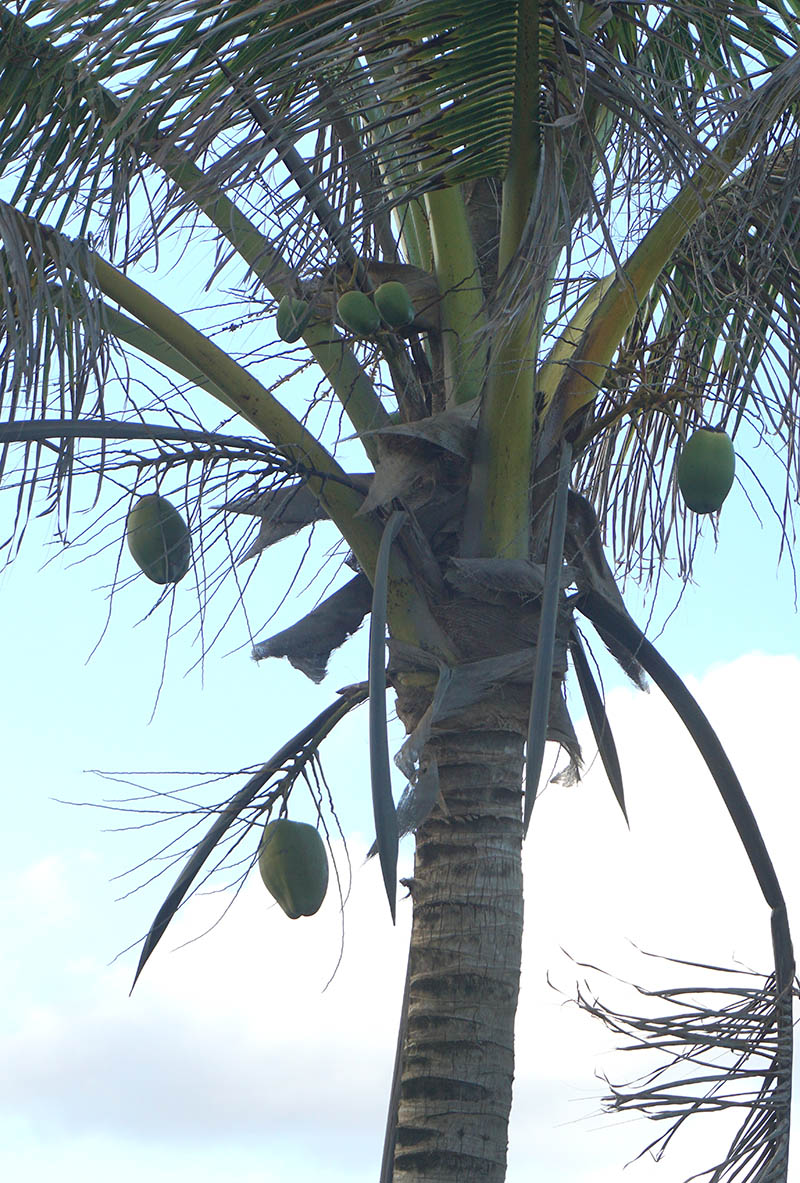
Ripe coconuts ready to fall.

A coconut tree typically produces 30 or so fruit a year. The fruits are technically drupes and not nuts. (I’m glad the fruit is misnamed – I’m not sure I could handle writing about cocodrupes). They have a hard shell and weigh four or five pounds. The trees can grow to 80 feet; one has to think a falling coconut represents some danger. In 1982, Dr. Peter Barss, a doctor practicing in Papua, New Guinea, published a paper with the ominous title “Injuries Due to Falling Coconuts” in the Journal of Trauma. Barss noted that, in his practice, 2.5% of the trauma admissions were the result of falling coconuts. He did not observe any deaths.

Barss’ work became the fuel for a persistent urban legend. People claimed more people died from falling coconuts than shark attacks. Officials in one town in Queensland, Australia removed coconut palms from the town beach. Poets got into the fray. The American poet Frederick Seidel wrote a poem he titled “Coconut.” It contains the following lines:

A coconut can fall and hit you on the head,

And if it falls from high enough can kind of knock you dead

Dead beneath the coconut palms, that’s the life for me!

(See the Wikipedia article Death by coconut for a complete attribution).

Now, there have been deaths by falling coconuts. Here are a few.

  • Sometime around 1777, a concubine died after she was struck by “a falling green nut.” She was with the court of King Tetui of Managia in the Cook Islands.
  • Four people died from falling coconuts in Sri Lanka in 1883.
  • A US marine died when a falling coconut hit him in the head as he slept. This was on Guadalcanal, in 1943.
  • In 1991, in Sri Lanka, a mourner at a funeral died when struck by a coconut.

The case of the US marine is intriguing. Imagine him, having survived an amphibious assault, battles with Japanese infantry, air attacks, and bombardment by Japanese battleships, dead from a falling coconut.

So some people have died from falling coconuts. I don’t know how that number compares to deaths by shark. I do know that, when I go to the the beach, I find a place in the shade of a coconut tree. But I look up to make sure I’m not directly under any hanging nut, or drupe, or whatever.

Three Not Yet Identified

Unknown One

I used the signage along the Paseo de Puerta de Tierra to identify the palm trees described above. I checked the identification with my palm tree book. See Notes and Sources. But there are several I cannot identify. Here are three of the most prominent.

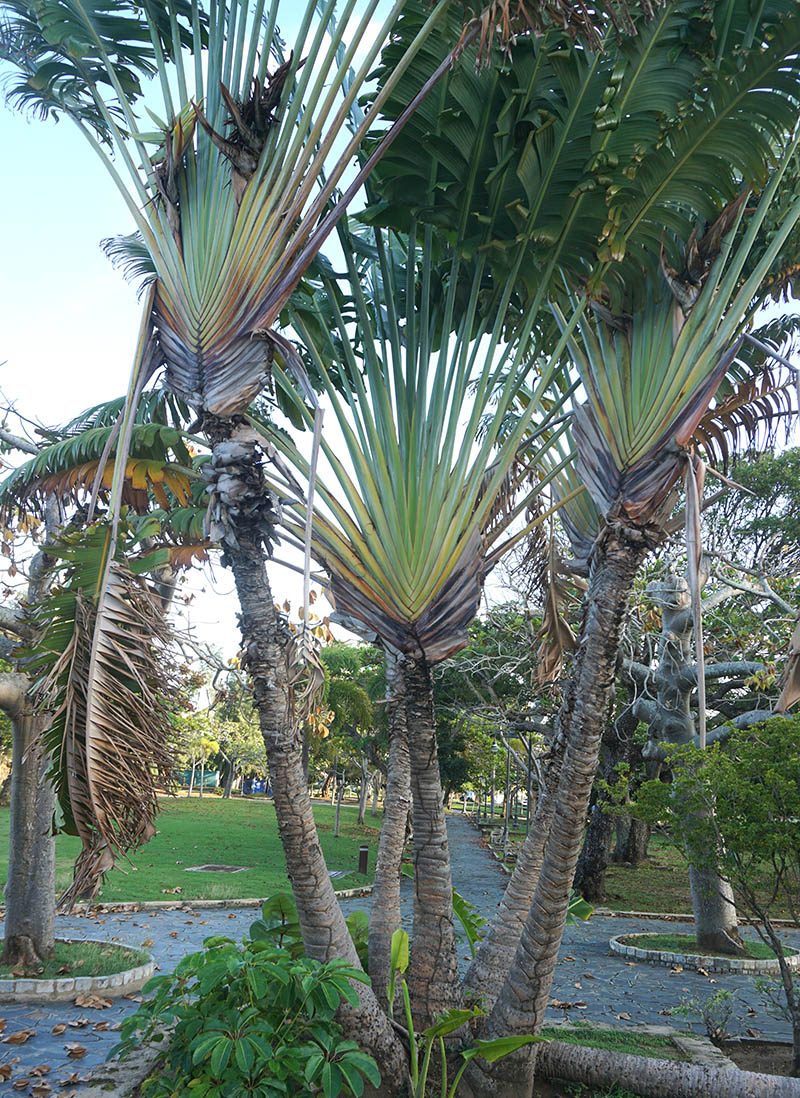
A palm tree (?) in Parc Luis Munoz Rivera.

Unknown number One (above) shows multiple trunks and large palmate fronds. I think it is a palm – I suppose it could be a Cycad or a Cyclanth or a Pandans or possibly a Cordylines. These plants are closely related to palms and are often confused with them by the inexperienced observer, of which I am a perfect example.

Unknown Two

These palm trees are lining Avenida Ashford in the Condado section of San Juan.

I first thought Unknown 2 (above) was a member of the genus Phoenix and was thus a member of the date palms. It does share the unusual trunk structure and lack of a distinct crownshaft. However, the fronds are palmate, not pinnate.

A more mature example of Unknown 2. in a planting across the street from the Supreme Court of Puerto Rico.

The more mature example of Unknown 2 shows the palmate fronds to better effect.

Unknown Three

Unknown Three is located in front of the abandoned Normandie Hotel located next to the Caribe Hilton.

The third unknown has one very large palmate frond arranged in one plane. I’ve seen it used in ornamental plantings – for example, in the thin grass strip between a sidewalk and a building. One can see a good example of this type of planting on the south side of the old federal courthouse in Old San Juan.

Unknown Three as found along the southern wall of the old federal courthouse in Old San Juan.

Final Thoughts

I guess I’ve learned a bit about palm trees. It is amazing what one can see when one opens their eyes to what’s around them.

Notes and Sources

I relied heavily on the book Palms Throughout the World, by David L. Jones, Smithsonian Institute Press, Washington, D. C., 1995. The two figures are from this book. I got my copy via Amazon.

I used several articles in Wikipedia. The main article – Palm Trees – has links to articles about specific palm trees and other useful links.

I relied on the Wikipedia article Death by Coconut for information on that morbid topic.

The photos are all mine, edited with Adobe Lightroom and/or Photoshop.

Street Art: Some New Findings

Early February 2021

Introduction

Street art is constantly evolving. Old works get defaced, painted over. New works appear, get discovered. Here are some of my recent finds. I’ve arranged them by location. Then I’ll share some arranged by theme.

La Perla

La Perla is in Old San Juan, just outside the wall to the north, snuggled between the walled city and the Atlantic. The street art there seems to symbolize the neighborhood’s attempt to overcome a reputation for drugs and crime. I walked through there one recent Sunday afternoon. I found it lively, friendly, colorful.

Upbeat La Perla mural in La Perla. I looked on Instagram for @12.mks with no success.
A fanciful coqui on a wall in La Perla. Check out Senkoe on Instagram – the artist has works all over the planet.
Another colorful coqui. I’m not sure who the artist is. Coquis are small tree frogs with a distinctive call – coKEY coKEY coKEY – hence their name.
A woman with flowers.
The title says A Virgin for La Perla, Thank you. Alicia Enoz [?] 2021.
Woman with rooster. I did not see an artist’s name or identifier.

I found images of people along the walkway by the ocean. They are probably well known Puerto Rican musicians but I have not further identified them. Here are a three of them.

Three images of Puerto Rican musicians.

The next four are details of a mural on a long wall. I could see parts of it – others sections were blocked by parked cars.

Four sections of a mural on a block long retaining wall.

Calle Cerra

Calle Cerra runs south from Avenida Juan Ponce de Leon. It crosses Avenida Fernando Juncos and goes south for three more blocks. It is a small area rich in public art. And not all of it is wall murals. Here are some examples of yarn art I found on a fence.

Two examples of yarn art found on a fence along Calle Cerra, in the Santurce neighborhood of San Juan.
The yarn artist Stino created the two works above. Check out some more of her work in Instagram.
I could not find any information for Javier Cortion. Can anyone help with identifying the artist?
A rooster is a clever way to adorn a night deposit box. I presume the artist is LOMIO but I could find no information for that name.
Parked cars and street signs are a challenge. There have been a few times when drivers moved their cars for me. I looked up ABAST.ART but I did not see an immediate connection to this work.
Unknown woman, unknown artist, Calle Cerra.
A mural just off Calle Cerra. It continues to the right but a parked truck blocked my view. I’ll check back and see if I can capture the whole mural.
A mural just off Calle Cerra, in Santurce. The message is as powerful as it is simple – three European ships sail off leaving people in agony. I could not find an artist’s signature or other identifier.

Theme: Puerto Rican Flag

Artists often use the Puerto Rican flag as a starting point for their work. Here are some examples. I’ll identify the location in the captions.

An exotic car passing under the Puerto Rican flag. I found this near Calle Cerra just off Avenida Fernando Juncos.
A three story building on Calle Cerra. I looked up ABEY but could not find an artist with that identifier.
A three story building in La Perla. It is located just outside the wall near one of the gates to the city.
Part of the block long wall mural in La Perla.

Conclusion

I’ve been capturing images of street art here for six or seven years now. I am surprised, when I go through my images, to see how few of the works I’ve captured remain. So enjoy the images above while you can – the originals won’t be there for long.

Sources

These are all my images. In most cases, I’ve done minimal editing – I’ve cropped them to remove extraneous background and adjusted the levels. I did more extensive edits to the second to last Calle Cerra image. I made the background a uniform color and brightened the other colors. I use Adobe Lightroom, Photoshop and sometimes InDesign for my work.