Author Archives: jmilohas@outlook.com

HMS Argyll

November 20, 2014

The Royal Navy was back in port, for an overnight visit. The HMS Argyll, a Type 23 frigate, was docked at Pier 1. The Argyll is a Duke Class frigate, with all 13 of the ships in the class named after Dukedoms. Three Type 23s have been sold to Chile so it is possible I’ll see a Chilean version at some point.

The HMS Argyll docked at Pier 1, San Juan, November 2014

The HMS Argyll docked at Pier 1, San Juan, November 2014

The Type 23s were under design as the Falklands War occurred, and the original designs were modified based on lessons learned from that conflict. They were originally envisioned as anti-submarine ships, with towed sonars to locate the subs, and helicopters to destroy them. As originally designed, the frigates had no on-board air defense missiles – anti-air support was to have been supplied by fleet oilers accompanying the frigates while at sea. The frigates were redesigned to carry Viper missiles to protect against low-flying aircraft (i.e., Argentine Skyhawks) and anti-ship missiles like the Exocet.

This seems a good idea to me. If I were at sea, in a frigate, hunting submarines, I would not want some pukes on an oiler trying to protect me from Exocets. Way too much room for error. To illustrate the point: In March of this year, the Argyll accidentally launched a torpedo. Fortunately, it was unarmed and the incident caused more embarrassment than damage.

You would think firing torpedoes by accident is a rare occurrence, and it probably is. I know of one other instance. The Fletcher class destroyer, USS William D Porter fired a live torpedo at the new battleship, USS Iowa, in November 1943, during a live fire exercise. The Porter was escorting the Iowa to North Africa, and the battleship was carrying President Franklin D Roosevelt, Secretary of State Cordell Hull, the Chiefs of Staff and other dignitaries off to meet with Churchill and Stalin in Cairo and Teheran. Roosevelt, long an admirer of all things naval, asked to have his wheelchair pushed to the port side so he could observe the torpedo. His Secret Service agent, ever alert, pulled his pistol as a means to protect him, proving that agency’s troubles may not be as recent as we have been led to believe. The Iowa was able to increase speed; the torpedo passed astern and exploded harmlessly in her turbulent wake.

The Porter was ordered to Bermuda and the whole ships company arrested, thinking the torpedo may have been an assassination attempt. The investigation showed the firing was an accident, and the Porter was ordered to the Aleutians. While there, she managed to fire a live 5 inch shell, by accident of course, towards the base commander’s official residence.  Whenever she entered port, other Navy ships would signal her: “Don’t shoot. We’re Republicans.” Her short career came to an end when she was sunk by a kamikaze off Okinawa in June of 1945. Perhaps my Dad, on Okinawa at the time, heard of the sinking.

I would have thought one of more of the Dukes of Argyll would have been famous military commanders. That does not seem to be the case. The Duke of Argyll is traditionally associated with one of the most powerful noble Scottish clans, and the Duke is known by other titles, including Earl of Argyl, Earl Campbell and Cowall, Viscount Lochow and Glenyla, Lord Campbell, Lord Lorne, Lord Kintyre, Lord Inveraray, Mull, Mover and Tiry’, Baron Hamilton of Hameldon and Baron Sundridge. His son and heir is traditionally known as the Marquess of Kintyre and Lorne. None of these names, at least according to my cursory research on the topic, is associated with British military endeavors of any note.

Maybe the HMS Argyll was named after a famous British warship, like Jellicoe’s flagship at the Battle of Jutland, the Iron Duke, the namesake of another Type 23 frigate. The current HMS Argyll is the third ship to bear that name. The first, a ship of the line, was launched in 1722, and, after a short, undistinguished career, was sunk in 1748 as a breakwater. The second was launched in 1904, a Devonshire class armored cruiser, but sunk after running aground on Bell Rock in the foam and froth of the Firth of Forth.

Perhaps this is why the current HMS Argyll has not been modernized to the standards of some of her fellow Type 23s, and is therefore relegated to less demanding naval tasks. For example, on her current deployment, she is doing, with the assistance of the US Coast Guard, anti-narcotic patrols. According to the rather breathless Royal Navy press releases (what ever happened to British understatement?), complete with pictures, she has stopped two vessels and confiscated more than 20 million pounds (currency, not weight) worth of cocaine. She also, in September of this year, called at Baltimore to participate in the celebrations of the 200th anniversary of the writing of The Star Spangled Banner.

The Baltimore port call shows the Royal Navy at its very best. What other of the world’s navies would send a ship to help celebrate a poem written to commemorate a defeat of her armed forces? That would be like the US sending an aircraft carrier to Tokyo to celebrate Pearl Harbor Day.

To be fair, the British did have a pretty good run in 1814. The end of the Napoleonic and the Peninsular Wars allowed the transfer of seasoned veterans to the North American theater. In August, under the command of General Robert Ross and Admiral Alexander Cochrane, the British unleashed their new strategy – attack in the Chesapeake region to relieve pressure on the outlying areas. The British came ashore in Benedict, Maryland, defeated a rapidly assembled American militia, and proceeded to march into and burn and loot Washington.

Ross and Cochrane next turned their attention to Baltimore. Cochrane led the ineffectual bombardment (rockets’ red glare, bombs bursting in air, and all that stuff) of Fort McHenry, while Ross was killed by American sharpshooters during the Battle of North Point, the failed land invasion of Baltimore. Ross’s body, preserved in a barrel of Jamaican rum, was eventually interred in Halifax, Nova Scotia. That was surely a waste of good rum – what were the British thinking?

The British embarked and retreated by sea, out the Chesapeake Bay, into the Atlantic, around Key West, into the Gulf of Mexico, and up the Mississippi River to New Orleans, where they were gobsmacked by Major General Andrew Jackson and the American forces there.

Cochrane once again led the naval forces, while Major General Edward Pakenham, brother-in-law to the Duke of Wellington, replaced Ross and commanded the British army.

There was apparently some tension between Cochrane and Pakenham. According to legend, Pakenham at one point asked for more help from the fleet. Cochrane refused, saying the troops had already received more than was needed, and that he (Cochrane) would put his sailors ashore if need be to make his point.

In the event, the British assault on the American fortifications was poorly executed. A flanking maneuver failed to arrive on time when the canal Cochrane’s sailors were digging collapsed. The assaulting troops forgot (!) the ladders and fascines needed to breach the earthen defensive works. Pakenham died of grapeshot wounds. The Americans held off the British, who eventually withdrew. In his eulogy of Pakenham, Wellington blamed Cochrane for the defeat at New Orleans.

In 1958, Jimmy Driftwood wrote The Battle of New Orleans, which was recorded by Johnny Horton and named Billboard’s best song of 1959. It is written from the perspective of a foot soldier, and some of the lyrics include:

We looked down the river and we seen the British come,
An there must have been a hundred of them beatin on the drum.
They stepped so high & they made their bugles ring,
We stood beside our cotton bails & didn’t say a thing.

So, the military failures of Cochrane and Ross, and then Pakenham, led to the creation of two iconic American songs.

Now that is something to celebrate.

For more information, see Wikipedia entries for HMS Argyll, Duke of Argyll, William D. Porter, General Robert Ross, Admiral Alexander Cochrane, Major General Edward Pakenham, Battle of New Orleans.

I find the Royal Navy site interesting and informative: http://www.royalnavy.mod.uk/

Trade Winds

November 13, 2014

The winds have shifted. I’ve been here two weeks now, and the prevailing winds are now from the northeast, off the Atlantic. When I first arrived, the winds were from the south, from the Caribbean. The difference is palpable.

The northeast winds are of course the trade winds. If you think about these winds from a meteorological perspective, they are the prevailing pattern of easterly surface winds found in the tropics. They strengthen or weaken based of the status of the North Atlantic Oscillation, the fluctuations in air pressure over the Azores (relatively high) and Iceland (relatively low).

The trade winds typically weaken and move north in the summer. Sunsets in Florida are redder in the summer, less so in the winter. The opposite is true here –dust from North Africa carried by the trades cause this. Drought conditions in North Africa create more dust and more dramatic sunsets. My maternal grandmother, a New Englander born and bred, used to say, when she saw a red sunset:

                                                Red sky in the morning

                                                Sailors take warning.

                                                Red sky at night

                                                Sailors delight.


Perhaps she was thinking of trade winds and North African dust when she taught me this.

The trades of course carried the Europeans across the Atlantic in the Age of Discovery. The sailing ships – Portuguese caravels, Spanish galleons, French nefs, Dutch fregats, British men-o-war – sailed south along the Iberian Peninsula and along the North African coast. This was often the most difficult part of the journey – ships could be becalmed for days or weeks before moving far enough south to get to the zone of consistent winds. Once there, they scooted across the Atlantic, carrying their cargoes of guns and germs, and, later, slaves. They returned by means of the Gulf Stream and the anti-trades. Perhaps I’ll visit those topics in another letter.

Caribbean air is warmer, more humid, almost steamy, hazier than North Atlantic air. Convective storms are common, with sometimes spectacular lightning displays. Historically, the average daytime high temperatures in San Juan drop almost five degrees during November, as the trade winds take hold, and rise by about that much in April, when the trades move north, allowing the Caribbean air to once again dominate. I wonder if and how plant life here adapts to these, to us, subtle changes in humidity, temperature and day length. I do know there is one tree that flowers, a bright red showy flower, only in February. I’ll have to do some research on that, starting by trying to learn the name of the tree.

But wait, you say: The trades blow over an ocean – doesn’t the air mass get saturated with water vapor? There are, after all, rain forests in Puerto Rico, aren’t there? Why are there no convective storms, thunder, lightning, associated with the trades?

Great question. It turns out the trades have an inversion layer, at about 10,000 feet, that prevents clouds from rising to create convective storms. You can actually observe this. Note the cloud structure the next time you fly into San Juan. Observe the clouds over the sea. You’ll be at about 35,000 feet, and the clouds will look like popcorn, all capped at the height of the inversion layer. Scattered showers for sure, but no thunderstorms.

So, it seems the weather pattern here has shifted to winter mode, and at just about the same time Croghan, Syracuse, Utica, Rochester got their first snowfall.

Neat, eh?

DSCN0902

The images show the effects of the nice clear air. They were taken from Punta Escambron, looking east, along Condado and beyond. The first starts right at the end of Condado and you can see, on the horizon to the left, all the way to Punta Cangrejos and, to the extreme left, Isla La Cancora,  beyond Isla Verde, almost to Pinones.

DSCN0907

The second, at a different scale, shows the Condado Vanderbilt on the right. Last year, the two buildings were a salmon color –they’ve been repainted to the off white you see here. The Marriot, in central Condado, is a bit to the left, the square building with red letters on top. The salmon colored building to the left, in the last group of high rise buildings, is Condado del Mar, where we stayed on our second trip to Puerto Rico. Ocean Park is the area with no high rises; Isla Verde begins beyond that.


See the Wikipedia entry for Trade Winds for more information.

Thinking About Concrete

November 15, 2014

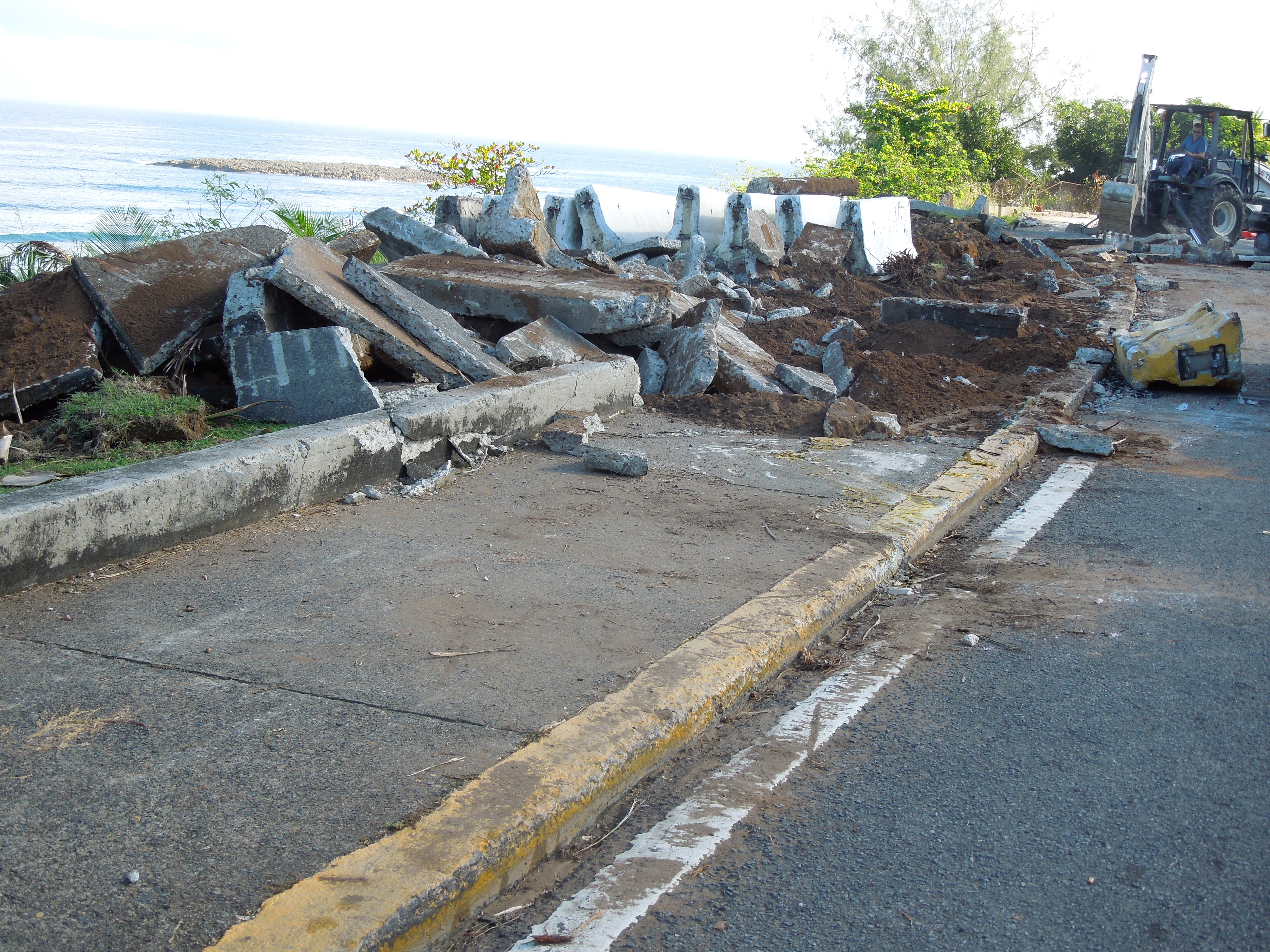
I’ve been thinking about concrete lately. Concrete is of course the preeminent construction material of our time. Every day I see concrete being poured somewhere nearby, at intersections being reconstructed in Old San Juan, along the roadway by Playa Escambron as bicycle lanes are installed. As quickly as it is being poured, it is being jackhammered (as along the roadway in back of our building) or ripped (as along the sidewalk across from El Hamburger) out in other places Our friend Mario probably had activities like this in mind when, one morning over coffee at the kiosco, he said Puerto Ricans were good at growing concrete.

Sidewalk across street from El Hamburger.

Sidewalk across street from El Hamburger.

Concrete is an interesting material, with a long history. It is really three things mixed together – an aggregate of some sort, a cementing material, and water. The Assyrians and Babylonians used sand as the aggregate and clay as the cement. The English engineer John Smeaton invented the first modern concrete in the late 1700s when he created a concrete that hardened under water. His material was used for, among other things, locks in canals, and probably helped make the Erie Canal possible.  – I know the engineers who built Clinton’s Ditch based their designs on English practice.

Joseph Aspdin, an English bricklayer, mixed clay and ground chalk (limestone, really) in a kiln and produced a cement that, when mixed with aggregate and water, produced a concrete much stronger than previous concoctions. Aspdin’s 1824 discovery, now known as Portland cement, remains the basis for current cement mixes. In 1849, Joseph Monier used wire mesh to reinforce concrete to make more durable flowerpots. He was at the time the gardener in charge of the orangery at the Tuileries Gardens, near the Louvre, and had to move the orange trees into and out of the greenhouses every year. He was looking for something more durable than clay (brittle) or wood (subject to decay), the materials of choice at the time.

Monier’s early successes with his pots led him to start a business which eventually used iron-reinforced concrete (chimenti et fer, to him) for pipes, water storage tanks, stairways, and other structures.

A water storage tank designed by Joseph Monier and  constructed from ciment et fer. Circa 1890.

A water storage tank designed by Joseph Monier and constructed from chimenti et fer. Circa 1890.

Monier’s business had its ups and downs. He displayed his creations at the Paris Exposition in 1867 and received his first of several patents. He became estranged from his first son who started a competing company; his second son died in a construction accident, when he fell off a scaffold. Napoleon III, in 1870, started the disastrous Franco-Prussian War. Monier’s business was destroyed by a Prussian bombardment, and his horses were stolen and slaughtered for food. He restored his business after the war, generated several more patents, all of which he sold to foreign interests for one-time fees. His construction company went bankrupt in 1890 and he lived in retirement, hounded by tax collectors convinced he was getting royalties from his foreign patents.

Monier’s marriage of iron and concrete was propitious. Concrete is strong in compression (pushing forces), weak in tension (pulling forces); iron just the opposite.  Concrete and iron (later steel) – yin and yang, light and dark, Apollo and Dionysius, Cadmus and Harmonia, push and pull, tension and compression – combine to make a material that is strong, durable, and relatively easy to manipulate.

Robert Maillart’s Salginatobel Bridge, circa 1930.

Robert Maillart’s Salginatobel Bridge, circa 1930.

David Billington, a civil engineering professor at Princeton, is interested in the process by which new technologies are incorporated into engineering practice. He has written on dams (Grand Coulee, Hoover)and the New Deal, thin shell concrete structures, and, germane to this letter, the adoption of cast iron and reinforced concrete (Monier’s chimenti et fer) into late 19th and early 20th century construction. His book The Tower and the Bridge describes the transition in terms of opportunities for thinking about structures as forms of public art. Billington moves from the Tower (as in Eifel) to the Bridge (as in Roebling’s Brooklyn) and then to a series of Swiss bridges made of reinforced concrete as examples of structural art. The Swiss, apparently, procure bridges by a less cumbersome process than most countries, allowing their engineers room to be creative in their use of new materials. Billington focused much of his attention on the works of Robert Maillart and his followers.

Why these thoughts on concrete, you ask? Great question. The Shi Long Ling came into port the other day and docked at Pier 14, below our balcony. Unlike most ships entering port here, she was empty, riding high, her bulbous bow almost completely out of water, CHINA SHIPPING BULKER on her side. Puerto Cabella, Venezuela had been her most recent port of call. I have no idea what type of cargo she discharged there. By the way, a bulker is a ship that carries cargo that has to be loaded and unloaded by the ship’s cranes, unlike, for example, tankers and container ships. Compare the Shi Long Ling to the loaded Pacific Basin freighter entering port.

The Shi Long Ling at Pier 14, Port of San Juan, 11/13/2014.

The Shi Long Ling at Pier 14, Port of San Juan, 11/13/2014.

A loaded bulk freighter entering port, 11/14/14.  Compare to the empty Shi Long Ling. This ship, the Daiwan Wisdom, may be carrying Portland cement manufactured in Spain

A loaded bulk freighter entering port, 11/14/14. Compare to the empty Shi Long Ling. This ship, the Daiwan Wisdom, may be carrying Portland cement manufactured in Spain

I had been wondering what the piled material next to the pier was. Another ship had docked at Pier 14 last week and discharged a partial load of steel. The fork lifts had to dance their way around the material to stack the steel into neat piles, only to be reloaded onto flatbed trucks.

Stacks of steel rods, Pier 14, November 13, 2014. Note the flatbed truck being loaded with the steel rods.

Stacks of steel rods, Pier 14, November 13, 2014. Note the flatbed truck being loaded with the steel rods.

Now, I’m sure the steel rods are for reinforced concrete, the fer in chimenti et fer. A ship discharging steel arrives in port about every two months, by my informal observations, and most of the steel is in the form of these rebars, as they are inelegantly called – they are after all rods, and not bars. The rebars are trucked to construction sites around the island and, I suspect, transshipped, in smaller vessels, to Caribbean Islands lacking substantial port facilities.

OK, the piled material. It turns out it is concrete, huge chunks of concrete rubble, perhaps from highways or buildings, and the Shi Long Ling is being loaded with it. This is quite a process. First, the front end loaders moved piles of what appears to be sand ship side. You can see one of the piles beneath the S in CHINA SHIPPING BULKER in the image of her. The ship’s cranes lifted it into each of the four holds. Next, the loaders brought buckets of the rubble ship side, which the ship’s cranes lift into the prepared holds. This has been going on for three days now.

This was a truly Sisyphean task. A parade of trucks carrying more rubble arrived, causing the pile to enlarge even while the ship was being loaded. It is as if the rubble was in storage, ready to pounce on the first ship to come take it away.

Apparatus used to lift concrete rubble into the bulk transport shop Shi Long Ling.

Apparatus used to lift concrete rubble into the bulk transport ship Shi Long Ling.

Who would want concrete rubble, and why? It turns out concrete can be recycled. It is crushed into appropriate particle sizes, and the crushed product is used as aggregate in new concrete mixes, replacing virgin aggregate. By one estimate, 140 million tons (!) of concrete are recycled each year, in the US alone. Using recycled concrete as aggregate apparently results in a concrete product that weighs 10-15% less than concrete made with virgin aggregate, and can cut waste landfill disposal costs, among other alleged benefits

I don’t know where the Shi Long Ling will go next, with her load of concrete rubble for recycling. China? Back to Venezuela? Perhaps one of these days I’ll get on the web and research commodity flows, specifically concrete rubble.

So, the activities I’ve been watching in the port, the steel rebars and the concrete to be recycled, all relate back to the efforts of a Parisian gardener trying to protect his orange trees.

Who knew?

References:

Billington, David. The Tower and the Bridge: The New Art of Structural Engineering. Princeton University Press, 1985.

See Wikipedia entries for concrete, cement, Robert Maillart, and Joseph Monier for more information.


Two Warships in Port

November 11, 2014


Two warships entered port Saturday morning for port calls. They are still here as of this morning. Although one is Royal Navy, and the other Brazilian, they share some history.

Almirante Saboia (G 25) is a Brazilian amphibious landing ship. It is docked at the pier along the channel in back of our building. You can make out vehicles on her deck in the attached image. I have no idea why the Brazilian navy needs ships of this type – is Brazil planning an assault on Key West? The Canary Islands? Perhaps, thinking more benevolently, the ship is a floating storehouse of supplies to aid victims of natural disasters, hurricanes, tsunamis and the like.

DSCN0893

Almirante Saboia began life with the Royal Navy, and was commissioned in 1970 as Sir Bedivere (L3004). I’m not sure if her namesake is the Knight from the Round Table, or the Monty Python character. In any case, she seems to have had a rather charmed life. She supported the amphibious operations in the Falklands War, and in fact avoided damage when a bomb dropped by an Argentine Skyhawk glanced off her side and failed to detonate. She was moored in the San Carlos Water at the time. By the way, John McCain was flying a Skyhawk from the USS Oriskany when he was shot down over Hanoi in October, 1967.

The Sir Bedivere also supported operations in the Persian Gulf, British interventions in Sierra Leone, and operations off Somalia, among others. She was stricken from the fleet, refitted, and transferred to the Brazilian navy in 2009. She is named after a Brazilian admiral, most likely not at all associated with any Round Table.

HMS Dragon (D45) is the fourth of six Daring class anti-aircraft escort vessels. They are the newest ships in the Royal Navy and, a sure sign of the times, are the first to have gender-neutral berthing for the crew. She was commissioned in April, 2012. Some websites like to point out that these ships are superior in anti-aircraft capability as compared to the US Navy’s Aegis class guided missile cruisers. This, while probably true, seems a bit specious – the first Aegis class cruiser (the USS Ticonderoga) entered service in 1981. Nancy Reagan had the honor of smashing the champagne bottle on her bow. Nancy had probably consulted with her astrologer prior to the event.

DSCN0892

I thought I might have run into some of these sailors while on my out and about but I have not. They are probably in the museums and not the seedy places I hang out. Of course, I haven’t been on Calle Loiza since the ships came into port. Maybe they’re all there, at some establishment or another.


For more information see Wikipedia entries for HMS Dragon, Almirante Saboia, and Sir Bedivere.


Three Kings Day

January 6, 2015

It is Three Kings Day in Puerto Rico or, as they say here, Dia de Los Tres Reyes Magos. There are images, statues, lighted displays and other sorts of representations of the Magi all over the city. It is a holiday, and families often exchange gifts on this day rather than Christmas. Children leave baskets with grass for the kings’ camels under their beds, and find presents from them in the morning.

Three_Kings_1

By tradition, the three kings are Gaspar, Balthasar, and Melchior. The biblical account of their visit neither names nor provides a number of magi. The gifts –gold, frankincense and myrrh –are enumerated and the three kings come from the assumption that it was one gift per king. And the word kings is recent – in biblical terms, they were referred to as magi -wise men, which could mean elders, sorcerers, astrologers, or other revered individuals.

According to the biblical account, the Magi followed a star, and Christmas trees often have a star on top in honor of that tradition. By judicious use of Newton’s Laws, archaeo-astronomers can recreate the skies over the Middle East around the time of Christ’s birth, and make guesses as to what the star might have been. Leading candidates are planetary conjunctions, especially of Jupiter, and Saturn, in Pisces, and then Jupiter, Saturn and Mars, again in or near Pisces. There were actually three conjunctions of Jupiter and Saturn over a period of several months – a truly notable event, since the triple conjunction in Pisces happens about once every 900 years. Other theories include a supernova (which would be a random event, and not amenable to a Newton’s Law analysis) and a comet, again a random event unless the orbit of the comet has since been elucidated. See http:// www.astronomynotes.com/history/bethlehem-star.html for a more complete discussion of these ideas.

That Newton’s Laws can be used in this manner illustrates perfectly what Alexander Pope had in mind when he wrote:

                                    Nature and Nature’s laws lay hid in night:

                                    God said, Let Newton be! and all was light.

Pope wrote this in 1730, in Epitaph. Intended for Sir Isaac Newton, In Westminster Abbey.

Newton, when he was alive, and before his brain became addled with quicksilver, would have given credit to Tycho Brae and Johannes Kepler for their careful observations and, in Kepler’s case, synthesis. Kepler published his three laws of planetary motion in 1609; Newton was able to derive them starting with his Laws of Motion and his Universal Law of Gravitation, in 1687. These types of calculations have become the basis for modern astronomy, at least as far as orbital motions are concerned.

I think this excellent example of collaboration should be celebrated in verse, and hereby propose:

                                    Newton stood atop the shoulders Kepler.

                                    Said to Johannes: You is one good helper!

OK, I’ll admit it again: I’m no James Dickey.

In religious terms, Three Kings Day celebrates more than the arrival of the Magi in Bethlehem. It is the Feast of the Epiphany, celebrating the recognition of Jesus as the Son of God. In the Eastern Orthodox tradition, the celebration is of Jesus’ baptism in the River Jordan, and, if the denomination follows the Julian and not the Gregorian calendar, January 19 is the Holy Day.

Three Kings Day has taken on local customs in different parts of the world. In Macedonia, a priest tosses a wooden cross into a river. The local men swim to retrieve it; the one who succeeds is considered blessed for the year. In England, the yule log is finally allowed to go out. The leftover charcoal is gathered and saved, to be used to light the yule log for the next Christmas season. People bake and share Twelfth Cake, a dense fruit cake. Ginger snaps and other spice-rich foods commemorate the spices brought by the Kings. The Monday after Twelfth Night is Plough Monday and marks the beginning of the new agricultural year. The large cities in Poland begin the festivities with long parades, sometimes led by camels freed from the local zoo. Poles, after having the chalk blessed, write K+M+B (each letter followed by a cross) over their doors so as to avoid illness and misfortune in the coming year. In New Orleans, the bakeries begin to produce King Cakes and the first parades of the carnival season, which lasts until Mardi Gras, hit the streets of the French Quarter.

A stern San Juan Bautista overlooks a sound stage installed on his plaza, just north of the Capitol. The  sound system was playing a salsified version of Jingle Bells as I walked by.

A stern San Juan Bautista overlooks a sound stage installed on his plaza, just north of the Capitol. The
sound system was playing a salsified version of Jingle Bells as I walked by.

All of Plaza San Juan Bautista was converted to an entertainment venue.

All of Plaza San Juan Bautista was converted to an entertainment venue.

The Three Kings greet visitors to San Juan near Castillo San Cristobal (left) and from the arches of City Hall at Plaza D’Armes (right).

The Three Kings greet visitors to San Juan near Castillo San Cristobal (left) and from the arches of City Hall at Plaza D’Armes (right).

A Three Kings event at the Cathedral, sponsored by  Church’s Chicken, among others.

A Three Kings event at the Cathedral, sponsored by Church’s Chicken, among others.

I suspect the Christmas lights and other decorations will come down, starting Wednesday morning. That means the next festival, at least according to my calendar, will be Festival de San Sebastian, SanSe15, the third weekend in January. All of Old San Juan is shut down; express buses (with police escort) bring people in from the outlying areas. More on that later.


For more information, see Wikipedia entries for Three Kings Day, Sir Isaac Newton, Tycho Brae, and Alexander Pope.

The HMS Severn

January 10, 2015

The Royal Navy, amid all the holiday celebrations, sneaked into San Juan for a port call. The HMS Severn was here on Christmas Eve day and overnight. The Severn is a river class patrol ship, usually assigned, with her two sisters, to fishing patrols. This last October, the Severn was assigned to the Atlantic Patrol Tasking (North), taking the place of the destroyer or frigate usually designated for this duty. In fact, the Severn replaced the Type 23 frigate HMS Argyll which headed home after her deployment. You may recall, in a previous letter, that the Argyll was often delegated to fleet ceremonial duties. That continued after she left here with a trip to Havana, widely covered on the local television news.

Two views of the HMS Severn, taken 12/24/14.

Two views of the HMS Severn, taken 12/24/14.

 The Severn carries a crew of 48, including a medical detachment, and displaces about 1,700 tons. She is smaller than the mega-yacht A, owned by Russian multi-billionaire Andrey Milinchenko, which is as of this writing (1/10/15) still in port. I bet the food on the Severn is not as good as that served on A – tinned bully beef and the occasional shot of Nelson’s Blood versus Beluga caviar and ice cold Stoli. And the Severn does not, so far as I can tell, have even one pool, let alone three.

The current HMS Severn is the ninth Royal Navy ship to bear that name, with the various ships illustrating the evolution of naval warfare. The first six Severns were men-o-war, sail-powered ships of the line. The seventh, launched in 1856, a sail-powered frigate, was converted to screw propulsion in 1860. She was stricken in 1876. The next, launched in 1875, was a Mersey-class protected cruiser. Naval architects were grappling with how to add armored protection to ships intended to be fleet and nimble. A protected cruiser had some armor plating on its deck, while an armored cruiser added armor plating to its sides. The armor added substantial weight and thus detracted from speed and range.

The next Severn, built in England in 1914 and originally destined for Brazil, was a specialized shore bombardment vessel, specifically a monitor. Her shallow draft allowed her to go close to shore, which she did in the Battle of the Yser, in 1914, during which she bombarded German troops and artillery positions. The shallow draft caused a torpedo from the German submarine U-8 to pass harmlessly under her, but also made her unseaworthy. She was towed to the Rufiji River delta, in Tanzania, then German East Africa, in July 1915, where she, along with her sister ship HMS Mersey, were able to move upstream and fired upon and sank the German light cruiser SMS Konigsberg. The German cruiser had been a thorn in the Admiralty’s side while acting a commerce raider in the Red Sea. She would have been a bigger threat but the Germans kept running out of coal.

The monitor HMS Severn, 1914. From the Wikipedia page under her name.

The monitor HMS Severn, 1914. From the Wikipedia page under her name.


The SMS Konigsberg, circa 1910. From the Wikipedia page under her name.

The SMS Konigsberg, circa 1910. From the Wikipedia page under her name.

This was about the same time as the Canadian roust-about and African Queen captain Charlie Allnut conspired with the British Methodist missionary Rose Sayer to run rapids, avoid German fortresses, and eventually sink the German gunboat Queen Louisa, deployed downriver on a large lake, probably Lake Victoria. The Queen Louisa sank just after Charlie and Rose were married by the Louisa’s captain, and immediately before they were to be executed as British spies.

The efforts of the monitors Severn and Mersey, and Charlie Allnut and the African Queen, pretty much ended the German naval efforts in East Africa. The Germans managed to salvage a few of the guns from the Konigsberg and used them in continuing land operations, but to little strategic effect.

The fleet submarine HMS Severn was launched in 1934. She served in pretty much all of the Royal Navy’s World War II areas of operations: the Mediterranean (she started the war in Malta), the North Atlantic (she helped track the Bismarck), and the Indian Ocean, at Trincomolee. She was stationed at Ceylon as the war ended, and sold for scrap soon thereafter. The current HMS Severn was launched in 2002 and commissioned in 2003. She and her crew are probably making a port call somewhere, perhaps Bermuda, even as I write this.

The River Severn, at 220 miles, is the second longest river in the UK. It rises in mid-Wales and flows generally west. It has a drainage area of about 4,400 square miles. By way of comparison, the Mohawk River is about 150 miles long and drains about 3,400 square miles. The Severn’s tributaries include the River Avon, as in Stratford-on-Avon, and it flows through Powys, Newton, Welshpool, Shrewsbury, Ironbridge, Bridgnorth, Bewdley, and Upton on its way to the Celtic Sea.

Back in 1979, we visited friends in England and I made a one day pilgrimage to Ironbridge. I left London from Paddington Station, changed at Birmingham, changed again at Wolverhampton and ended at Telford Station. That was auspicious – Thomas Telford (1754-1834) was a Scottish civil engineer. Telford specialized in roads, canals, and other infrastructure, so much so that he was known as the Colossus of Roads during his lifetime. Telford, among his many contributions, used lead and boiling sugar to make water tight connections between cast iron plates – these connections were needed in the construction of iron viaducts to carry canals across valleys.

But I was not there to honor Telford – I was there to see the first iron bridge ever made. The Iron Bridge was built in the late 1770s to span the River Severn in Shropshire and opened for traffic on January 1, 1781. It was crafted from local cast iron and came in over budget. It was, however, a commercial success, and soon the tolls were sufficient to pay investors a dividend of 8% per year. The town of Ironbridge came into existence at its northern end. When I was there, the area was being transformed into an English Heritage site to commemorate the industrial revolution.

Severn_4

Two images of the Iron Bridge, taken during my trip there, Summer 1979.

Two images of the Iron Bridge, taken during my trip there, Summer 1979.

Severn_6While we’re at it, here’s another image from the trip – me and my very young son. My wife has always said this image captures my best side.

The trip to Ironbridge, while fascinating, was not the most memorable event of that trip. One evening, while having a cup of tea in their small kitchen, our host and hostess got into an argument over some matter long since forgotten. At one point, our hostess threw a tea cup at her husband. He must have been used to this – he ducked, and I got hit in the head with the missile. I’ve always felt, but for that concussive blow to the head, I might have amounted to something.

Perhaps the long term effects of that concussive impact make it difficult for me to tell fiction from reality. Perhaps – I’ll have to think about that. In the meantime, I’m writing these last few words in Ricks Café, on the first floor of the Hotel Casablanca, on Calle Fortaleza in Old San Juan. Ricks Café is one of those wonderful places where every hour is happy hour. Sam’s playing the piano, again, and it seems that most of the usual suspects are here.


For more information, see Wikipedia entries for HMS Severn, River Severn, SMS Konigsberg, African Queen, and Casablanca.

Brown Algae

December 16, 2014

I was on my morning walk the other day and happened by the small protected beach at Playa Escambron. I was surprised at the amount of vegetation in the water and on the beach. As I stood there, getting my camera ready, a Puerto Rican gentleman walked by and said something to me in Spanish. I shrugged and said “No Espanol” to which he replied “Too much seaweed.”

DSCN0941(1)

Now, seaweed is a rather generic term, used to describe pretty much any rooted or floating vegetation. It has been used to describe various members of the red, green, and brown algae, some of which, for example, wakame, nori, kombu, and arame, are alleged to be highly nutritious. Check out Amazon for a wide variety of edible seaweed products, including seaweed Pringles, product of Thailand. I bet a few of those would look good on your Christmas platter.

I suspect the seaweed I saw was a brown alga, of the genus Sargassum, known commonly as gulfweed. Portuguese sailors first encountered gulfweed on their 15th century voyages into the Atlantic and named the brown floating seaweed after a plant that grew in their cisterns on the Iberian Peninsula, with the Portuguese name sargaco. Columbus also encountered gulfweed on his voyages to the New World.

Early mariners convinced themselves that the Sargasso Sea, named after the alga, was so filled with gulfweed as to be impassable. While that is not true, it is true that the floating mats of Sargassum create a unique ecosystem. The catadromous American (Anguilla rostrata) and European (Anguilla anguilla) eels begin their complex life cycles there, as larvae, before starting their journeys to North American and European rivers and eventual sexual maturation. Sigmund Freud began his scientific career dissecting hundreds of eel specimens in a fruitless search for the male eels’ reproductive organs, not realizing that the eels that returned and migrated upstream (elvers) were far from sexual maturity. I wonder what would have been the history of psychiatry had Freud found their sexual organs.

The life history of the European eel figures in Graham Swift’s 1983 novel Waterland, long one of my favorites. In one scene, an elver was somehow placed in young Mary Metcalf’s knickers, while she was swimming with the local boys in the Great Ouse in the English fens. This occurred during (and maybe caused?) the beginnings of her sexual explorations of ‘holes and things’ with Tom Crick and, unknown to Tom, his daft half-brother. The movie version (1992), although inexplicably moved to Pittsburg, is worth seeing. Jeremy Irons is excellent, as is Lena Headey who played the young Mary.

Perhaps some of the gulfweed I saw had drifted here from the Sargasso Sea. It is known to drift, driven by the wind, for hundreds of miles, creating brownish mats of plant life. The brown color derives from the pigment fucoxanthin, which absorbs light in the blue-green to yellow green portion of the visible spectrum. Fucoxanthan, it is claimed, has medicinal benefits and is sold as a dietary supplement. Perhaps, the next time I see large amounts of gulfweed, I’ll collect some and figure out a way to extract the pigment and start a business selling it, from a table on the waterfront, to cruise ship passengers. They are not likely to return and complain and ask for their money back.

Wind driven gulfweed on the wine dark sea, Playa Escambron, December 2014,

Wind driven gulfweed on the wine dark sea, Playa Escambron, December 2014,

I wonder if the Portuguese, or for that matter, the Spanish, Dutch, French or English, sailors thought of the sea as wine dark. Homer apparently did, as this phrase shows up in both the Iliad and the Odyssey. I don’t have my translations (Lattimore and Fagles) here with me so I can’t quote exact lines. I do know that Homer’s wine-dark sea has caused some speculation among scholars.

One suggestion concerns the fact that the Greeks diluted their wine, often twenty-fold, with water. One research chemist, in collaboration with a classics scholar, suggested the hard water from the Grecian peninsula and islands caused a color change, to a bluish hue. I’ve had a bit of Greek wine, mostly retsinas, and I can fully understand they would have been better diluted with water, or, for that matter, dry cleaning fluid, or most any other liquid. Still, I would like to experiment with other Greek wines, the older ones, like Chian, Coan, Corcyraean, Cretan, Euboean, Lesbian, Leucadian, Mendean, Peparethan, Rhodian and Thasian. I will dutifully mix a little of these wines with the hard waters here and record the results. I’ll send pictures.

Most scholars dismissed the blue-wine theory pretty much out of hand, which led to other speculations. I like the theory that Homer was color-blind. Since he was reputedly all blind, not just color-blind, this seems, on the surface, unlikely. The theorists had an answer: all the Greeks of that era were color-blind.

I rather like this theory. I like the idea that certain populations can have distinct genetic patterns. You undoubtedly recall the excitement when the Mediterranean diet was in vogue – a diet rich in olive oil, fish, and red wine, if I recall. The diet was touted as the reason Greeks and other southern European peoples had low rates of coronary heart disease, and lived long, healthy lives dancing the syrtos,  kalamatianos, hasapiko, siritaki and other Zorba-like dances. Matt Ridley, in his excellent book Genome, debunked this, and instead attributed the patterns of coronary heart disease to patterns of genetic variations of the APOE genes found on chromosome 19.

I was disappointed to learn this – I rather liked the Mediterranean diet. We still use olive oil, and the occasional glass of red wine.

This does lead to an idea. I’ll extract fucoxanthin from the gulfweed, and dissolve it in cheap Spanish olive oil. I’ll call it Mediterranean Elixir (from the Wine-Dark Sea), and sell it to cruise ship visitors at an inflated price. I’ll claim it is useful for preventing seasickness, curing erectile dysfunctions, awakening a tired libido, and being an excellent remedy for hangovers.

If you want in on this, send a check for $10,000 or whatever you can afford. I think I’m onto something here.


References:

The Iliad of Homer (Lattimore translation). Chicago: University of Chicago Press, 1951.

The Odyssey of Homer (Lattimore translation). New York: Harper & Row, 1967.

The Iliad of Homer (Fagles translation). New York, Viking/Penguin. 1990.

The Odyssey of Homer (Fagles translation). New York, Viking/Penguin. 1996.

Graham Swift, Waterland, Heinemann, 1983.

Matt Ridley, Genome: The Autobiography of a Species in 23 Chapters, Fourth Estate, 1999.

For an interesting discussion of the phrase wine dark sea, see www.nytimes.com/1983/12/20/science/homer-s-sea-wine-dark.html

See Wikipedia entries for brown algae, Phaeophyton, fucoxanthin, and eels for more information.

A Came into Port

December 29, 2014

A came into port the other day. She was quite a sight. She came down the channel in back of our building, did a 180 degree pivot, and backed into Pier 16. I was watching from our balcony and waved at the crew. One waved back. I hope this means I’ll get an invitation to visit her while she is in port.

A_Landing

A, at almost 400 feet long, is a mega-yacht. She was built by the German firm Bloom + Voss at the HDW shipyard in Kiel, the same shipyard that built the Bismarck. She was designed by Phillipe Starck and Martin Francis. The first contract was executed in 2004, and she was delivered in 2008, at a cost estimated at $330 million dollars. She weighs about 5500 tons, which makes her larger than some warships.

There are clearly unique design features. The hull decreases in width as the height above the waterline increases, a feature know in the naval architecture world as tumblehome. The bow is certainly rakish, designed to slice through waves rather than ride over them. There is an open air pool in the back of the superstructure but the rest of the living areas are behind glass.

Two cruise ships in San Juan, 12/24/2014. Note that neither has a tumbledown design.

Two cruise ships in San Juan, 12/24/2014. Note that neither has a tumblehome design.

A’s design reminded me of something I’d seen before but could not quite recall. Was it a yacht owned by a nefarious character, perhaps Dr. Malware, CEO of TOOTH (The Organization Organized to Hate) in one of the James Bond movies? Was it Franklin Delano Roosevelt’s presidential yacht? A pre-World War I dreadnought? Inquiring minds have to know, so I did a little research.

Tumblehome hulls were common in oared and sail warships; the design evolved as steel became the construction material of choice. The Confederate ironclad CSS Virginia had a tumblehome form, as illustrated in the iconic chromolithograph illustrating the first battle between ironclads, in 1862.

First naval battle between ironclad ships, Hampton Roads, 1862. The CSS Virginia  (left) was built from the remains of the scuttled USS Merrimac.

First naval battle between ironclad ships, Hampton Roads, 1862. The CSS Virginia
(left) was built from the remains of the scuttled USS Merrimac.

For some reason, the French became the leading proponents of this type of design.

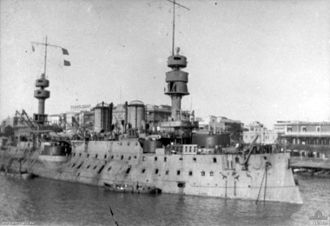
The 1891 French battleship Jaureguiberry.

The 1891 French battleship Jaureguiberry.


Note the Jaureguiberry’s rakish bow as well as the tumblehome hull. She very well may have been the impetus for the design team as they designed A.


The USS Zumwalt at launch. It is alleged the tumbledown design reduces  the radar image to that of a small fishing boat

The USS Zumwalt at launch. It is alleged the tumblehome design reduces the radar image to that of a small fishing boat

The US Navy has adopted this design for the new Zumwalt class destroyers. The first, DD 1000, was launched in 2013 and will be fully operational in 2016.

The birth of A was not without problems. The owners thought the exterior paint job defective, and sued the contractors for $100 million dollars, with the lawsuit brought in federal court in Union, New Jersey. Imagine that – a tenth of a billion dollars over a paint job. I bet that’s more than the GDP of some sub-Saharan African nations. And they have Ebola to worry about. And Union, New Jersey? Was that some kind of perverse punishment for the defendants’ lawyers? Union not too long ago was ground zero for law suits brought under various provisions of the Clean Air Act.

The Russian multi-billionaire Andrey Igorevich Melnichenko commissioned and owns A, along with a private jet (a Boeing 737), an apartment in New York overlooking Central Park, Harewood Estate in Ascot, Surrey, and another estate in the Antibes. And probably other stuff as well. He is somewhere in Forbes list of 100 wealthiest people. Not bad for somebody born in 1972. He married the Serbian model and pop singer Aleksandra Nikolić in September 2005. Whitney Houston performed at the wedding. It is rumored that, prior to her wedding, Aleksandra was romantically involved with Bruce Willis. Aleksandra managed to exert her influence on the interior design of A, forcing, for example, a downsize of the on-board discotheque.

As you might imagine, the internet has all kinds of information and opinions about A. David Pelly of Boat International wrote it was “…the most extraordinary yacht launched in recent memory. It is stunning.” Maritime commentator Peter Mello was somewhat less charitable “…one of the most hideous vessels ever to sail the seas.” Use this link for a video tour given to a reporter from the Wall Street Journal: http//:megayachtnews.com/2010/04/superyacht-a-andrey-melnichenko. The tour does not mention the fact that the ship’s conference room is bomb-proof (I’m not sure from what type of bomb) nor that A is equipped with veterinary facilities such that the Melnichenko’s dog need not be quarantined when travelling to distant ports.

So here’s my question: Could I be happy sailing the seven seas in A, in 24,000 square feet of living area, swimming in her three pools, using her smaller boats stored inside the hull, dancing in the downsized discotheque, being served gourmet meals and otherwise waited on by a crew of 35 to 40?

I don’t know, but I’d like to give it a try. Andrey, if you’re reading this, give me a call. If you let me use A, all expenses paid, for three months, I promise I won’t bug you about using your 737. I’m sure we can work something out.


For information about the paint lawsuit, see: http://johnhelmer.net/wp-content/uploads/2013/12/Melnichenko-Hamilton-Yachts-orig-complaint-UNN-L2634-10-Append-XII-BI-07-08-10-Cmplt.pdf

See Wikipedia entries for Tumblehome, Battle of Hampton Roads, Andrei Melnichenko, Zumwalt, and Motor Yacht A for more information.


Ponce of Lion, Lions of Ponce

               January 28, 2015

          Lions frequently adorn monuments and other forms of public art in Puerto Rico. The depictions are of African lions, with manes.

Lions_1

Lions in a plaza just to the south the capitol building, Old San Juan.

Apparently, in historic times, lions populated all Africa, Asia to as far as the Indian sub-continent and southern Europe, and were therefore known to the early Europeans. Herodotus and Aristotle wrote of their presence in Northern Greece. The mythical and powerful Nemean lion, the offspring of Typhon (or Orthrus) and Echidna, lived near the Peloponnesian town of Nemea.

It was said the Nemean lion would take a woman from a local village as hostage, and wait for the town’s warriors to search for her. The woman would feign injury and lure a would-be savior into a cave. The woman would then transform herself into a lion, devour the warrior, and offer his bones to Hades.

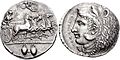
Camarina AR Tetradrachm 74000073.jpg

Hercules and the Nemean Lion, Greek coin.

 The Nemean lion was such a scourge that Eurystheus, the King of Tiyrns, made its death the first of Heracles’ twelve labors. Heracles (aka Hercules) managed to accomplish this task even though the lion was protected by its golden fur, impenetrable to arrows and other human weapons. In fact, after managing to slay the lion, Heracles had to use the lion’s own claws to skin it, after which he used the pelt for his own purposes. The Nemean lion is perhaps the model for the constellation Leo, and therefore of great interest to anyone born with that birth sign.

You might think the Nemean lion gave birth to the word nemesis, but you’d be wrong. Nemesis comes from another Greek myth. She (also known as Rhamnousia or Rhamnusia or Adrasteia) appeared whenever a mere mortal showed signs of hubris and needed a smack-down from the Gods. Nemesis aside, the Nemean lion is an example of an evil temptress, like Jezebel of the Old Testament and the Temptress of the Rhine, to name just two. It is sobering to wonder why so many ancient cultures had stories of seductive temptresses leading innocent men to their demise. It is certainly an oft-told tale.

The idea of the lion came early to the New World, probably in the person of the conquistador and explorer Juan Ponce de León. His was an old family, from what is now the province of Valladolid, in northwestern Spain. The independent Kingdom of León (Lion) was in existence then. In 1235, an early ancestor married Aldonza Alfonso, an illegitimate daughter of King Alfonso IX of León, and soon their descendants became the Ponce of León.

Juan Ponce de León was born in 1474 or 1475, and fought in the campaigns against the Emirate of Granada that resulted, in 1492, in the recapture of all of southern Spain from the Moors. His military skills no longer needed, he signed on, along with various other settlers, to sail with Christopher Columbus on his second voyage to the New World. The expedition landed in Hispaniola in November 1493, and soon Juan Ponce de Leon became governor of the eastern province of Higuey. This was in great part due to his leading Spaniards against rebellious Tainos in what became known as the Higuey massacre.

San Juan Bautista (now known as Puerto Rico), the large island to the east of Hispaniola, soon captured his interest. He learned from Tainos visiting his settlement of gold and fertile land there. One Vicente Yáñez Pinzón had been given a charter from the Spanish crown to explore it, but the charter expired. Juan Ponce de León explored the island in 1508, and indeed found gold. He was named governor of the island in 1508, an action endorsed by Ferdinand II in 1509.

Political intrigues ensued. Diego Colón, son of Cristóbal Colón (the Spanish form of Christopher Columbus, who had died in 1506), sued the Crown to regain the rights and privileges granted his father, which the Crown had come to realize were perhaps too generous. This made Juan Ponce de Leon’s position as Governor untenable, and, in spite of various interventions from Ferdinand, Juan Cerón took over as Governor of San Juan Bautista, in November 1511.

Ferdinand, wishing to reward Juan Ponce de León for his loyal service, offered to let him explore, at his own expense, to the northwest, where it was thought as yet uncharted islands existed. In return, Ponce de León would be granted rights to those new lands. The expedition resulted in the discovery of Florida, but, on his third trip there, in a battle with the Calusa Indians, he was wounded by an arrow to his thigh. The expedition returned to Havana, where Ponce de Leon died, in July 1521. He was interred in San Juan, in the crypt of the San Jose Church, from 1559 to 1836, at which time his remains were transferred to the Cathedral of San Juan Bautista.

Ponce, now the second largest city in Puerto Rico, is named after Juan Ponce de León y Loayza, Juan Ponce de León’s great grandson. It is in Ponce that the idea of lions in public places is celebrated, especially around the Plaza las Delicias, in central Ponce. Local artists were commissioned to paint life-size fiberglass lions; the results are colorful, whimsical, fun. Here are some images of them.

Lions_2

Lions_3            Ponce’s artistic powers that be did not ask me to participate. If they had, I would have done something like this.

My-Lion

What do you think?


References: See Wikipedia entries for Christopher Columbus, Ponce de Leon, Nemean Lion, Nemesis, and Ponce for more information. Image of Greek coins from Wikimedia Commons entry for Nemean Lion.


SanSe15

January 18, 2015

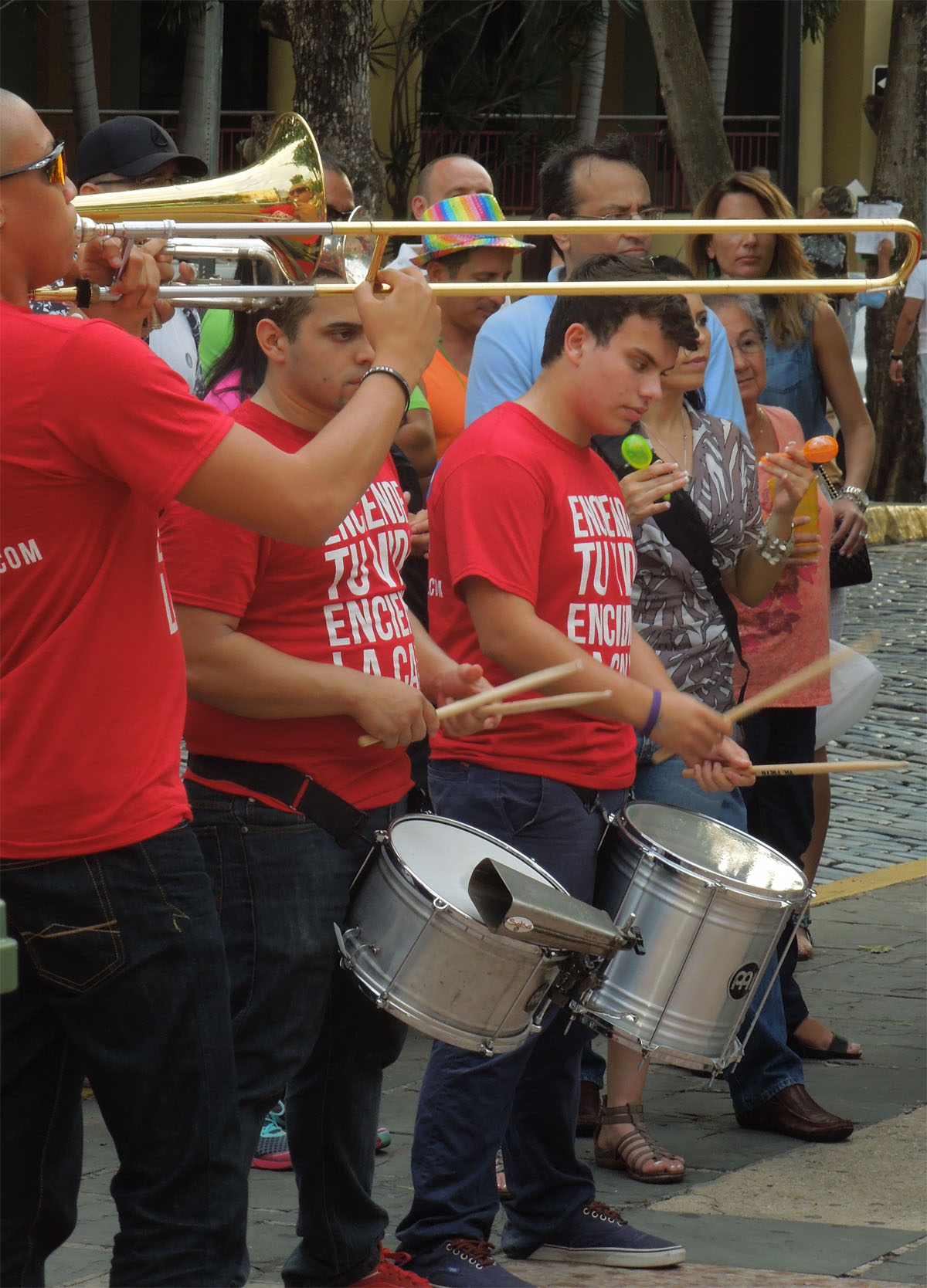
The Festival de Calle de San Sebastian (SanSe15) ended today. It started Thursday afternoon. It is a huge event. Traffic patterns are affected all the way to Sagrado Corazon. Police escort express buses from there, the last stop on the urban train line, to near Plaza Colon in Old San Juan. All of Old San Juan is blocked off, and pedestrians own the streets. Strange creatures can be seen, and corporate advertisers hire informal bands for impromptu parades through the crowds. The police get about on their motorcycles, and emergencies are handled by ATVs equipped for that purpose.

SanSe15_1

Saint Sebastian, a possible namesake of the festival, died around 288 AD, at the hands of the Roman emperor Diocletian. Various paintings show him tied to a stake and killed with arrows. Another story has him saved and healed by Irene of Rome Somehow, Sebastian arranges a meeting with Diocletian, criticizes him to his face, and gets clubbed to death for his troubles. I’m not sure what Sebastian was thinking – was he arguing with Diocletian about Zeno’s Paradox? The Aristotelian model of the universe?

It is possible Calle de San Sebastian was named for the saint. It is also possible the street was named for San Sebastian, a Spanish town on the Bay of Biscay, about 12 miles from the French border. In any case, I found little evidence of a religious theme to this festival.

The festival has been going on for 45 years. It first started as a celebration of the local artists along Calle de San Sebastian. At that time, I’ve been told, that part of the city was rife with galleries and local artists. The festival was a modest affair, lasting two weeks, designed to show (and hopefully sell) the works of art. Over time, the event took on a different flavor and has in fact become somewhat controversial. It has been shortened to three and a half days. The residents of Old San Juan do not like the festival at all – it certainly interferes with their daily routines. In fact, some lock their apartments and visit friends and family in other parts of the island to avoid the crowds, noise, and trash.

SanSe15_2Preparations started several days in advance of opening night. Traffic barriers were placed to create the bus lanes. Beer deliveries, a regular feature of life in Old San Juan, reached a feverish pitch. See the leaning tower of Medalla, below left. Related to that, truckloads of portable toilets made their way into the city. The police set up a temporary headquarters in the parking lot next to the Sheraton Old San Juan. Normal bus routes were changed in mysterious ways, keeping everybody guessing as to where to catch their bus into or out of Old San Juan. Residents and employees had to get passes to allow them near the walled city. We’re two miles away from Old San Juan, and we received a notice from the local police station that we would need a pass just to access our building. We don’t have a car, so that made no difference to us.

SanSe15_3_4

SanSe15_5_6_7Food stalls were put up in the city, including Plaza d’Armes (left) and in the small plaza in front of Paraquoia San Francisco de Asis (right), the Plaza Salvador Brau. SanSe15_8_9 We took the bus into Old San Juan Thursday afternoon. We met our friends Chris and Mike and took a little walk about. It was crowded, but nothing like it would be on the other days. We watched an AT&T group parade by us while we were on Calle San Francisco. These groups start in Plaza Colon, go up San Francisco, right to San Sebastian, and then a left to make their way through the crowd gathered there.

SanSe15_10_11SanSe15_12

I walked into Old San Juan late Friday afternoon. The way in (along the ocean) was marked by beer inflatables at the two gas stations along the way, each of which had set up food stands to feed people going into and out of the festival. Entrepreneurs were along the route, but especially where the buses unloaded, with their coolers, selling soda, cold water, Medalla, Heineken, hats, whistles, and t-shirts. And that was before you got close to the festival. Traffic was limited to buses (with motorcycle escort) and delivery vehicles.

There were six sound stages set up for the festival: Plaza Colon, Plaza d’Armes, the small plaza in front of El Convento, Plaza de la Barandilla at Calles Tanca and San Francisco, Plaza San Jose near the Gothic cathedral at the end of San Sebastian, and the main stage in the plaza with the Totem del Quinto Centenario, overlooking Castillo El Morro. Each stage had a series of acts, ranging from DJs to jazz to salsa to rock and roll oldies and pretty much everything in between.

Food and beer were everywhere. Bacalaitos are a Puerto Rican specialty – flour, water, shredded codfish and seasonings ladled into hot oil until golden brown.

SanSe15_13_14

The streets were filled with strange and wonderful people. The Douglas Tavern was an excellent respite from the crowds and noise, and Magnas, a Puerto Rican beer, were two for $5.

SanSe15_15_16

I repeated the trip to the festival on Saturday afternoon. This time I figured out the buses, and got on an M3 running on the new bus lanes in back of our building. Several days of intense work had made the lanes usable for the festival, with new lights, paving and not-quite-completed new concrete sidewalks. I suspect the lanes will close again after the festival to complete work there, but the plan is to have all buses into and out of San Juan running there. It will certainly make things easy for us.

SanSe15_17An impromptu band was playing in the small plaza in front of Starbucks and the Brickhouse. People jumped out in front and started doing some kind of line dance.

SanSe15_18_19

SanSe15_20I decided to make my way farther into the festival. I passed through Plaza Colon, where people were having their pictures taken with attractive women, in return for holding signs advertising some kind of wireless network. This would have been good to send to people enduring temperatures of minus 20 F and feet of lake effect snow at a time.


SanSe15_21 I did not avail myself of that opportunity – my debilitating shyness, I guess. Instead, as I walked up towards San Sebastian, a young person in an orange jumpsuit asked to have his picture taken with me. I have no idea why. Perhaps I’ll end up in a testimonial for Oriental Bank. I suspect this does not have, for my friends in the frozen north, the cachet a picture with two attractive blondes would have had. Oh well – next year.

I made my way to La Perla, an old community on the ocean side of Old San Juan, just outside its walls. La Perla was once the area of San Juan with abattoirs, and fish- and fell-mongers. It would have been unpleasant place, filled with stinks and smells. In recent times, it has become associated with drug trafficking, and tourists are often advised not to venture there. It, like the rest of Old San Juan, is a welcoming place during SanSe. In fact, La Perla is the home of the Heineken Cathedral. I worshipped at the altar, and discovered that Charlie Chaplin is alive and well.

SanSe15_22_23_24

I walked home that night, and on the way ran into another strange individual and a street band coming up Calle Fortaleza.

SanSe15_25_26_27

SanSe ends on Sunday, and since Monday is Martin Luther King’s Day, the party goes on into the evening and night. By the way, Puerto Ricans celebrate all US holidays, some Spanish holidays (e.g., their emancipation day), and some of their own.

Traffic into Old San Juan started early Sunday morning, and was backed up to beyond our building by about 10 am. The parking lot across from our building was nearly full. We’re about two miles from Old San Juan, so people walked in from there, running a gauntlet of neighborhood residents hawking cold water, beer, hats, t-shirts. The bus convoys were running as well.

SanSe15_28_29_30

I walked into Old San Juan on Sunday, at about 1 PM. The crowds were amazing. Take the New York State Fair on its most crowded day, put it on steroids, and you’re close. I started on Calle San Francisco, and an impromptu band, sponsored by Oriental Bank, came by.

SanSe15_31_32_33 The two guys on stilts were amazing. They never stopped moving to the music. I’m not sure what the person in the mask was all about. A Caribbean effigy? I’ll have to research that.

SanSe15_34_35

I made my way up to Calle San Sebastian, where street bands were working their way through the crowds. Again, the man and woman on stilts never stopped moving.

SanSe15_36_37_38

I can’t wait for SanSe16.